
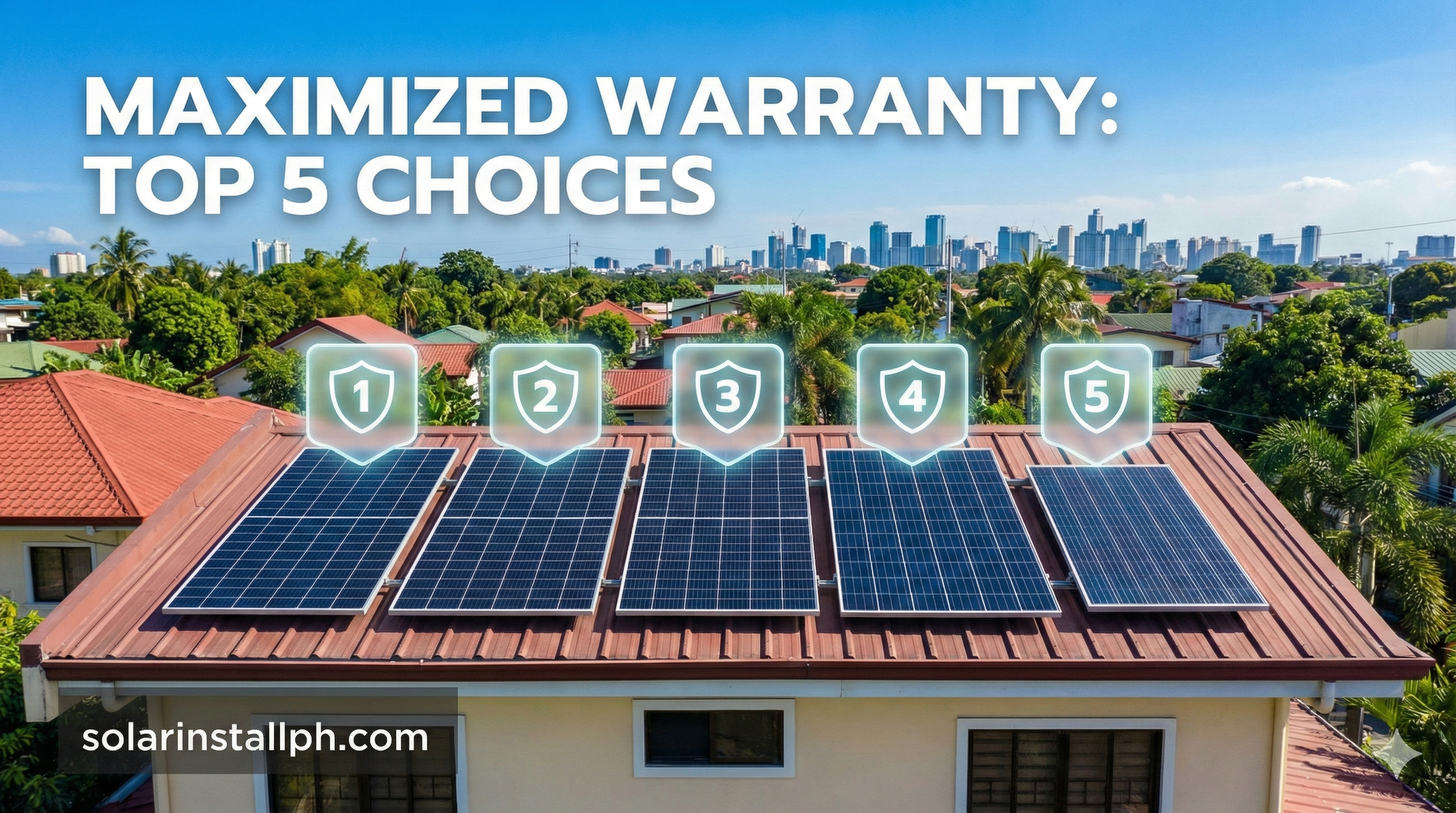
Maximized Warranty: Top 5 Choices
A solar warranty isn’t just a piece of paper; in the Philippines, it is your only insurance policy against a 25-year investment turning into a rooftop ornament.
We see this often: a homeowner buys a "cheap" system with a "25-year warranty," only to find out three years later that the installer has closed shop, the inverter manufacturer has no office in Manila, and that 25-year promise is legally unenforceable without shipping the panel back to China at your own cost.
Real warranty maximization isn’t about finding the highest number (e.g., "30 years"). It is about finding the strongest local enforceability. If you want a system that protects your wallet for decades, you need to understand the difference between marketing fluff and hard support.
Here is the no-nonsense guide to the top 5 warranty choices available in the Philippine market for 2025, and how to ensure they actually protect you.
The "25-Year" Myth: Product vs. Performance
Before we list the brands, you must distinguish between the two types of warranties. Most aggressive sales agents will say "25-year warranty" without clarifying which one they mean.
Product Warranty (The Real Protection): This covers manufacturing defects—delamination, burnt junction boxes, moisture ingress, or frames cracking. Standard is 10–12 years. Premium is 25+ years.
Performance Warranty (The Standard): This only guarantees that the panel will still produce roughly 80% of its rated power after 25 years. Almost every panel has this. It does not cover the panel breaking; it only covers the panel working inefficiently.
If your panel stops working entirely in Year 13, a "25-year performance warranty" is useless if your "product warranty" expired in Year 12. For a deeper dive, read our comparison of panel warranty terms to see exactly how these terms differ by brand.
Top 5 Warranty Choices for 2025
We have selected these based on a mix of term length and local Philippine support. A 10-year warranty with a service center in Pasig is worth infinitely more than a 25-year warranty with a service center in Shenzhen.
1. SunPower (Maxeon) – The Premium Choice
Best for: Homeowners who want "install and forget" reliability and have a higher budget.
SunPower (now spinning off its manufacturing as Maxeon) is the gold standard. While standard panels offer a 10-12 year product warranty, SunPower’s Maxeon line offers up to 40 years on both product and performance (subject to registration terms).
Why it wins: Their "interdigitated back contact" technology eliminates grid lines on the front, removing 85% of the reasons conventional cells fail (corrosion and cracking).
The catch: You pay a significant premium—often 2x the price per watt of standard Tier 1 panels.
Local Context: SunPower has a long history in the Philippines (they used to manufacture here), meaning their supply chain and installer network are mature.
2. Enphase Microinverters – The Longevity King
Best for: Systems with shading issues or homeowners paranoid about inverter failure.
Inverters are the most likely component to fail. A typical string inverter lasts 10–12 years. Enphase microinverters, which sit under each panel, come with a standard 25-year warranty in many markets (verify specific PH terms with your installer, as some default to 10-15 years unless extended).
Why it wins: If one microinverter fails, only one panel goes down. You don't lose your whole system.
Local Context: Enphase has established a strong foothold in the Philippines. Because the units are small, warranty replacements can often be shipped via standard courier rather than requiring a truck.
3. Huawei & Growatt – The Local Support Leaders
Best for: The practical majority looking for a balance of cost and support.
We grouped these two because they solve the biggest headache in the Philippines: Service Centers.
Huawei: Offers 5 to 10-year warranties (often 5 years full + 5 years parts). They are massive in the Philippines, meaning spare parts and technicians are actually available.
Growatt: A favorite for residential installs. They have a physical service presence in the country where technicians can actually bench-test a faulty unit.
If you buy a niche European or unknown Chinese brand, you might wait 6 months for a replacement. With these two, the turnaround is often weeks. Check out our guide on inverter warranty support to see how different brands handle claims locally.
4. Canadian Solar / Trina / Jinko (The Tier 1 Workhorses)
Best for: Best ROI (Return on Investment).
These three giants (and similar Tier 1s like LONGi or JA Solar) offer very similar terms: 12-year product warranty and 25-year performance warranty.
Why it wins: They are affordable and proven. Millions of these panels are installed across Luzon, Visayas, and Mindanao.
The Strategy: You don't pay the SunPower premium. Instead, you bank the savings. If a panel fails in Year 15 (after the product warranty expires), you can afford to replace it with the money you saved upfront.
Warning: Ensure your installer sources these from authorized Philippine distributors. Grey market imports may not be covered by the local warranty.
5. The "Labor & Workmanship" Warranty
Best for: Protecting against roof leaks and bad wiring.
This isn't a brand; it's a contract term from your installer. Manufacturers do not cover labor. If a panel fails, they will give you a new panel, but they won't pay the guy to climb your roof and swap it.
The Standard: 1–2 years workmanship warranty.
The Goal: Look for installers offering 5+ years workmanship warranty. This shows they are confident their roof penetrations won't leak and their wiring won't loosen.
Critical Step: You must verify your installer's credentials before signing. A 10-year workmanship warranty is worthless if the installer goes bankrupt in Year 2.
The "Orphan System" Risk
The biggest warranty risk in the Philippines isn't the equipment breaking; it's the installer disappearing. We call systems left behind by bankrupt companies "Orphan Systems."
If your installer ghosts you:
Panel Warranty: You may have to contact the manufacturer directly. This is hard if you don't have the original purchase serial numbers.
Inverter Warranty: Manufacturers like Huawei or Fronius may help you find a new certified installer to process the claim, but you will have to pay for the service call.
Labor Warranty: This is gone.
This is why we stress that the installer is your warranty. If you are worried about this scenario, read our guide on what to do if your solar installer disappears.
Consumer Protection: RA 7394
Under the Consumer Act of the Philippines (RA 7394), you have rights against hidden defects.
Implied Warranty: Even if a contract doesn't state it, products must be fit for the use intended.
DTI Complaints: If a supplier refuses to honor a clear warranty, the DTI (Department of Trade and Industry) is generally very responsive to mediation.
Lemon Law: While typically for cars, the principle of "repair, replace, refund" applies to durable goods.
However, relying on the DTI is a hassle. It is better to prevent the issue by documenting everything. Keep your Proof of Purchase, Serial Numbers, and Warranty Certificates (not just the proposal flyer) in a safe place.
Conclusion: The Checklist
To maximize your warranty, do not just ask "how many years?" Ask these five questions:
Is the Product Warranty longer than 10 years?
Does the inverter brand have a local service center in the Philippines?
Does the quote include a workmanship warranty of at least 3–5 years?
Is the installer an authorized partner of the equipment brand? (This ensures the manufacturer will honor the claim).
Have I read the general guide to solar warranties to understand the fine print on exclusions like "force majeure" or salt mist corrosion?
A warranty is only as good as the company standing behind it. In the Philippines, that means choosing established brands with local roots over fly-by-night operators offering "too good to be true" promises.