
Battery Life: What to Expect
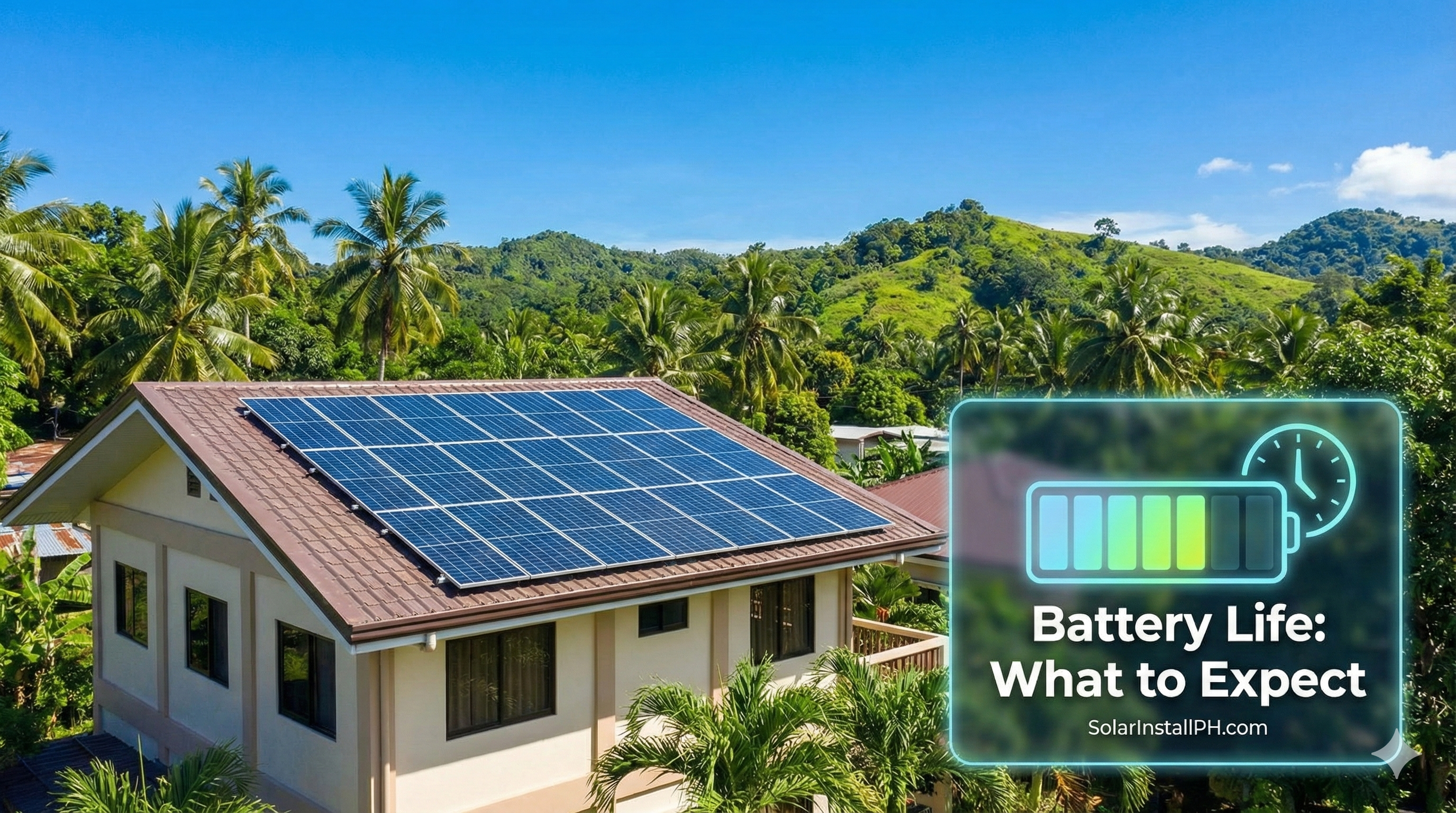
If you are reading this, you are likely looking at a quote for a solar battery system and wincing at the price tag. Solar panels are cheap; batteries are expensive. Naturally, the first question on your mind is: "How long will this thing actually last?"
In the Philippines, where the ambient temperature often hovers around 32°C and humidity is relentless, this is a critical question. The brochure might say "10-year warranty" or "6,000 cycles," but lab conditions in Germany or China are very different from a concrete garage in Cavite.
Here is a realistic, no-nonsense look at what you can expect from solar battery life in the Philippine setting (updated for 2025).
The "10-Year" Standard: Fact or Marketing?
In 2025, the industry standard for Lithium Iron Phosphate (LiFePO4) batteries is a 10-year warranty or 6,000 cycles.
Does this mean the battery will die on Year 10, Day 1? No.
Unlike a lightbulb that burns out instantly, batteries degrade like the tires on your car. They slowly lose capacity over time. When manufacturers talk about "End of Life" (EOL), they usually mean the point where the battery can only hold 80% of its original capacity.
So, if you buy a 10kWh battery today, in 10-12 years, it might effectively be an 8kWh battery. It will still power your house, but it will run out 20% faster than when it was new. For a deeper dive into the technical degradation curves, check out our guide on solar battery lifespan factors.
Lead-Acid vs. Lithium: The Great Divide
Your battery life expectation depends entirely on the chemistry you choose. In the Philippines, we still see people buying Lead-Acid (Motolite-style or Gel) batteries because they are "cheaper."
This is a false economy.
Lead-Acid (AGM/Gel)
Real-World PH Lifespan: 2 to 3 years.
The Killer: Heat and Depth of Discharge (DoD).
Expectation: If you discharge these batteries below 50% capacity, you damage them permanently. If you keep them in a hot room (above 25°C), their chemical life is cut in half. You will likely replace them 3-4 times in a decade.
Lithium-Ion (LiFePO4)
Real-World PH Lifespan: 10 to 15 years.
The Advantage: They can handle deep discharges (up to 90% or 100%) and are much more resilient to heat.
Expectation: You install them and forget them. They are virtually maintenance-free.
If you are still on the fence, read our detailed comparison of lead-acid vs. lithium batteries to understand why lithium is the only sensible choice for 2025.
The "Heat Tax": How Philippine Weather Affects Batteries
This is the most important section for Filipino homeowners. Most battery datasheets are tested at 25°C (77°F).
In the Philippines, daytime temperatures in an enclosed garage or utility room can easily reach 35°C to 40°C.
What Heat Does to Lithium
While LiFePO4 is safer and tougher than the lithium in your phone, heat accelerates "Calendar Aging." This is the chemical degradation that happens just by sitting there.
At 25°C: A battery might lose 1-2% capacity per year.
At 40°C: That loss can double to 3-4% per year.
What to Expect:
If you install your battery in direct sunlight or a poorly ventilated steel shed, do not expect it to hit the 15-year mark. It might hit 80% health in Year 7 or 8 instead of Year 10.
Action Item: Always install your batteries in the coolest part of the house. A shaded carport wall or an indoor utility room is ideal. Avoid direct sun at all costs.
Cycles vs. Time: Two Ways They Age
Batteries age in two ways, and depending on how you use your solar system, one will matter more than the other.
1. Cycle Aging (The "Bill Buster" User)
If you use your battery to store solar energy during the day and run your aircons at night to save on your Meralco bill, you are "cycling" the battery daily.
Expectation: You will consume about 365 cycles a year.
Result: A 6,000-cycle battery will theoretically last 16 years (6,000 / 365). In this scenario, you will likely hit the cycle limit before the calendar limit.
2. Calendar Aging (The "Brownout Prepper" User)
If you only bought the battery for backup power during typhoons or brownouts, your battery sits at 100% charge most of the time.
Expectation: You might only cycle it 20 times a year.
Result: You will never hit 6,000 cycles. Instead, time will degrade the battery. Keeping a lithium battery at 100% charge in high heat accelerates degradation.
Tip: If you have a smart inverter (like Deye or Huawei), set it to keep the battery at 90% or 95% instead of 100% if you don't need every drop of power. This small buffer can extend calendar life significantly.
The Role of the BMS (Battery Management System)
You aren't just buying a box of chemicals; you are buying a computer that manages chemicals. The BMS is the brain of the battery. It balances the cells, prevents overcharging, and cuts off power if things get too hot.
A cheap, generic battery often has a weak BMS that cannot balance cells quickly. This leads to "imbalanced capacity," where one bad cell drags down the performance of the whole pack.
What to Expect:
High-quality brands (like Huawei, Pylontech, or Deye) have sophisticated BMS units that communicate with the inverter. This communication prevents user error—like trying to force-charge a frozen battery or over-discharge a hot one. Read why a good BMS is crucial for system longevity.
Warranty Fine Print: What You Need to Know
When you look at the warranty document, don't just look at the years. Look for the "Throughput" clause.
Most warranties will say: "10 Years OR X MWh of Throughput, whichever comes first."
Throughput is the total amount of energy you have pumped in and out of the battery.
If you use the battery aggressively (e.g., charging and discharging it twice a day—once from solar, once from cheap off-peak grid power), you might burn through your warranty in 7 years, even if the "10 Year" sticker is still shiny.
Also, check the temperature clauses. Some warranties are void if the battery log shows it was operated consistently above 45°C. This is why buying from reputable, top-rated battery brands for 2025 is safer than buying "gray market" units with no local support.
Maintenance: Yes, Even "Maintenance-Free" Needs Love
Lithium batteries are often sold as "maintenance-free," but that doesn't mean "ignore-able."
What to Expect:
Dust: In the Philippines, dust is everywhere. If dust clogs the cooling fins or fan intakes of your battery/inverter unit, heat builds up, and life goes down.
Connections: Thermal cycling (getting hot and cold) can loosen terminal bolts over time. A loose connection causes resistance, heat, and potential melting.
Action Item: Once a year, have your installer check the torque on the connections and clean the air intakes. For a full checklist, see our guide on maintaining your battery bank.
Summary: Realistic Expectations for PH
If you buy a quality LiFePO4 system in 2025 and install it correctly in a shaded area:
Years 1-5: You will notice zero difference. It will perform like new.
Years 6-10: You might notice the capacity drop slightly. Maybe the aircon runs for 3.5 hours during a brownout instead of 4 hours.
Year 10+: The battery is likely out of warranty but still functional. It will continue to work, perhaps at 70-80% capacity, for another 5+ years before it becomes too weak to be useful.
The Bottom Line:
Treat your battery like a 15-year appliance. It will likely outlast your refrigerator and your washing machine, provided you respect the one thing it hates most: Heat.