
LGU Permit Hurdles: A How-To Guide
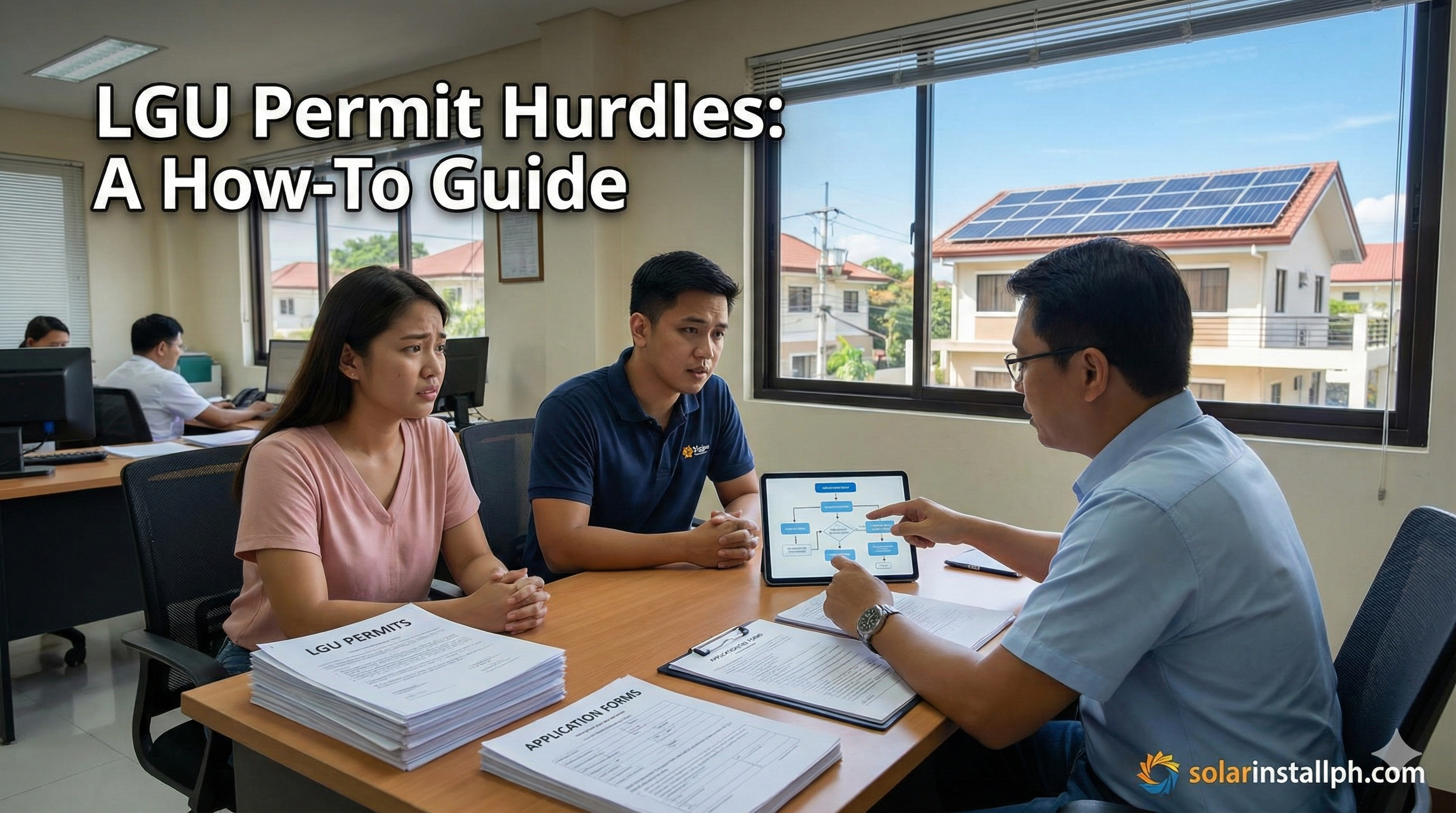
If you ask any solar installer in the Philippines what the hardest part of their job is, they won’t say "wiring the inverter" or "carrying panels up a ladder."
They will say: "Dealing with City Hall."
While the Department of Energy (DOE) and the Energy Regulatory Commission (ERC) have moved mountains to streamline renewable energy adoption—recently scrapping the mandatory REC meter and allowing "banked" credits—Local Government Units (LGUs) are often stuck in the past.
For many City Engineers, a rooftop solar installation is still treated like building a new mall. They ask for piles of blueprints, structural guarantees, and clearances that can feel overkill for a 5kW system.
If you are planning to go legal (and you should), you need to be ready for the LGU obstacle course. Here is your guide to the most common hurdles and how to jump over them in 2025.
Hurdle 1: The "Chicken and Egg" Loop
This is the classic bureaucratic standoff.
The Utility (e.g., Meralco) says: "We cannot give you a Net Metering contract until you give us the Certificate of Final Electrical Inspection (CFEI) from City Hall."
The LGU (City Hall) says: "We cannot give you a Building Permit (which leads to the CFEI) until you show us approval from Meralco."
The Fix: You need the "Yellow Card" (or Technical Evaluation).
This is a preliminary document from the utility that acknowledges your intent to connect. It is not a final contract, but it proves to the City Engineer that the utility is aware of the project.
Action: Do not go to City Hall empty-handed. Apply to the utility first. Get the Technical Evaluation/Notice. Then go to the Office of the Building Official (OBO).
For a detailed look at how this sequence works, read our breakdown of the permitting process for rooftop solar.
Hurdle 2: The "Structural Analysis" Surprise
You submit your application, and the OBO officer looks at your house plans.
"Sir, this house is 15 years old. How do we know the roof won't collapse under the solar panels? We need a Structural Analysis signed by a Civil Engineer."
This is a valid safety concern, but it is also a major hidden cost.
The Cost: A Civil Engineer typically charges ₱15,000 to ₱30,000 to inspect your roof, run the calculations, and sign the "Certificate of Structural Stability."
The Hassle: If you lost your original house blueprints (which most of us have), the engineer has to measure everything from scratch ("As-Built" plans), which costs extra.
The Fix: Budget for this early. If your house is new (under 5 years), you might get away with just a photocopy of the original structural plans. If it’s older, prepare to pay for the analysis. Do not try to fake this; a collapsed roof is far more expensive than a civil engineer's fee.
Hurdle 3: The Barangay & HOA Blockade
Before you even reach City Hall, you can get stopped at the gate—literally.
Some Homeowners Associations (HOAs) and Barangays have strict "aesthetic" guidelines.
The Issue: Neighbors might complain about "glare" from the panels. The HOA might say the panels are "unsightly" if visible from the street.
The Consequence: The LGU will not process your building permit without a Barangay Clearance. And the Barangay won't give you a clearance without HOA approval.
The Fix: Secure the HOA permit first. Bring a technical datasheet showing your panels use "Anti-Reflective Coating" (standard on Tier 1 panels) to debunk the glare myth.
Hurdle 4: The "Professional" Signature Requirement
You cannot draw your own electrical plan, even if you are an electrical engineering student.
The LGU requires all plans (Electrical, Civil, Architectural) to be Signed and Sealed by licensed professionals (PEE, CE, Arch).
The Trap: Some "freelance" installers will quote you a low price but hand you unsignatured plans, telling you, "Ikaw na bahala sa City Hall" (You handle City Hall).
The Reality: You will be forced to hire a PEE separately just to sign the papers. This can cost ₱5,000 to ₱10,000 per signature.
The Fix: Always verify if the "Permitting Fees" in your installer's quote include the Professional Sign & Seal fees. If not, you are looking at a hidden P20k expense. See our guide on solar panel installation costs to see what should be included.
Hurdle 5: The "Assessment Fee" Shock
After weeks of waiting, your permit is approved! You go to the window to claim it, and they hand you an "Assessment Bill."
The Bill: It’s not just a P500 filing fee. LGUs charge based on the construction cost or the capacity of the system.
The Range: For a residential system, this usually ranges from ₱5,000 to ₱15,000 depending on the city. Some wealthy cities charge more; provinces often charge less.
The Fix: Treat this as a mandatory tax. There is no negotiating the assessment fee.
Why You Cannot Just Skip This
It is tempting to look at this list and say, "Kalokohan 'to (This is nonsense). I'll just install 'Colorum'."
I get it. But skipping the LGU permit is dangerous.
Insurance: Unpermitted work voids your fire insurance.
Net Metering: You cannot get Net Metering without the CFEI. You will waste all your export credits.
Resale Value: If you sell your house, the buyer’s bank will ask for permits for all improvements.
We cover the specific dangers of "flying under the radar" in our article on skipping LGU permits.
Conclusion: Patience is Your Capital
Navigating the LGU maze is not about being smart; it’s about being patient. The timeline is rarely the "2 weeks" promised on the City Hall website. It is realistically 1 to 3 months.
But once you have that Certificate of Final Electrical Inspection (CFEI) in your hand, the hard part is over. Meralco will install your meter, and you will be a legitimate power producer for the next 25 years.
Next Steps
Ask your installer if they have a dedicated "Liaison Officer" for your specific city. A liaison who knows the OBO staff in Quezon City might be useless in Parañaque. Local knowledge speeds up paperwork.
For a realistic view of how long you’ll be waiting, check our LGU permit timeline guide.