
Big Scale Energy for Businesses: 7 Tips
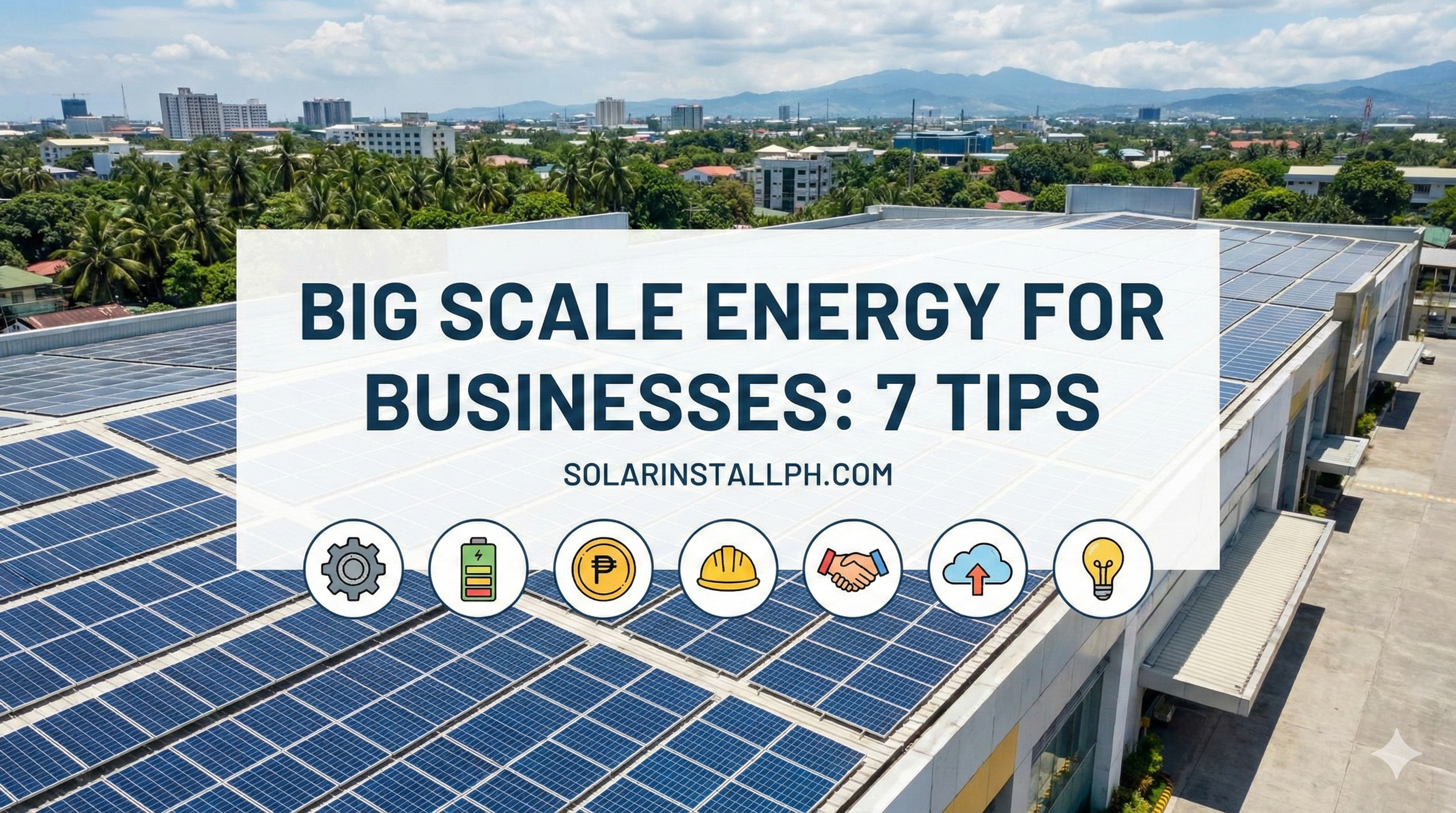
In the Philippines, electricity isn't just a monthly bill—it is often the second largest operating expense after payroll. With rates hovering between ₱11 and ₱14 per kWh for many commercial sectors in 2025, relying solely on the grid is a vulnerability.
For factories, malls, cold storage facilities, and office towers, "going solar" is no longer about CSR (Corporate Social Responsibility) or green marketing. It is a defensive financial strategy. A well-designed system locks in a portion of your energy cost at roughly ₱2.50 to ₱3.50 per kWh (the levelized cost of solar energy) for the next 25 years.
However, commercial solar is not just "residential solar made bigger." The engineering stakes are higher, the permitting is stricter, and the financial models are different.
Here are 7 tips for Philippine business owners and facility managers planning a large-scale solar transition.
1. Audit Your Load Profile, Not Just Your Bill
Many business owners make the mistake of sizing a system based on their total monthly bill. This is dangerous. You need to size based on your daytime load profile.
Solar only produces power from roughly 8:00 AM to 4:00 PM.
Ideal Scenario: A manufacturing plant operating 8 AM – 5 PM. Your consumption matches solar production perfectly. You can offset nearly 100% of your daytime usage.
Tricky Scenario: A BPO or Call Center operating 24/7. Your daytime load is only half the picture. If you install a massive system to cover your night shift (hoping to "bank" the credits), you will hit regulatory limits (see Tip #2).
Before calling an installer, request your 15-minute interval data from Meralco or your local DU (Distribution Utility). This data reveals exactly how much power you use when the sun is shining.
2. Respect the 100kW Regulatory Cliff
This is the most critical regulatory hurdle in the Philippines.
Under the current Net Metering rules, you can only export excess power to the grid if your system size is 100kWp or below.
If you install 99kW: You can export your Sunday excess (when the factory is closed) and get bill credits to offset your weekday or nighttime usage.
If you install 200kW: You generally cannot export. You fall into the "Zero Export" or "Own Use" category.
For systems larger than 100kW, you must install a Zero Export device. This device throttles your inverters to ensure no power flows back to the grid. If you are a 5-day operation, a large system >100kW might waste energy on weekends because it has nowhere to go.
Tip: For a detailed breakdown of costs for different system sizes, check our guide to commercial solar pricing.
3. The "Roof Audit" Comes First
We have seen businesses approve a multi-million peso solar project, only to realize their roof needs to be replaced in 3 years.
Solar panels have a lifespan of 25+ years. If your GI sheet roof is already 10 years old and showing rust, do not install solar on top of it without remediation. Removing panels to fix a leak later is expensive and kills your ROI.
Commercial Roof Checklist:
Structure: Can your purlins handle the additional dead load (approx 12-15kg per sqm)?
Material: Is it a standing seam roof (best, no penetration needed) or a screw-down roof (requires careful waterproofing)?
Access: For large factory rooftop solar projects, you must install permanent walkways (catwalks). If maintenance staff step on panels to clean them, they will cause micro-cracks that degrade performance over time.
4. Explore Financing and Incentives
You do not always need to pay cash. The financial landscape for RE (Renewable Energy) in the Philippines has matured.
Bank Loans: Most major Philippine banks (BPI, BDO, Security Bank) now have specific "Green Energy" loan products with favorable rates and longer tenors.
Leasing / PPA: Some installers offer a Power Purchase Agreement (PPA). They build the system on your roof for free, and you agree to buy the power from them at a rate lower than Meralco (e.g., ₱9/kWh vs ₱12/kWh).
Fiscal Incentives: Under RA 9513 and the BOI (Board of Investments), qualified businesses may be eligible for Income Tax Holidays (ITH) or duty-free importation. However, the administrative cost of BOI compliance is high; it usually only makes sense for very large systems (MW scale).
For smaller businesses, simply utilizing the Net Metering benefits to lower OpEx is often the fastest route to ROI without the paperwork headache of BOI registration.
5. Don't Just Buy "Tier 1"—Buy "Local Support"
"Tier 1" is a financial ranking for panel manufacturers, not a quality score. While you should stick to reputable brands (Trina, Jinko, JA, Canadian, Longi), the more important factor is after-sales support in the Philippines.
If a 100kW inverter blows out, how fast can the manufacturer ship a replacement?
Some brands have local depots in Manila or Cebu with spare units ready.
Others require you to ship the broken unit back to China for "evaluation," leaving you without solar for 3 months.
Ask your installer: "Where is the authorized service center for this inverter brand?"
6. O&M Is Not Optional
A residential homeowner can get away with hosing down their panels once a year. A business cannot.
In commercial zones, dust, smog, and bird droppings can reduce output by 15-20% quickly. For a 500kW system, a 15% loss is equivalent to losing tens of thousands of pesos per month.
Monitoring: Ensure your system has module-level or string-level monitoring. You should receive alerts if one string goes down.
Cleaning Contract: operationalize a cleaning schedule. In dusty industrial areas, this might be monthly.
Safety: Ensure your O&M team follows safety protocols. We discuss this further in our factory rooftop solar guide, particularly regarding walkways and load-bearing limits.
7. Look Beyond Just "Solar" (GEOP and Storage)
If your power demand is massive (average peak demand >100kW), you have options beyond just installing your own panels.
You might be eligible for the Green Energy Option Program (GEOP). This allows contestable customers to ditch their distribution utility's generation charge and contract directly with a Renewable Energy Supplier (RES). You can source 100% renewable power from the grid without installing a single panel on your roof.
Learn more about eligibility in our GEOP program overview.
Furthermore, consider Hybrid Systems. If your business loses money during brownouts (e.g., spoilage in cold storage), a grid-tied system won't help you because it shuts off during outages. Integrating a commercial battery allows you to keep critical loads running. While batteries increase the upfront cost, the "avoided loss" during brownouts often justifies the expense.
Check available incentives for businesses to see if battery storage costs can be offset.
Summary
Commercial solar is a capital expenditure that behaves like a financial product: it requires due diligence, precise sizing, and maintenance to yield high returns.
Analyze 15-min interval data, not just monthly bills.
Stay under 100kW if you need to export, or use Zero Export if you go bigger.
Check your roof lifespan and structural load.
Compare financing (Cash vs Loan vs PPA).
Prioritize local support over brand name hype.
Budget for O&M (cleaning and monitoring).
Consider GEOP if you are a large contestable customer.
By following these steps, you turn a fluctuating liability (your electric bill) into a predictable, fixed asset.