
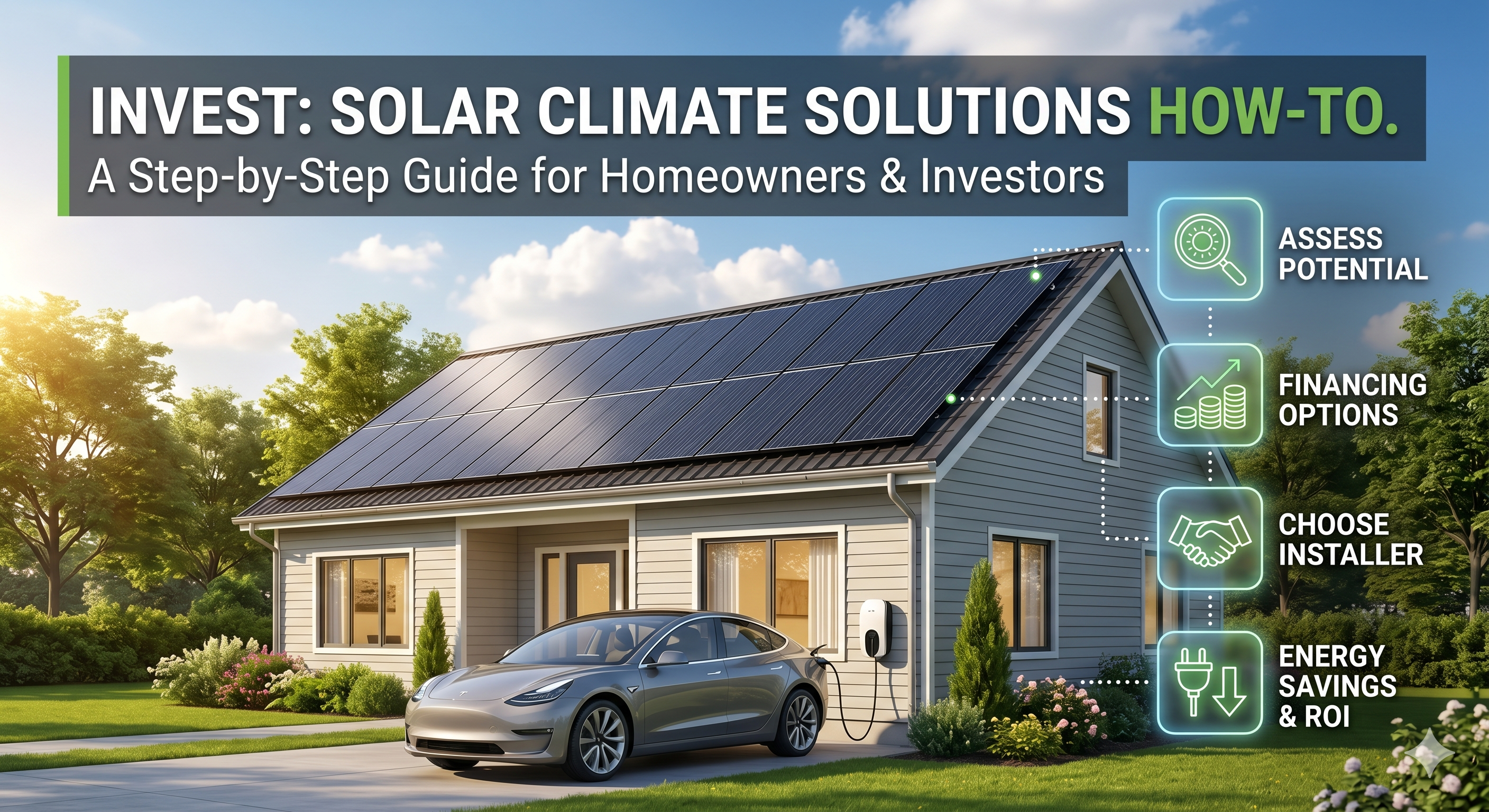
Invest: Solar Climate Solutions How-To
Invest: Solar Climate Solutions How-To
In 2026, the Philippine energy landscape has reached a critical turning point. With residential electricity rates hitting ₱13.81 per kWh as of March 2026 and a declared national energy crisis, solar energy is no longer just an environmental choice but a mandatory financial defense.
The Department of Energy (DOE) has set aggressive targets under the Philippine Energy Plan 2023–2050, aiming for a renewable energy share of 35% by 2030 and 50% by 2050. For homeowners and businesses, this transition offers a tangible way to "climate-proof" their finances while contributing to a decentralized, resilient grid.
Why Solar is the Ultimate 2026 Investment
Investing in solar is uniquely effective in the Philippines due to our high electricity costs and abundant solar resources.
Rapid Financial Returns
The high cost of traditional power means that solar installations in the Philippines pay for themselves faster than in many other countries. Most residential and commercial users are now seeing a full ROI in under four to five years. With a 25-year system lifespan, this translates to roughly two decades of virtually free electricity.
Hedging Against Rate Volatility
Philippine utility rates are subject to global fuel price fluctuations and transmission charge increases. By generating your own power, you lock in your energy costs. For businesses, this stability is a competitive advantage; for homeowners, it is a hedge against the rising cost of living.
How to Invest: A Step-by-Step Guide
A successful solar investment requires moving beyond just buying panels to understanding the full ecosystem of hardware, policy, and permitting.
1. Right-Sizing Your System
The most common mistake is sizing a system based on "gut feeling" rather than a data-driven load profile.
Daytime Load Analysis: Solar is most efficient when it powers your daytime consumption directly.
Future-Proofing: Consider your 2026 needs, such as adding an electric vehicle (EV) or more air conditioning units as temperatures rise.
Cost Estimation: Use our detailed guide on residential solar costs to understand the price per kWp in the current market.
2. Choosing High-Performance Hardware
In 2026, the market is flooded with options. To ensure your investment survives the Philippine climate, focus on:
Tier 1 Panels: These are manufactured by companies with stable balance sheets and proven track records. You can compare the best solar panels in the Philippines to see which brands lead in efficiency.
Inverters: Choose inverters that can handle local grid fluctuations.
Mounting Systems: Given our 20+ typhoons a year, mounting rails must be rated for at least 250 kph winds.
3. Navigating the Streamlined Permitting Process
As of late 2025, the government implemented a "whole-of-government" push to speed up solar adoption.
Time-Bound LGUs: Under a new Joint Memorandum Circular, LGUs must issue electrical permits within three working days and Certificates of Final Electrical Inspection (CFEI) within seven working days.
"Deemed Approved": If an LGU fails to act within these periods, the application is treated as approved, allowing you to proceed with your installation.
Simplified Requirements: The Energy Regulatory Commission (ERC) has standardized documentary requirements for all grid-connected distribution utilities (DUs).
4. Maximizing Returns with Net Metering
To truly make your solar investment profitable, you must connect to the grid via Net Metering. This allows you to sell excess power back to your utility (like Meralco) in exchange for credits on your bill. Understanding the net metering application process in the Philippines is crucial, as it involves coordinating with your LGU, the DU, and the ERC.
2026 Market Trends to Watch
The investment landscape has evolved with new technologies and policies that increase consumer power.
Energy Storage Integration: As the grid becomes more stressed, adding "hybrid" storage is becoming standard for 24/7 reliability.
Shared Net Metering Credits: Under new 2025 supplemental policies, users can now share net metering credits across multiple accounts within the same utility franchise area, a process known as multi-site aggregation.
Renewable Energy Certificates (RECs): Solar owners now retain ownership of RECs from the electricity they consume, which can be sold or traded in the Renewable Energy Market for additional revenue.
Common Pitfalls to Avoid
DIY Disasters: Attempting to install your own system often voids hardware warranties and makes you ineligible for Net Metering.
Unaccredited Installers: Always verify installer credentials to ensure they are registered with the Department of Energy (DOE) and follow the Philippine Electrical Code.
Skipping Maintenance: While solar is low-maintenance, the dust and salt air in the Philippines require periodic cleaning to maintain peak efficiency.
Conclusion
Investing in solar in 2026 is one of the few decisions where financial self-interest and environmental stewardship align perfectly. By following the correct net metering and permitting steps, you aren't just buying hardware—you are securing your household's energy future against a volatile global market.
FAQ
Is a solar system still worth it if I don't use much power during the day?
Yes, but you must have Net Metering. This allows you to earn credits during the day which then pay for your nighttime usage.
Can I get a loan for my solar installation?
Many Philippine banks (BPI, BDO, and Security Bank) now offer specific "Green Finance" or "Eco-Loans" where the monthly loan repayment is often lower than your previous electricity bill.
How long do solar panels actually last in the Philippines?
Standard Tier 1 panels are warrantied for 25 years and typically still produce at 80% to 85% of their original capacity after three decades.