
Why Batteries Matter for Inverters?
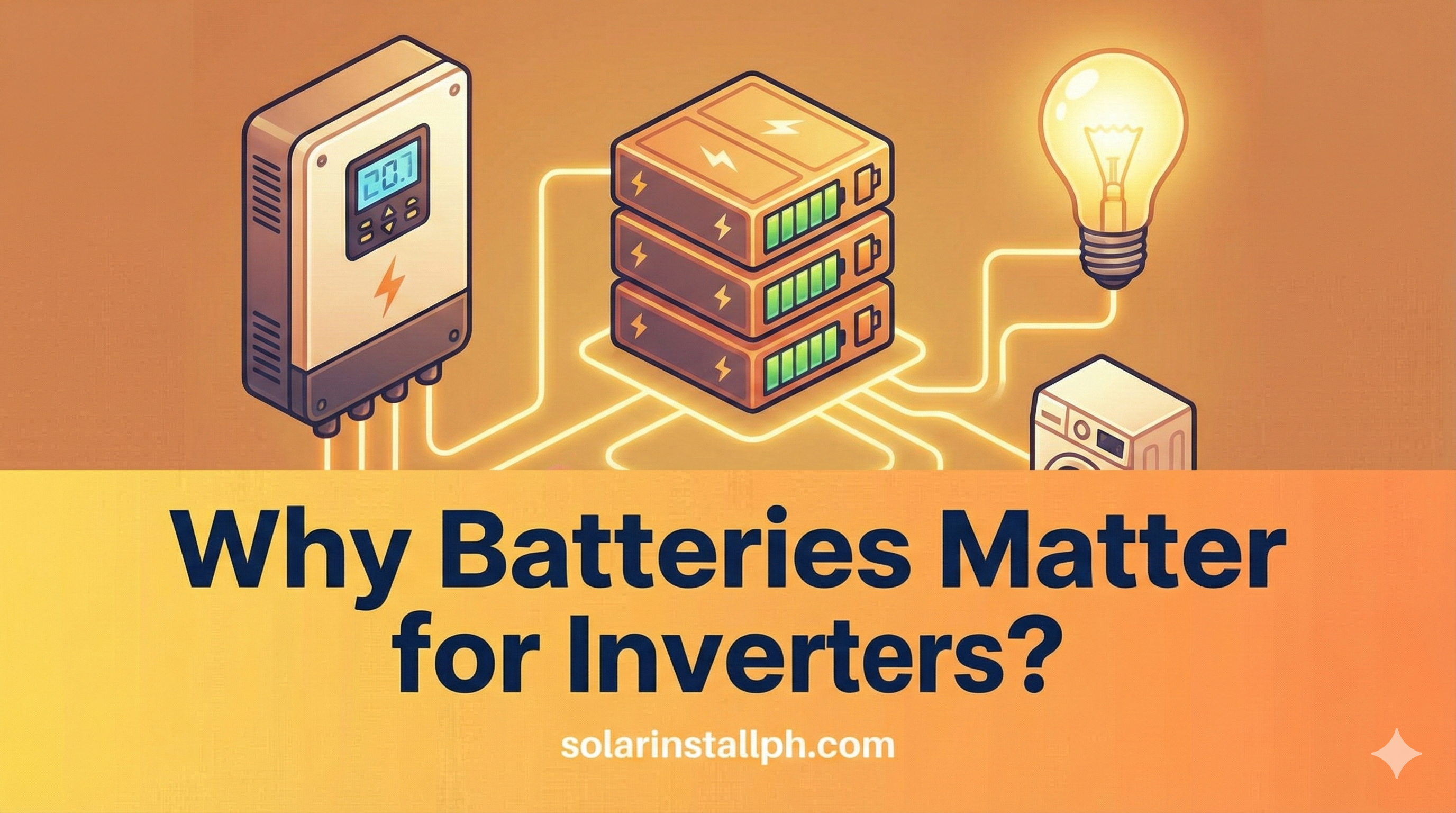
If you are considering solar for your home or business in the Philippines, you have likely focused heavily on the solar panels: how many you need, their wattage, and where they will sit on your roof. However, the real workhorse of your system is the inverter, and its most critical partner is the battery.
There is a common misconception among Filipino homeowners that simply installing solar panels guarantees electricity during a brownout. This is false. A standard grid-tie system will shut down the moment the grid fails, regardless of how bright the sun is shining. To keep the lights on when Meralco or your local electric cooperative goes dark, you need energy storage.
This article explores the symbiotic relationship between inverters and batteries, why this pairing is essential for energy security in the Philippines, and how to choose the right configuration for your specific needs.
The Inverter-Battery Relationship Defined
To understand why batteries matter, you first have to understand what the inverter actually does. Solar panels produce Direct Current (DC) electricity. Your appliances—lights, air conditioners, refrigerators—run on Alternating Current (AC) at 230V (the standard in the Philippines). The inverter converts that DC to AC.
In a system without a battery, the inverter constantly balances the power coming from the roof with the power being used by the house. Any excess is sent to the grid (if you have Net Metering), and any deficit is pulled from the grid.
When you add a battery, the inverter takes on a much more complex role. It becomes a traffic controller. It must decide:
When to charge: Should it send solar power to the house, the grid, or the battery?
When to discharge: Should it pull from the battery to run the aircon, or pull from the grid?
Safety management: It must monitor the battery's health to prevent overcharging or deep discharging, which can destroy expensive lithium cells.
This is why hybrid inverters differ significantly from standard grid-tie inverters. A hybrid inverter has specific hardware and software designed to communicate with a battery management system (BMS), creating a smart energy ecosystem rather than just a passive power generator.
The Philippine Context: Brownouts and Frequency Fluctuations
The primary driver for battery adoption in the Philippines is not just saving money—it is reliability. Our grid infrastructure faces frequent challenges, from rotational brownouts during the dry season to infrastructure damage during typhoon season.
The "Anti-Islanding" Safety Feature
Standard grid-tie inverters have a mandatory safety feature called "anti-islanding." If the grid goes down, the inverter must immediately shut off. This prevents your solar system from feeding electricity back into the power lines, which could electrocute linemen working to repair the outage.
This leads to the frustration of "solar envy": sitting in a dark, hot house during a noon brownout while staring at perfectly functional solar panels on your roof.
How Batteries Change the Game
When you pair a hybrid inverter with a battery, the system can disconnect from the grid (island itself) and create a "microgrid" within your home. The battery provides the reference voltage that the inverter needs to operate. This allows you to run critical loads—like your internet router, lights, and fans—completely independent of the utility company.
For many homeowners, this solution for brownouts is the deciding factor in purchasing a solar system. It turns a financial investment into a security asset.
Economics: Self-Consumption vs. Exporting
Beyond backup power, batteries matter for the financial performance of your system. This is becoming increasingly relevant as electricity rates in the Philippines continue to fluctuate and rise.
Maximizing Self-Consumption
In a typical household, energy usage peaks in the early morning and the evening (when everyone is home). However, solar production peaks between 10:00 AM and 2:00 PM. Without a battery, you are forced to sell that prime midday energy to the grid.
While the Net Metering program in the Philippines allows you to earn credits for this export, the economic logic is shifting. In some scenarios, it is more financially beneficial to store your excess solar energy in a battery and use it yourself at night, rather than selling it to the grid and buying it back later. This is especially true if you are in an area where the export rate (the price the utility pays you) is significantly lower than the import rate (the price you pay them), or if your local cooperative has strict limits on how much you can export.
Peak Shaving for Businesses
For commercial establishments, batteries are crucial for "peak shaving." Many businesses pay a demand charge based on their highest usage spike during the month. By using battery power during those spikes, a smart inverter can smooth out the demand curve, resulting in significant savings on electricity bills.
Chemistry Matters: Lead-Acid vs. Lithium-Ion
The type of battery you choose dictates how your inverter operates. Historically, deep-cycle lead-acid batteries were the standard. They were heavy, required maintenance (topping up water), and had a short lifespan.
Today, Lithium Iron Phosphate (LiFePO4) is the gold standard for residential solar in the Philippines.
Communication Protocols
Modern inverters and lithium batteries "talk" to each other using protocols like CAN bus or RS485. This digital communication is vital. The battery tells the inverter exactly what its State of Charge (SoC) is, its temperature, and the maximum current it can accept.
If you use an old-school lead-acid battery, the inverter generally has to guess the charge level based on voltage, which is notoriously inaccurate. With lithium, the BMS provides precise data.
If you are trying to decide between the two technologies, our comparison on lead-acid vs. lithium batteries explains why the higher upfront cost of lithium usually results in a lower cost of ownership over 5 to 10 years.
Sizing the Battery to the Inverter
One of the most common mistakes in Philippine solar installations is mismatched sizing. You cannot simply plug any battery into any inverter and expect optimal performance.
The C-Rate Factor
The "C-rate" measures how fast a battery can be discharged.
1C means a 5kWh battery can provide 5kW of power for one hour.
0.5C means a 5kWh battery can only provide 2.5kW of power (but for two hours).
If you have a 5kW hybrid inverter and you want to run a 2HP air conditioner (which might surge to 3kW or 4kW on startup), but you bought a cheap battery with a low C-rate, the system will fail or trip the breaker. The inverter could handle the load, but the battery couldn't deliver the juice fast enough.
Voltage Matching
Inverters are designed for specific battery voltage ranges.
Low Voltage (48V): Common for residential systems (5kW–8kW). These are safer to handle and easier to find.
High Voltage (HV): Common for larger residential or commercial systems. HV batteries are more efficient because they require lower current to move the same amount of power, resulting in less heat and thinner wires.
You must ensure your inverter matches your battery's voltage architecture. A 48V battery will not work with a High Voltage inverter. When calculating how much storage you need, you must consider both the total capacity (kWh) and the power delivery (kW) to match your inverter's capabilities.
AC Coupling vs. DC Coupling
How the battery connects to the inverter affects efficiency.
DC-Coupled Systems (Hybrid): The solar panels charge the battery directly via DC, and the inverter converts it to AC only when needed. This is highly efficient and is the standard for most new installations in the Philippines.
AC-Coupled Systems: This is used when you already have an existing grid-tie solar system (say, with a Sungrow or SMA string inverter) and you want to add batteries later. You install a second inverter (a battery inverter) that takes AC power, converts it back to DC to charge the battery, and then back to AC to use it. This is less efficient due to the multiple conversions but is a great retrofit solution.
The Role of the Battery Management System (BMS)
The BMS is the brain of the battery, and the inverter relies on it for safety. In the Philippines, where temperatures can get very high, thermal runaway is a risk. A good BMS monitors individual cell temperatures.
If the battery gets too hot, the BMS sends a signal to the inverter to stop charging or reduce the current. Without this communication, a "dumb" inverter might keep pumping energy into an overheating battery, leading to degradation or fire risks.
Furthermore, the BMS balances the cells. Over time, some battery cells charge faster than others. The BMS ensures all cells are equalized, maximizing the usable capacity of the pack. An inverter cannot do this on its own; it needs the BMS.
Choosing the Right Setup for Your Home
When you are ready to invest, you are not just buying components; you are buying a system architecture.
Scenario A: The Budget-Conscious Grid-Tie
If your area rarely experiences brownouts and you just want to lower your bill, you might skip the battery for now. However, you should consider installing a "battery-ready" hybrid inverter. It costs slightly more than a standard inverter, but it allows you to plug in a battery later without ripping out your entire system.
Scenario B: The Energy Security Seeker
If you live in a province with unstable power or a subdivision in Metro Manila that loses power during storms, the battery is non-negotiable. You should look for a setup with a reputable guide to solar batteries indicating high cycle life (6000+ cycles) and a hybrid inverter with a fast transfer time (less than 10 milliseconds) so your appliances don't even blink when the grid cuts out.
Scenario C: The Heavy User
If you plan to run air conditioners at night using solar power, you need a large battery bank. In this case, the inverter's continuous charge/discharge rating becomes critical. A 5kW inverter might not be enough if you are trying to charge a massive 20kWh battery bank during a short window of sunlight while also running the house. You might need parallel inverters to handle the load.
Maintenance and Longevity
Batteries are the most expensive consumable in a solar system. While solar panels can last 25 years, batteries typically last 10–15 years depending on chemistry and usage.
The inverter plays a massive role in extending this life. Advanced inverters allow you to set "Depth of Discharge" (DoD) limits. For example, you can program the inverter to never drain the battery below 20%. This buffer significantly extends the lifespan of lithium batteries compared to draining them to 0% every night.
Additionally, the inverter's ability to pull from the grid to keep the battery at a healthy float voltage during weeks of rain (common during the Philippine monsoon season) ensures the battery doesn't sit empty for long periods, which is chemically harmful.
Conclusion
Batteries are no longer just an optional accessory for solar installations in the Philippines; they are central to the system's intelligence and utility. They transform your inverter from a simple power converter into a smart energy manager that provides security, independence, and financial optimization.
While the upfront cost of adding a battery is significant, the value of having power during a brownout and the ability to maximize your solar harvest often outweighs the expense. As technology improves and prices stabilize, the question is shifting from "Do I need a battery?" to "Which battery best matches my inverter?"
If you are planning your system, prioritize compatibility. Ensure your inverter and battery speak the same language, handle the same voltages, and are sized correctly for your specific load profile. This synergy is the key to a solar system that truly delivers on the promise of energy independence.