
What Drives Green Energy Adoption?
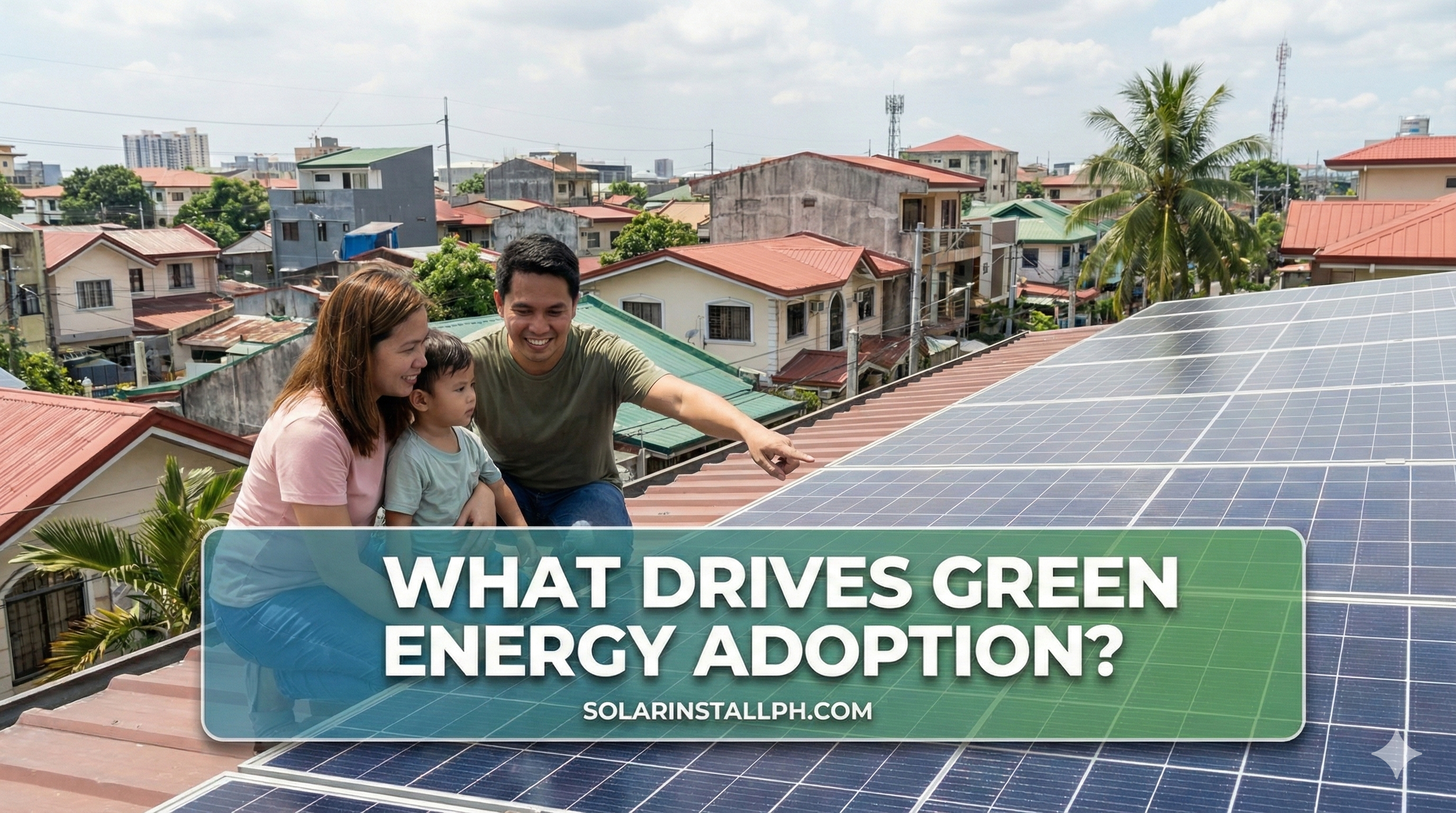
In the Philippines, the decision to install solar panels or switch to renewable energy rarely comes from a purely altruistic place. While we all want a cleaner planet, the real momentum behind the green energy shift in 2025 is driven by something much more tangible: survival.
Financial survival, operational survival, and the simple need to keep the lights on when the grid fails.
For years, the industry spoke in terms of "saving the earth." Today, we speak in terms of Levelized Cost of Electricity (LCOE), energy security, and corporate compliance. Whether you are a homeowner in a Metro Manila subdivision or a plant manager in a Cavite industrial park, the drivers pushing you toward green energy are converging into a single, undeniable economic case.
Here is what is actually moving the needle in the Philippine renewable energy sector right now.
1. The "Bill Shock" Factor (Economics)
The single biggest driver of green energy adoption in the Philippines is the monthly Meralco or electric cooperative bill.
As of late 2024 and entering 2025, residential electricity rates have hovered between ₱11 to over ₱13 per kWh. This makes Philippine electricity some of the most expensive in Asia, rivaling prices in Japan and Singapore, despite our lower purchasing power.
For a household running two air conditioners, this translates to a bill that eats a significant chunk of monthly income. For businesses, power is often the second or third largest operating expense after raw materials and labor.
The Math Has Flipped
Five years ago, solar was a luxury. Today, it is a hedge.
Grid Price: ~₱13.00 / kWh (volatile, trending up).
Solar LCOE (25-year avg): ~₱3.50 – ₱4.50 / kWh.
The gap between these two numbers is your savings. When you install a system, you are essentially pre-buying your electricity for the next 25 years at a discount of 70% or more. This massive differential is why we see a surge in applications for Meralco solar savings programs and net metering. The ROI (Return on Investment) has compressed from 7 years down to 3.5–5 years for many commercial users.
2. Policy Maturity: The "Paper" is Finally Working
In the early days, laws like the Renewable Energy Act of 2008 (RA 9513) were groundbreaking but difficult to implement. In 2025, the mechanisms are finally mature.
Net Metering
This is no longer a "new" experiment. Distribution utilities (DUs) now have established workflows for Net Metering, allowing homeowners to sell excess power back to the grid. While the process can still be bureaucratic, it is functioning. The ability to offset your night bill with your day production is a critical driver for residential users.
The Green Energy Option Program (GEOP)
For businesses consuming at least 100kW (approx. ₱250k/month bill), the GEOP allows you to "fire" your current electricity supplier and contract directly with a renewable energy supplier. This creates competitive pressure. You aren't just installing solar on your roof; you are leveraging the market to buy cheaper wind or geothermal power from the grid.
These policy mechanisms have moved from theoretical frameworks to active market drivers. You can read more about how the law evolved in our look at RA 9513 solar growth.
3. Grid Instability and Energy Security
If high prices are the stick, reliability is the other stick.
The Luzon and Visayas grids frequently struggle with "Red" and "Yellow" alerts, especially during the summer months when hydro reserves are low and demand peaks. For a business, a 2-hour brownout isn't just an annoyance—it's lost production, spoiled inventory, and missed deadlines.
The Rise of Hybrid Systems
This unreliability is driving a specific technological shift: the move from simple grid-tied systems to Hybrid Systems (Solar + Battery).
Old Logic: "Batteries are too expensive; I'll just use a generator."
New Logic: "Diesel is ₱60/liter and noisy. Lithium batteries have dropped in price by 75% since 2015.".
While still a premium upfront, battery prices are falling to a point where "energy independence" is becoming viable for upper-middle-class homes and critical businesses. The desire to never suffer through a brownout again is a powerful emotional and operational driver. Learn more about the specific configurations in our guide to solar brownout backup.
4. Corporate ESG and Supply Chain Pressure
For the commercial sector, the pressure often comes from outside the Philippines.
Multinational corporations (MNCs) and export-oriented zones have strict decarbonization targets. If you are a Filipino factory supplying parts to a European car brand or an American tech giant, you are likely being asked to report your carbon footprint.
Scope 3 Emissions: Global companies are scrutinizing their supply chains. If you cannot prove you are using green energy, you risk losing the contract.
Green Financing: Banks like BPI, BDO, and specialized lenders are offering preferential rates for "Green Projects." Access to cheaper capital is a massive incentive for CFOs.
This "adapt or die" pressure from the global market is forcing Philippine industrial parks to blanket their rooftops with panels. It’s not just about saving money; it’s about remaining eligible to do business. See what perks are available to you in our article on renewable energy incentives for Philippine businesses.
5. Technology Accessibility and "Social Proof"
Finally, we cannot underestimate the "Joneses Effect."
Ten years ago, seeing solar panels on a roof was rare. It signaled that the homeowner was either an eccentric tinkerer or extremely wealthy. Today, in many subdivisions in Laguna or Pampanga, every third house has a visible array.
Normalization
Bankability: You can now walk into a bank and get a home improvement loan specifically for solar.
Turnkey Solutions: You don't need to be an electrical engineer. Professional installers offer full packages including permitting, engineering, and installation.
Aesthetics: Modern panels are sleek, all-black, and blend better with architecture.
As the technology becomes normalized, the "perceived risk" drops. When your neighbor shows you their electricity bill that went from ₱15,000 to ₱500, the psychological barrier to entry vanishes. If you are still crunching the numbers for your own home, check our comprehensive solar ROI guide to see if you fit the profile.
Summary
The Philippines is adopting green energy not because it is trendy, but because the alternative is unsustainable.
We have high rates, a shaky grid, and a legal framework that increasingly favors renewables. Whether you are driven by the bottom line, the need for 24/7 power, or client demands, the arrow points in only one direction. The question for 2025 is no longer "Why should I switch?" but "Why haven't I switched yet?"