
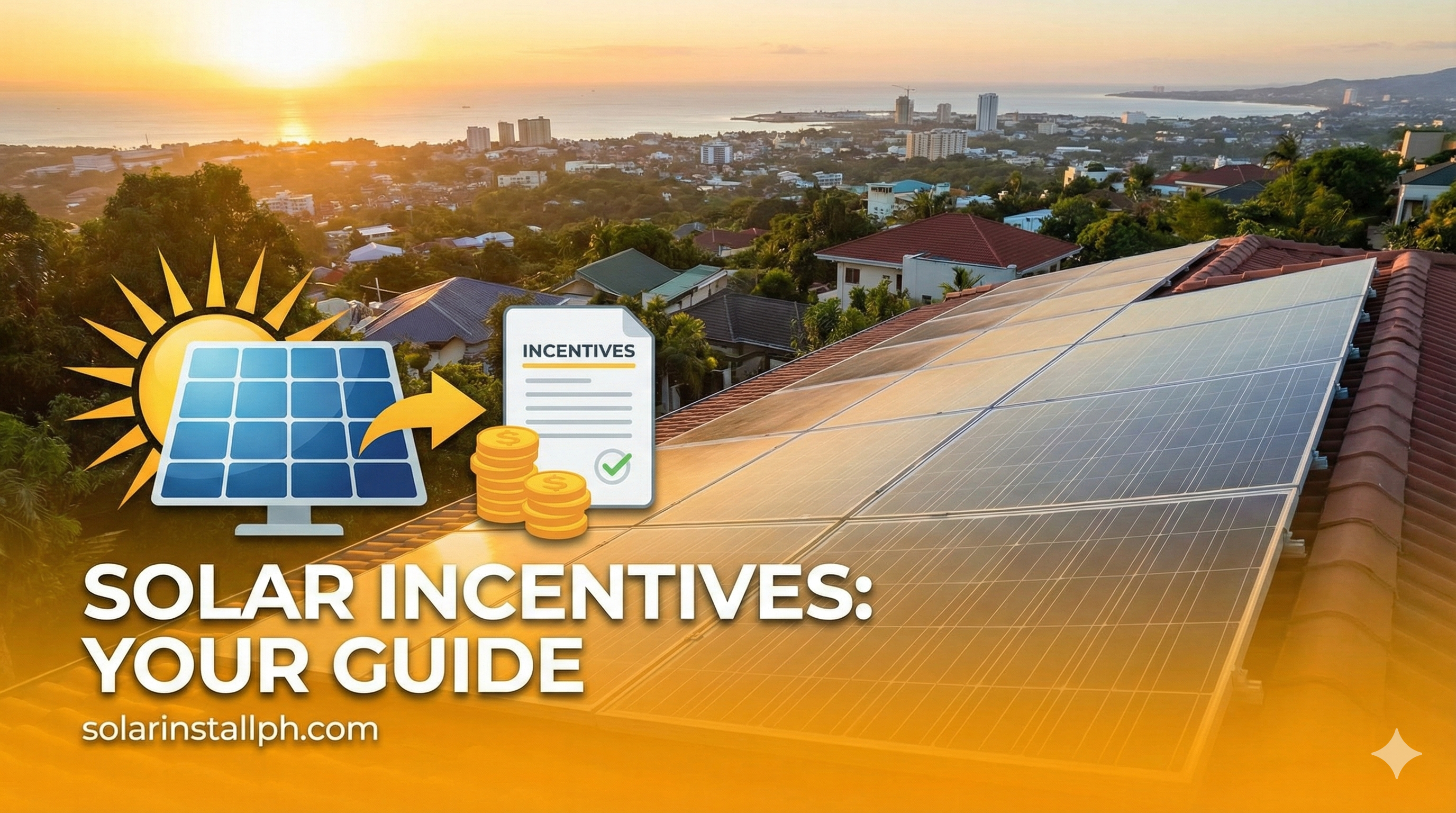
Incentives for Community Solar Philippines: Government Programs and Tax Benefits
Incentives for community solar in the Philippines refer to the government programs, tax benefits, and financial support mechanisms designed to encourage the adoption of shared solar energy systems among Filipino communities. In 2026, these incentives include VAT zero-rating under RA 9513, accelerated depreciation, and the new community solar net metering framework that allows multi-site aggregation.
Government Incentives for Community Solar in 2026
1. Renewable Energy Act (RA 9513) Incentives
The primary legislation driving solar adoption in the Philippines provides significant benefits:
Tax Incentives
- Income Tax Holiday (ITH): 7-year holiday for new commercial solar installations
- Duty-Free Importation: Solar equipment imports are exempt from customs duties
- VAT Zero-Rating: Solar equipment and installation services are effectively VAT-free
- Accelerated Depreciation: Businesses can depreciate solar assets faster for tax purposes
Net Metering Benefits
- Export excess solar for bill credits
- Credits roll over indefinitely (2026 update)
- Credits transfer to new property owners
2. 2026 DOE Community Solar Framework
The Department of Energy has introduced new policies specifically supporting community solar:
| Feature | Benefit |
|---|---|
| Multi-Site Net Metering | Offset multiple accounts (home + business) from one solar system |
| Aggregate Net Metering | Share credits across family members or business locations |
| 1 MW Capacity Limit | Raised from 100 kW — larger systems now eligible |
| 20-Day Processing | Fast-tracked permit approval |
| "Deemed Approved" Rule | Automatic approval if LGU misses deadline |
3. Local Government Incentives
Various LGUs in the Philippines offer additional community solar incentives:
- Permit Fee Reductions: Some cities offer 50–100% discount on solar permits
- Tax Abatements: Property tax exemptions for solar-equipped buildings
- Streamlined Processing: Dedicated solar counters in some municipalities
- Land Use Permits: Faster approvals for community solar farms
4. Financing Incentives
Pag-IBIG Home Improvement Loan
- Interest Rate: 6.25% p.a. (lowest available)
- Maximum Loan: ₱300,000 for solar
- Term: Up to 5 years
- Eligibility: 24 months contributions, property owners
Bank Green Loans
- BPI, BOC, Metrobank: 5–8% p.a.
- Terms: Up to 10 years
- Coverage: Up to 80% of system cost
Rent-to-Own (RTO) Programs
- ₱0 upfront cost
- Monthly payments lower than electricity savings
- Build equity over time
Who Qualifies for Community Solar Incentives?
Residential Communities
- HOAs: Common area solar on clubhouse, water pumps, streetlights
- Condominiums: Shared solar for common areas
- Barangays: Community microgrids for remote areas
Commercial Communities
- Business Districts: Shared solar for multiple establishments
- Industrial Parks: Bulk solar for factories and warehouses
- Schools: Campus-wide solar installations
How to Claim Community Solar Incentives
Step 1: Verify Eligibility
- Ensure your installer is DOE-accredited
- Confirm system meets technical requirements
- Check your LGU's specific incentive programs
Step 2: Documentation Required
- Business registration (for commercial)
- Property titles or lease agreements
- Solar system specifications
- Installer certifications
- Net metering application
Step 3: Application Process
- Apply for incentives through BIR (for tax benefits)
- Register with your LGU (for local incentives)
- Submit net metering application to your utility
Community Solar Incentive Comparison
| Incentive Type | Value | Who Qualifies |
|---|---|---|
| ITH (7 years) | ₱500,000+ savings | Commercial solar >1MW |
| VAT Zero-Rating | 12% of system cost | All solar installations |
| Duty-Free Import | 5-10% of equipment | Imported solar equipment |
| Pag-IBIG Loan (6.25%) | Low monthly payments | Pag-IBIG members |
| LGU Permit Discount | ₱5,000-20,000 | Varies by municipality |
Key Requirements for Incentive Eligibility
For Tax Incentives (RA 9513)
- Must use DOE-accredited installer
- System must meet technical standards
- Registration with DOE required
- Annual reporting may be required
For Net Metering
- System capacity up to 1 MW
- Compliant with utility grid standards
- PEE-signed electrical plans
- CFEI from LGU
2026 Updates Affecting Community Solar Incentives
✅ Enhanced Net Metering: Credits now roll over indefinitely
✅ Multi-Site Aggregation: Offset multiple accounts
✅ Faster Permits: 3-day electrical permits, 7-day CFEI
✅ Expanded Capacity: Up to 1 MW for eligible systems
✅ Simplified Documentation: Only 4 requirements for utility connection
FAQ
Who can avail of community solar incentives? Any Filipino community — HOAs, condo corps, businesses, or barangays — can qualify if they use a DOE-accredited installer and meet technical requirements.
How much can I save with incentives? Depending on system size and incentive type, savings can range from ₱50,000 to ₱500,000+ over the system's lifetime.
Are there incentives for off-grid community solar? Yes, but most incentives focus on grid-connected systems with net metering. Off-grid systems may qualify for equipment tax exemptions.
Where do I apply for these incentives?
- Tax incentives: Bureau of Internal Revenue (BIR)
- Local permits: Your city/municipal hall
- Net metering: Your distribution utility (Meralco, VECO, etc.)