
What Boosts Outdated Panel Power?
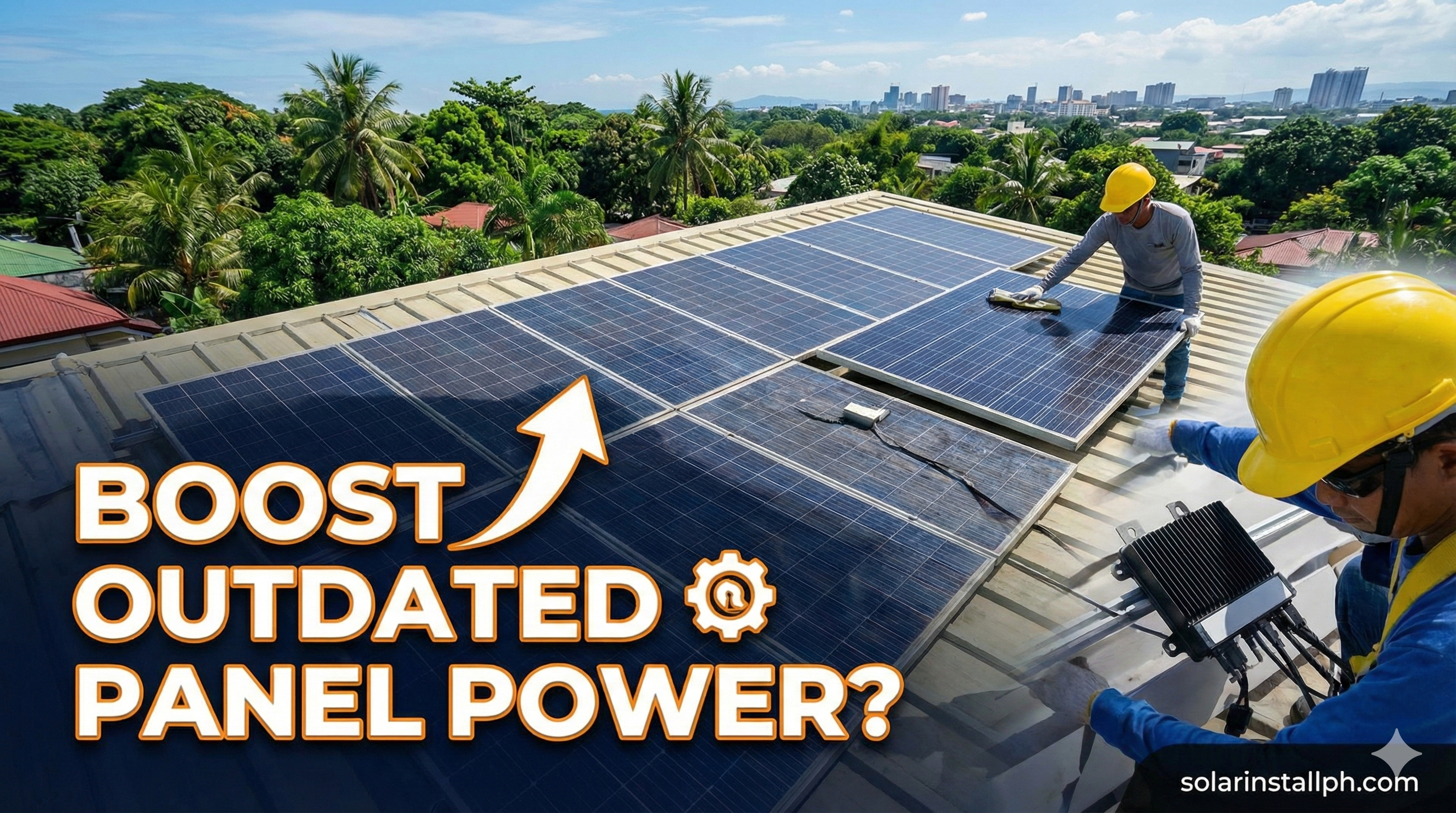
If you were an early adopter of solar in the Philippines—installing your system between 2013 and 2018—you might be noticing a dip in performance.
Back then, a 3kW system was a premium investment often costing upwards of ₱300,000. Today, you look at your inverter display (or likely, just your monthly bill) and notice it’s not hitting the same peak numbers it used to. Maybe your "zero bill" months are becoming rare.
It is easy to assume the panels are dying. The good news? Solar panels degrade very slowly (about 0.5% to 0.8% per year). If your output has dropped by 20% or 30%, it is rarely the silicon cells at fault. It is usually something fixable.
Here is a practical guide to boosting the power of an aging solar setup in the Philippine context.
1. The "Soap and Water" Boost (Soiling)
In Metro Manila and surrounding provinces, soiling is the number one cause of "phantom" power loss.
We aren't just talking about dust. We are talking about sticky diesel soot from jeepneys, construction cement dust, and the dreaded bird droppings (which become baked-on cement in the tropical sun).
The Reality: A thin layer of urban grime can block 10% to 15% of sunlight. If you haven’t cleaned your panels in a year, you are essentially throwing away one month of savings.
The Fix: Cleaning is the cheapest way to boost power. However, be careful. Philippine roofs get dangerously hot. Never hose down your panels at 12:00 NN. The thermal shock of cold tap water hitting 70°C glass can shatter your panels.
Strategy: Clean them at 6:00 AM or 5:00 PM. Use a soft sponge or mop—never abrasive scourers. For a detailed routine, read our guide on solar panel maintenance.
2. The "Heart Transplant" (Inverter Upgrade)
If your panels are the muscle, the inverter is the heart. And unfortunately, inverters age much faster than panels.
Most grid-tied inverters from the 2015 era had efficiencies around 95-96%. They also had older MPPT (Maximum Power Point Tracking) software that struggled with partial shading or sudden cloud cover.
The Upgrade: Replacing an old 5kW string inverter with a modern 2025 model (often 98-99% efficient) can instantly boost your total yield by 3-5% without touching a single panel.
The Bonus: New inverters come with Wi-Fi monitoring. You move from guessing your harvest to seeing it on your phone in real-time. If your old inverter has already failed or is showing error codes, this is the time to switch. Check our article on solar inverter upgrades to see if this makes financial sense for you.
3. The "Pacemaker" Solution (Retrofitting Optimizers)
Older systems usually rely on "string" technology. This means your panels are wired like old Christmas lights: if one panel is shaded by a growing mango tree or covered in bird dirt, the entire string drops to the performance of that weak panel.
The Problem: Over 10 years, trees grow, and neighbors build second floors. New shadows might be hitting your array that weren't there in 2015.
The Fix: You don't need to buy new panels. You can retrofit Power Optimizers (from brands like Tigo or Huawei) on just the shaded panels. These devices isolate the "weak" panel so it doesn't drag down the healthy ones.
Result: This can recover 10-25% of lost energy in partially shaded strings. It’s a targeted surgical fix rather than a full replacement. Learn more about identifying these issues in our guide to solar panel shading.
4. The "Expansion" Trap (Mixing Old and New)
Many homeowners ask: "Can I just buy three new 550W panels and add them to my old string of 250W panels?"
The answer is generally NO.
The Physics: If you mix a 250W panel (low current) with a 550W panel (high current) in the same series, the physics of electricity will force the big 550W panel to throttle down to the level of the small 250W panel. You pay for 550W but only get 250W.
The Correct Way: If you want to boost power by adding panels, you must create a new string.
If your current inverter has a spare MPPT slot (input), you can plug the new high-power panels there.
If not, you might need a second small inverter or a full inverter replacement.
Before buying anything, read our guide on adding solar panels to understand the wiring limits.
5. Check the Arteries (Wiring and Connectors)
In our humid, salty tropical air, copper corrodes. The MC4 connectors (the plastic clips connecting your panels) can become brittle or loose over a decade.
The Loss: Corroded contacts increase resistance. Resistance creates heat. Heat is lost energy (and a fire risk).
The Fix: A "health check" by a solar technician involves re-crimping old connectors and checking the DC wire insulation for rat bites or UV damage. It’s unglamorous, but ensuring your current path is clean can restore efficiency.
6. When to Just Replace Everything
Sometimes, the boost isn't worth the cost. If your panels are Poly-crystalline models from 2013 that have turned a strange brown color (browning EVA film) or have "snail trails" (microcracks), they might be degrading faster than normal.
If the cost of a new inverter + optimizers + labor approaches 50% of the price of a brand-new system, it is often smarter to strip the roof and start fresh with high-efficiency Bifacial panels. You can compare the numbers in our breakdown of solar upgrade costs.
Conclusion
Your old panels probably aren't dead; they are just dirty, throttled, or mismatched.
Clean them first. It’s nearly free and often solves 50% of the problem.
Check for new shade. If trees have grown, trim them or add optimizers.
Upgrade the inverter. If the box on your wall is 10 years old, it’s the bottleneck.
Do not rush to throw away working silicon. With a little maintenance or a targeted upgrade, a 10-year-old system can still significantly slice your Meralco bill for another decade.
Next Step
Do you suspect your inverter is the reason for your low output? Would you like me to help you interpret the error codes or flashing lights on your current inverter unit?