
Sun's Economic Surge: A Nation's Shift
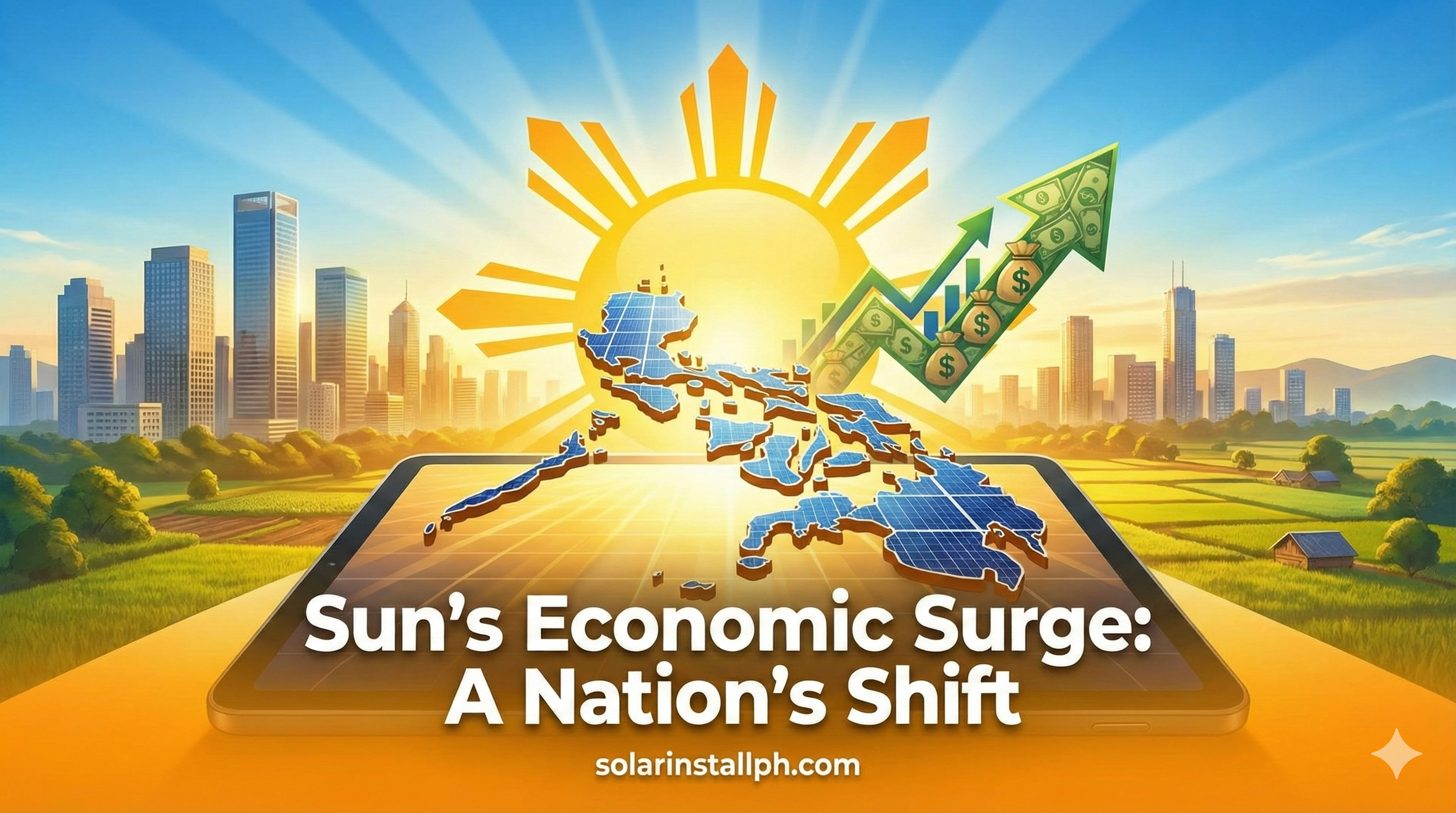
For years, solar energy in the Philippines was viewed as a niche luxury—something for eco-conscious haciendas or remote resorts. That narrative is dead. In 2025, solar is no longer just an environmental statement; it is a raw economic engine reshaping the country’s financial landscape.
From the boardrooms of Makati to the rice fields of Central Luzon, the shift is palpable. We aren't just seeing panels on roofs; we are seeing a fundamental restructuring of how Filipinos generate, value, and consume power. High electricity rates from Meralco and regional co-ops, combined with aggressive government policies, have tipped the scales. Solar is now the pragmatic choice for survival and growth.
This isn’t about saving the polar bears anymore. It’s about saving the peso, securing energy independence, and creating a new industrial backbone for the nation.
The 2025 Landscape: More Than Just Green Energy
The data from the last 12 months paints a clear picture: the Philippines is in the middle of a renewable energy gold rush. With the government’s target to hit a 35% renewable energy share by 2030, the pressure is on, and the market is responding.
In 2024 alone, we saw record-breaking capacity additions. We are moving from small-scale pilots to massive utility-grade infrastructure. The Department of Energy (DOE) has successfully auctioned gigawatts of capacity through the Green Energy Auction Program (GEAP), signaling to the world that the Philippines is open for business.
But the real story is local. Commercial and Industrial (C&I) users—factories, malls, and cold storage facilities—are leading the charge. They aren't waiting for the grid to get greener; they are building their own power plants on their rooftops. This decentralization is reducing the strain on the Luzon grid and insulating businesses from volatile coal prices.
Investment Floodgates: Foreign Capital Meets Local Needs
One of the most significant shifts in the last two years has been the influx of Foreign Direct Investment (FDI) into the Philippine renewable sector. The removal of the 40% foreign ownership cap on renewable energy projects was the catalyst. Now, we are seeing major players from Europe and Asia partnering with local conglomerates to build gigawatt-scale solar farms.
This influx of capital does two things:
It stabilizes technology costs. As supply chains mature within the country, equipment becomes more accessible.
It forces grid modernization. Billions of pesos are being poured not just into generation, but into the transmission upgrades needed to move power from solar-rich provinces to hungry metro centers.
For a deeper look at where the big money is going, you can read our analysis on solar farm investment trends. The landscape is competitive, and for the first time, the Philippines is positioned as a top-tier destination for green capital in Southeast Asia.
The "Green Collar" Job Boom
Economic shifts are ultimately about people. The solar surge is creating a new category of employment in the Philippines. We aren't just talking about installers climbing roofs. The industry demands a diverse workforce:
Engineers and Designers: To plan complex hybrid systems for BPOs and hospitals.
Legal and Compliance Officers: To navigate the labyrinth of ERC compliances and LGU permits.
Sales and Consultants: To explain ROI to skeptical homeowners.
Maintenance Crews: To clean and service the gigawatts of capacity already installed.
This is a massive opportunity for technical vocational graduates. The demand for skilled labor is currently outstripping supply. A competent solar technician in 2025 commands a premium wage because mistakes in high-voltage DC systems are dangerous and costly.
The Peso Value: Savings for Homes and SMEs
Let’s bring this down to the kitchen table. Why are regular Filipino families draining their savings to buy solar? Because the math is undeniable.
With grid electricity rates frequently hitting ₱12 to ₱14 per kWh, the "do nothing" cost is painful. A standard residential solar system now offers a payback period of roughly 4 to 5 years. After that break-even point, you are effectively harvesting free energy for the next two decades.
For small businesses, this is a lifeline. A sari-sari store with a freezer, or a computer shop running 15 units, can see their operating costs slash by 30-40% with a properly sized system. This frees up capital for inventory or expansion. If you are still on the fence about the numbers, check our updated guide on residential solar costs to see what a realistic entry price looks like today.
Furthermore, financing is finally catching up. Banks like BPI and repayment schemes like PAG-IBIG’s home improvement loans are making the initial capex easier to swallow. It’s no longer cash-up-front or nothing.
Policy Drivers: Why This Is Happening Now
The government deserves credit for creating the framework that made this possible. It wasn't overnight, but the accumulation of policies has created a sturdy floor for the industry.
Renewable Portfolio Standards (RPS): This mandates that distribution utilities (like Meralco) source a specific portion of their power from renewables. It creates a guaranteed market for solar generators.
Green Energy Option Program (GEOP): This allows large consumers (consuming 100kW and up) to ditch their local utility’s default mix and buy 100% renewable energy directly from a supplier.
Net Metering: The ability for homeowners to sell excess power back to the grid remains the cornerstone of residential adoption.
However, navigating these incentives can still be tricky. Misunderstanding the tax breaks or the application process for net metering can delay your ROI. It is crucial to understand the government incentives currently available to maximize your investment.
Growing Pains: The Challenges Ahead
It would be dishonest to say everything is perfect. Rapid growth brings friction.
1. Grid Congestion:
Our transmission lines are struggling to keep up. We have solar farms ready to generate but unable to push full power to the grid because the National Grid Corporation of the Philippines (NGCP) lines are congested. This "curtailment" is a major economic risk for large investors.
2. Land Conversion Issues:
There is a rising tension between agriculture and energy. Converting prime agricultural land into solar farms is controversial and regulated. The industry is pivoting towards "Agrivoltaics"—growing crops under raised panels—but this is still in its infancy in the Philippines.
3. The Quality Control Crisis:
As demand spikes, fly-by-night installers appear. We see systems failing after three years because of poor waterproofing or undersized wiring. The economic loss of a failed system hurts the industry's reputation. This is why we constantly emphasize vetting your provider. You can review our outlook on the industry's growth and risks to understand the broader market health.
The Verdict for 2025
The solar surge is not a bubble; it is a correction. For too long, the Philippines has paid too much for imported coal and diesel. The shift to solar is an economic rationalization.
For the homeowner, it means lower bills and higher property value. For the nation, it means energy security and a modernized workforce.
If you are looking to participate in this shift, start with a clear calculation of your potential returns. Don't just buy a kit online; understand your load profile. Read our detailed Solar ROI guide for 2025 to run the numbers yourself.
The sun is shining on the Philippine economy. The only question is whether you are set up to catch it.