
Power Outage: Inverter Guide Philippines
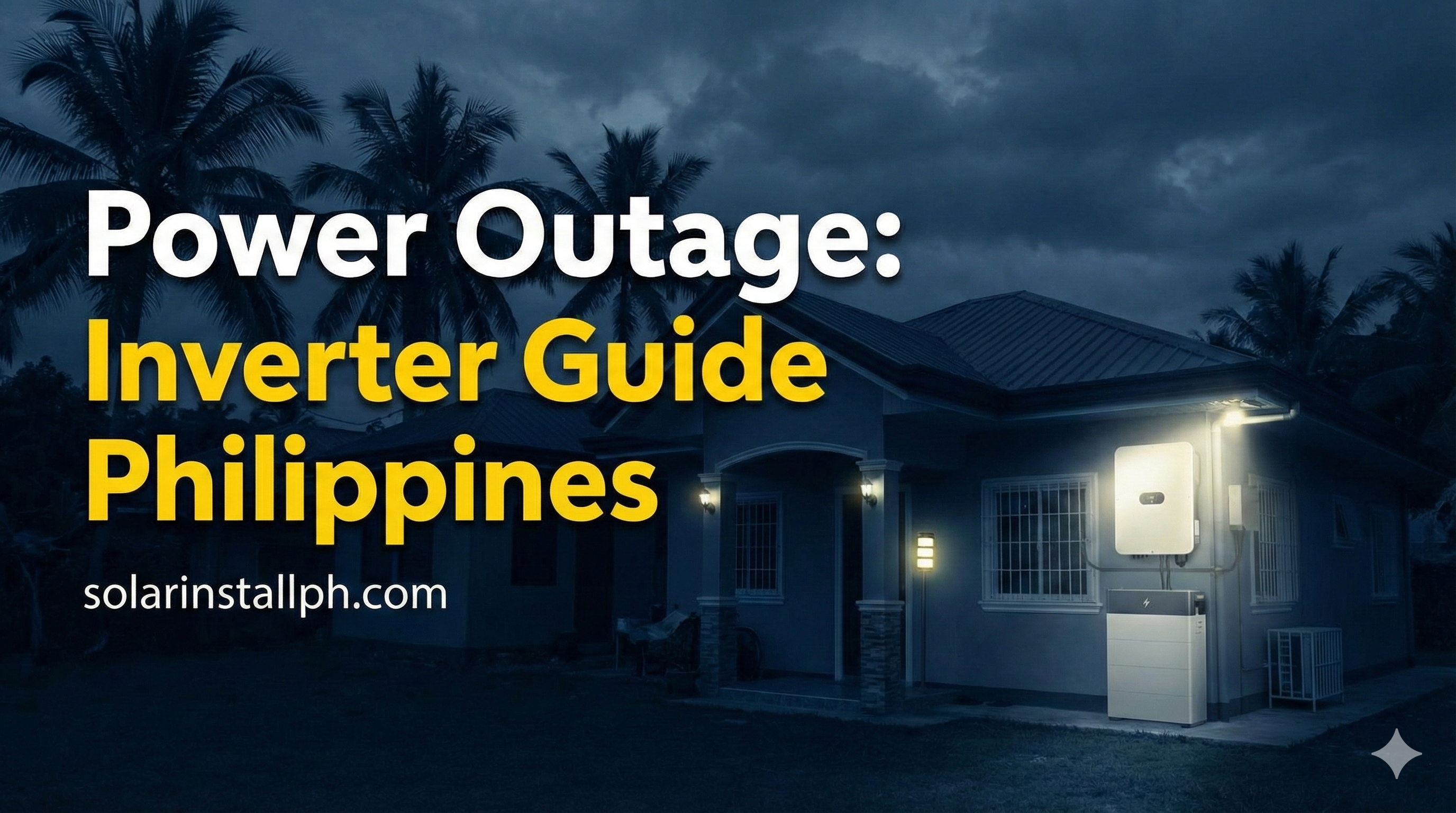
It is the most common shock for new solar owners in the Philippines. You spend heavily on a rooftop solar system. Then, on a sunny Tuesday afternoon, the neighborhood power goes out—and your house goes dark too.
You look at your inverter. The screen is blank. You look at your roof. The sun is blazing.
"Why don't I have power? I have solar panels!"
This is the reality of Grid-Tie Solar. In the Philippines, where brownouts are a monthly (or weekly) occurrence, understanding how your inverter behaves during a power outage is critical.
If you want your lights to stay on when Meralco or your local coop goes off, you need to understand the technology, the safety rules, and the costs involved. Here is your practitioner’s guide to solar power during outages in 2025.
The Safety Rule: Why Your Solar Shuts Down
First, let’s clear up the myth: your system isn't broken. It is doing exactly what it was programmed to do.
Standard grid-tie inverters (the most common type installed in PH) have a mandatory safety feature called Anti-Islanding Protection.
When the grid goes down—whether due to a storm, maintenance, or a supply shortage—your inverter detects the loss of frequency immediately. It is legally required to shut down within milliseconds.
Why? Safety for Linemen.
Imagine a Meralco lineman climbing a pole to fix a broken line. He assumes the line is dead because the grid is off. If your solar panels were still pumping 220V electricity into that line, you could electrocute him.
Anti-islanding ensures your house does not become an "island" of live power in a dead sea of grid lines.
The Solution: Hybrid Inverters & EPS
If you want to defeat the brownout, you cannot use a standard grid-tie inverter. You need a Hybrid Inverter with a feature often called EPS (Emergency Power Supply) or "Backup Output."
Unlike a standard inverter, a Hybrid Inverter has two AC outputs:
Grid Port: Connects to Meralco. This shuts down during a brownout.
Load / Backup Port: Connects to a specific sub-breaker panel in your house. This stays alive during a brownout, powered by your batteries and solar panels.
Do I Need Batteries?
Yes.
You generally cannot have backup power without batteries. Solar production is volatile—a cloud passes, and production drops from 3000W to 500W instantly. Without a battery to act as a buffer, your appliances would crash constantly.
For a deeper dive into battery technologies, read our comparison of lead-acid vs lithium batteries.
Top 3 Inverter Setups for Brownouts (2025)
Not all "brownout-ready" inverters work the same way. Here are the three most common setups we install in the Philippines today.
1. Deye Hybrid (The "All-in-One" Workhorse)
Best For: Homeowners who want a simple, powerful backup without buying extra accessories.
Deye has taken the Philippine market by storm because their hybrid inverters are "native" backups. You don't need to buy a separate box. The unit itself handles the switching.
Performance: It can pull power from panels and batteries simultaneously to run heavy loads (like an inverter aircon) during a blackout.
Cost: A 5kW Deye hybrid inverter typically costs between ₱50,000 – ₱55,000 (unit only).
Battery Match: Works perfectly with low-voltage (48V) Lithium Iron Phosphate (LiFePO4) batteries.
2. Huawei Sun2000 + Backup Box (The Premium Tech)
Best For: Tech-focused homes prioritizing safety and high-voltage efficiency.
Huawei is primarily a grid-tie inverter. To make it work during a brownout, you must add a separate hardware device called the Backup Box (B0 or B1).
How it works: When the grid fails, the Backup Box physically disconnects your house from the grid and reroutes power to your critical loads.
Limitation: The single-phase Backup Box (B0) usually has a limit of roughly 5kW output.
Cost: You pay for the inverter (~₱60k) plus the Backup Box (~₱15k - ₱20k) plus the high-voltage LUNA battery (which is significantly pricier than standard 48V batteries).
Check our full Huawei inverter review for more on their specific ecosystem.
3. Growatt SPF / SPH Series (The Budget Off-Grid/Hybrid)
Best For: Remote areas or budget-conscious backup.
Growatt offers "Off-Grid" inverters (SPF series) that can accept grid input. These are cheaper than true hybrids but have a downside: they often act like giant UPS systems. They might not blend solar and grid power as smoothly as a Deye or Huawei, but they will definitely keep the lights on.
Cost: A 5kW Growatt off-grid unit can be as low as ₱43,000.
The "Critical Load" Strategy
Here is the mistake most people make: They try to power the whole house.
Unless you have a massive battery bank (which costs hundreds of thousands of pesos), you should not try to run your entire main breaker during a brownout. Instead, we wire a Critical Load Panel.
This small breaker box contains only the essentials. We use the acronym LFRC:
Lights (Kitchen and Living Room)
Fans (Electric fans are low wattage and keep you cool)
Ref (Keep the food from spoiling)
Computer (Router/Modem for work-from-home)
By isolating these loads, a modest 5kWh battery can last you through a 4-hour brownout easily. If you try to run your 3HP aircon and electric stove, that same battery will die in 45 minutes.
For help sizing your needs, see our guide on battery capacity needs.
The Cost of Being "Brownout Proof"
How much extra does this peace of mind cost?
If you are choosing between a standard Grid-Tie system (no backup) and a Hybrid system (with backup) in 2025, here is the realistic price difference for a typical 5kW home setup:
Standard Grid-Tie 5kW: ₱230,000 – ₱280,000
Result: Zero bill, but no power during brownouts.
Hybrid 5kW + 5kWh Lithium Battery: ₱380,000 – ₱450,000
Result: Zero bill, plus power during brownouts.
The Premium: You are paying an extra ₱150,000+ effectively for the battery and the smarter inverter.
Is it worth it? If you work from home or run a business that loses money when offline, the answer is usually yes. If you just want to save on your Meralco bill, the standard grid-tie is a faster ROI.
You can compare financing options for these higher costs in our article on solar bank loans.
Common Brownout Mistakes to Avoid
Using Car Batteries: Do not use deep-cycle lead-acid or truck batteries for solar storage in 2025. They degrade quickly in our tropical heat and cannot handle deep discharges. Stick to LiFePO4 (Lithium Iron Phosphate).
Ignoring the "Changeover Time": Good hybrids switch to battery in less than 10 milliseconds (ms). Your computer won't even blink. Cheaper inverters might take 500ms, which will reboot your router and crash your PC. Ask your installer about the "transfer time."
Overloading the Backup: If you turn on a hair dryer during a brownout, you might trip the inverter's overload protection. You have to change your habits when running on batteries.
Conclusion: Is Hybrid Right for You?
If you live in an area with stable power (like parts of BGC or Makati) and you rarely experience outages, a standard grid-tie system is the smarter financial choice. It pays for itself faster.
But if you are in a province with an electric coop that fluctuates weekly, or if you simply cannot tolerate downtime, a hybrid inverter is an investment in stability.
Just remember: Solar does not equal Backup. Batteries equal Backup.
Ready to find an installer who knows how to set up critical loads correctly? Check our guide on how to verify installer credentials to ensure they are qualified for hybrid wiring.