
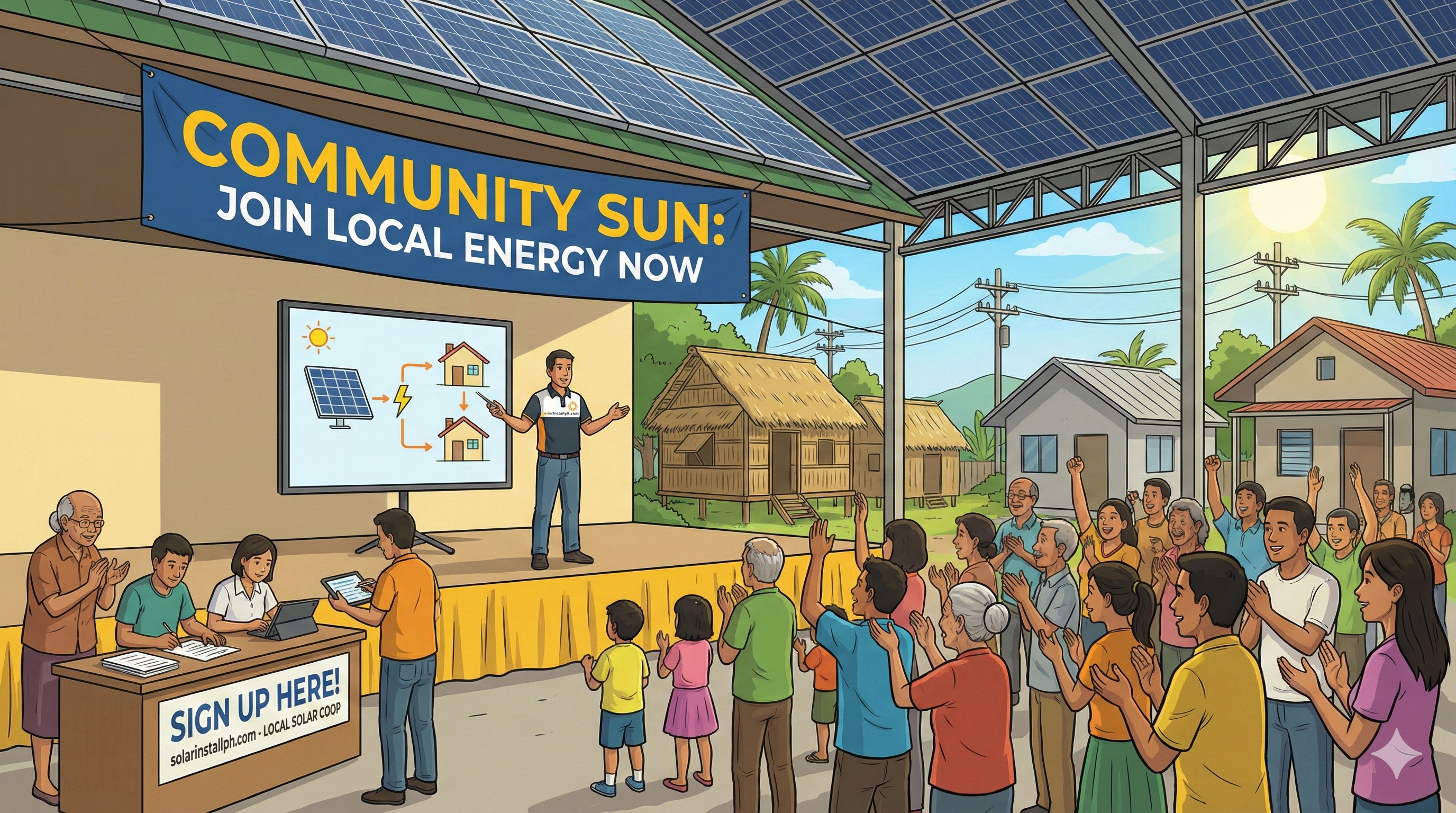
Community Sun: Join Local Energy Now
In the US and Europe, "Community Solar" is a trendy subscription service. You click a button on an app, pay a monthly fee to a solar farm 50 kilometers away, and get a discount on your electric bill. It is seamless, virtual, and easy.
In the Philippines, that model does not exist.
If you are waiting for an app to lower your Meralco bill without installing anything, stop waiting. In our current regulatory framework, "Community Sun" is not a financial product—it is a construction project. It is your Homeowners Association (HOA) deciding to stop burning cash on streetlights. It is your condo corporation realizing that the roof can power the elevators. It is a remote island village building its own microgrid because the main lines will never reach them.
"Joining local energy" in 2025 means taking ownership of your community's infrastructure. It is harder than clicking a button, but the financial returns are massive.
Here is how you can actually build and join a local energy network in the Philippines today.
The Philippine Definition of "Community Solar"
Because we do not yet have "Virtual Net Metering" (where you can credit your home bill from a distant panel), community energy here falls into two distinct buckets:
The Common Asset (Urban): A subdivision or condo installs a central system to power shared amenities (clubhouse, pool, pumps, lights). This lowers the monthly dues for everyone.
The Microgrid (Rural/Island): A standalone network that generates and distributes power to individual homes in unserved areas, sanctioned under the Microgrid Systems Act (RA 11646).
For 90% of you reading this in a grid-connected subdivision, Option 1 is your battleground.
Strategy 1: The HOA Power Plant
Every subdivision has a "ghost tenant" that uses more electricity than anyone else: the Common Area.
Between the clubhouse air conditioning, the pool pumps running 12 hours a day, and the hundreds of streetlights burning all night, the HOA’s electric bill is often the single biggest reason your monthly association dues keep going up.
The Solution: Solarize the Overhead
Instead of trying to wire solar to 500 individual houses (which is a legal nightmare), the HOA installs a commercial-scale solar system on the clubhouse roof.
Daytime: The panels power the admin office and the massive pool pumps for free.
Export: Any excess power is sold to the distribution utility (like Meralco) via the Net Metering program. The credits earned help offset the bill for nighttime loads.
Result: The HOA’s operating expenses drop by 30-50%. This savings prevents dues hikes or builds up the association’s emergency fund.
Actionable Tip: If you are an HOA officer, audit your "Common Area" meters. If you are paying more than PHP 15 per kWh (which is standard now), a solar asset will likely pay for itself in 4 to 5 years.
Strategy 2: The Streetlight Revolution
The most visible waste of energy in any village is the streetlighting. Standard sodium or even LED streetlights connected to the grid burn money from 6:00 PM to 6:00 AM.
Many communities are now "joining local energy" by cutting the cord entirely.
Switching to standalone solar street lights eliminates this line item from the electric bill permanently.
The Trap: Do not buy the cheap "all-in-one" plastic lights you see online. They last 6 months.
The Real Deal: Community-grade lights use separate panels and Lithium Iron Phosphate (LiFePO4) batteries mounted high on the pole. They are brighter, last 5-7 years before battery servicing, and stay on even during brownouts—improving village security.
Strategy 3: The "Water First" Approach
For many provincial subdivisions or farm lots, the water supply is independent. The community relies on a deep well and a massive electric pump to fill a central water tank.
This is the perfect candidate for "Community Sun."
Electric motors are hungry. The surge current required to start a 5HP or 10HP pump is massive. By installing a dedicated solar water pump system, the community can pump water strictly using solar power during the day.
Gravity is the Battery: You pump water up to the tank when the sun is shining. At night, gravity delivers the pressure.
Zero Fuel: You stop running the diesel generator or paying peak grid rates just to flush toilets.
Strategy 4: The Rural Microgrid
If your property is in a "missionary area" (places not reached by the main grid), the rules are different.
The Microgrid Systems Act now allows private groups to build their own mini-utilities. If you own a resort cluster or live in a remote barangay, you can form a consortium to build a centralized off-grid solar system.
Instead of every house buying a noisy, inefficient generator, the community shares one large solar array and a central battery bank.
Efficiency: One large inverter is more efficient than 50 small ones.
Reliability: You get 24/7 power, usually cheaper than the PHP 30-50/kWh cost of running individual gasoline gensets.
How to "Join" (The Politics of It)
The technology is easy. The engineering is solved. The problem is the people.
Building a community solar project requires consensus, and getting 200 homeowners to agree on spending money is difficult.
1. The Audit
Don't start with "Let's go green." Start with "We are bleeding money." Present the board with the last 12 months of utility bills. Show them that the pool pump alone costs PHP 40,000 a month.
2. The Financing
Communities rarely have cash upfront. Look for:
Special Assessment: A one-time fee per homeowner.
Green Loans: Banks like BPI or BDO offering financing for renewable projects.
Lease-to-Own: Some installers offer terms where you pay the monthly "solar installment" using the savings from the electric bill.
3. The Execution
Hire a reputable installer. Since this is a community asset, you need accountability. Do not use a "fly-by-night" operator. Use our guide on how to verify installer portfolios to ensure they have the experience to handle 3-phase commercial systems, not just small house kits.
Conclusion
"Community Sun" in the Philippines isn't something you sign up for; it's something you build.
It is an act of local independence. Whether you are cutting the cord on your streetlights or offsetting your clubhouse aircon, you are insulating your neighbors from the volatility of the global fuel market.
The grid isn't getting cheaper. The sun hasn't sent a bill in 4.5 billion years. It’s time your community connected to the latter.