
Panel Efficiency: Savings Explained
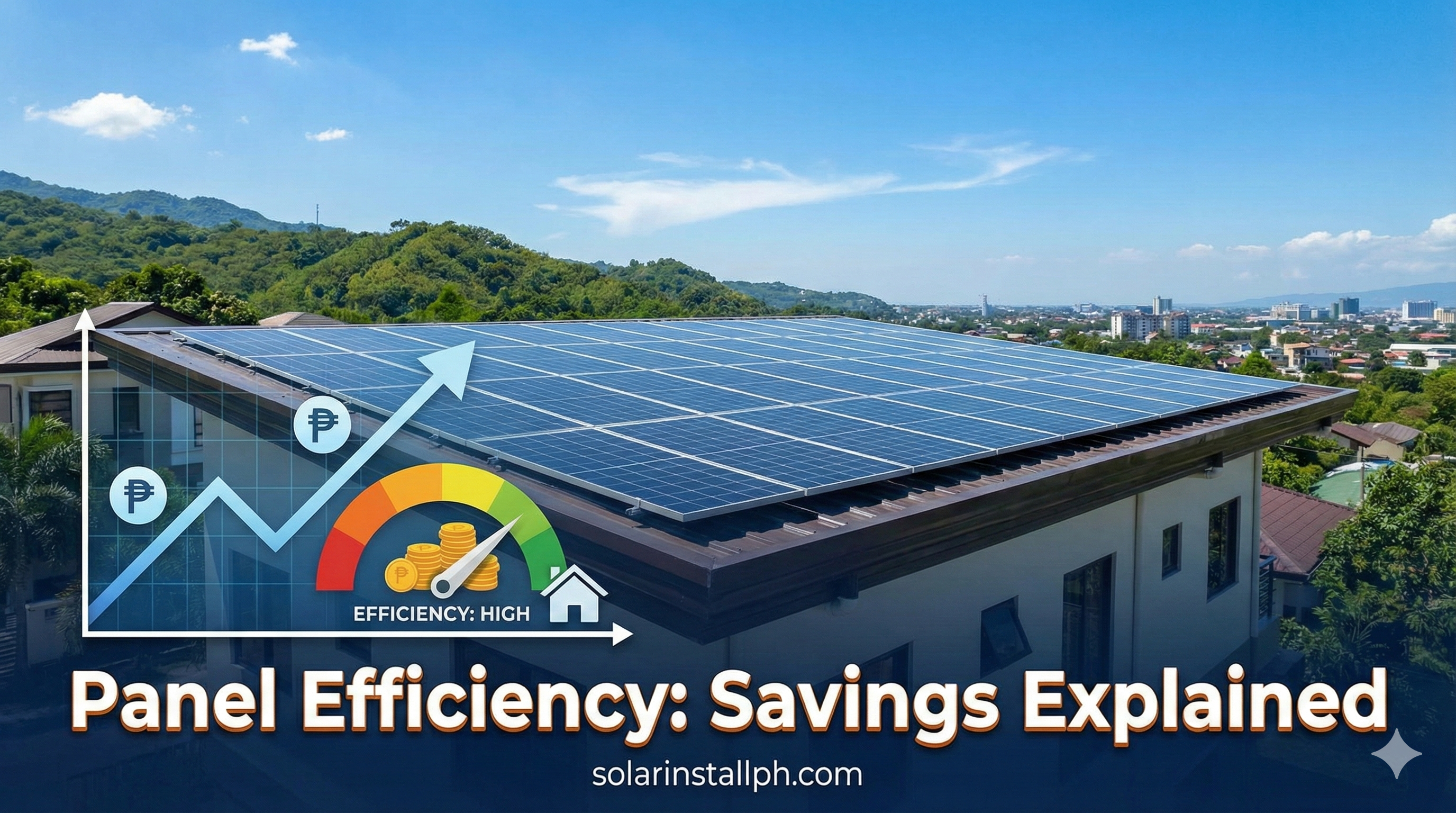
In the Philippine solar market, "efficiency" is the most abused buzzword in sales pitches. You will hear installers claim that a 22.8% efficient panel will "save you more money" than a 21% efficient panel.
This is often misleading.
If you install a 5kW system, you get 5kW of power, regardless of whether the panels are 18% efficient or 25% efficient. The electricity bill savings will be virtually identical.
So, why do we pay extra for high-efficiency panels? The real savings aren't in the amount of electricity they produce, but in the space they save and the longevity they offer.
Here is the honest breakdown of how panel efficiency actually impacts your wallet.
The "Pizza Box" Reality
Think of solar panels like pizza boxes.
Standard Efficiency (20%): A standard 12-inch pizza.
High Efficiency (22%): A standard 12-inch pizza, but inside a smaller 10-inch box.
You get the same amount of "pizza" (watts), but the high-efficiency version takes up less table space.
Efficiency = Power Density.
It measures how many watts fit into one square meter of sunshine. A 500W panel with 22% efficiency is physically smaller than a 500W panel with 20% efficiency, but they both output 500W.
If you have a massive roof in a province like Pampanga or Batangas, paying a premium for high efficiency is often a waste of money. You are paying for space savings you don't need. You could achieve the same power output by simply installing more of the cheaper, standard panels.
When Efficiency Does Save You Money
There are two specific scenarios in the Philippines where high efficiency (22%+) translates to hard cash savings.
1. The "Bitin" Roof (Metro Manila)
In crowded cities like Quezon City or Makati, roof space is the limiting factor. You might only have 25 square meters of usable south-facing roof.
Scenario: You need a 5kW system to zero out your ₱12,000 bill.
Standard Panels (400W, 20% eff): You can only fit 3.5kW. You still pay Meralco ₱4,000/month.
High Efficiency (440W, 22.5% eff): You can fit the full 5kW in the same space. You pay Meralco ₱0.
In this case, the "premium" price of the panels is worth it because it allows you to offset a larger chunk of your bill. You can learn more about how sizing impacts your bill in our guide to panel efficiency ratings.
2. Balance of System (BoS) Savings
"Balance of System" refers to everything that isn't the panel: the aluminum rails, the mid-clamps, the DC wires, and the labor.
High-efficiency panels are more powerful per unit. To get 10kW, you might need only 18 high-efficiency panels instead of 24 standard ones.
The Saving: You buy 6 fewer panels worth of rails, L-feet, and grounding lugs. The installation is faster (less labor). Sometimes, these savings offset the higher cost of the panels themselves.
The "Tropical Efficiency" Bonus (N-Type vs. P-Type)
In 2025, the real efficiency story isn't just about the percentage on the label; it's about the technology inside. The market is shifting from P-Type (PERC) to N-Type (TOPCon).
This matters for your savings because of heat.
P-Type (Older Standard): Efficiency drops significantly as the panel gets hot.
N-Type (New Standard): Handles heat much better. In the Philippine noon sun (where panels reach 65°C), an N-Type panel will maintain more of its power than a P-Type panel.
The Financial Impact:
Over 25 years, an N-Type system can yield 5-8% more total electricity than a P-Type system of the same nameplate wattage, simply because it doesn't "faint" as much in the heat. This is "free" energy that directly improves your ROI.
For a detailed look at pricing, check our article on residential solar costs.
Calculating the True Payback
When an installer pitches you a "Premium High Efficiency" system for ₱280,000 versus a "Standard" system for ₱220,000, do the math.
Will the premium system produce more power?
If the wattage is the same (e.g., both are 5kW), the answer is generally NO (unless it's N-Type vs P-Type).
Does the premium system fit better?
If it allows you to hit your target capacity when the standard one can't, the premium is worth it.
What is the degradation rate?
High-efficiency N-Type panels degrade slower (0.4% per year vs 0.6% for standard). By Year 20, the premium system will be producing significantly more power.
You can run these numbers yourself using our solar ROI guide.
Conclusion
Don't buy efficiency for the sake of efficiency. Buy it if you lack roof space, or if you want the long-term heat resistance of N-Type technology.
Large Roof: Save your money. Buy Tier 1 Standard panels (Mono PERC).
Small Roof: Invest in High Efficiency (N-Type/HJT) to maximize every square meter.
The goal isn't to have the coolest tech; it's to have the lowest electricity bill. For more on keeping that bill low, read about maximizing your net metering credits.
Next Step
Are you unsure which panel technology was quoted to you? Would you like me to look at your quote's datasheet to tell you if it's P-Type or N-Type?