
Why Grid-Tie: Sizing Your System?
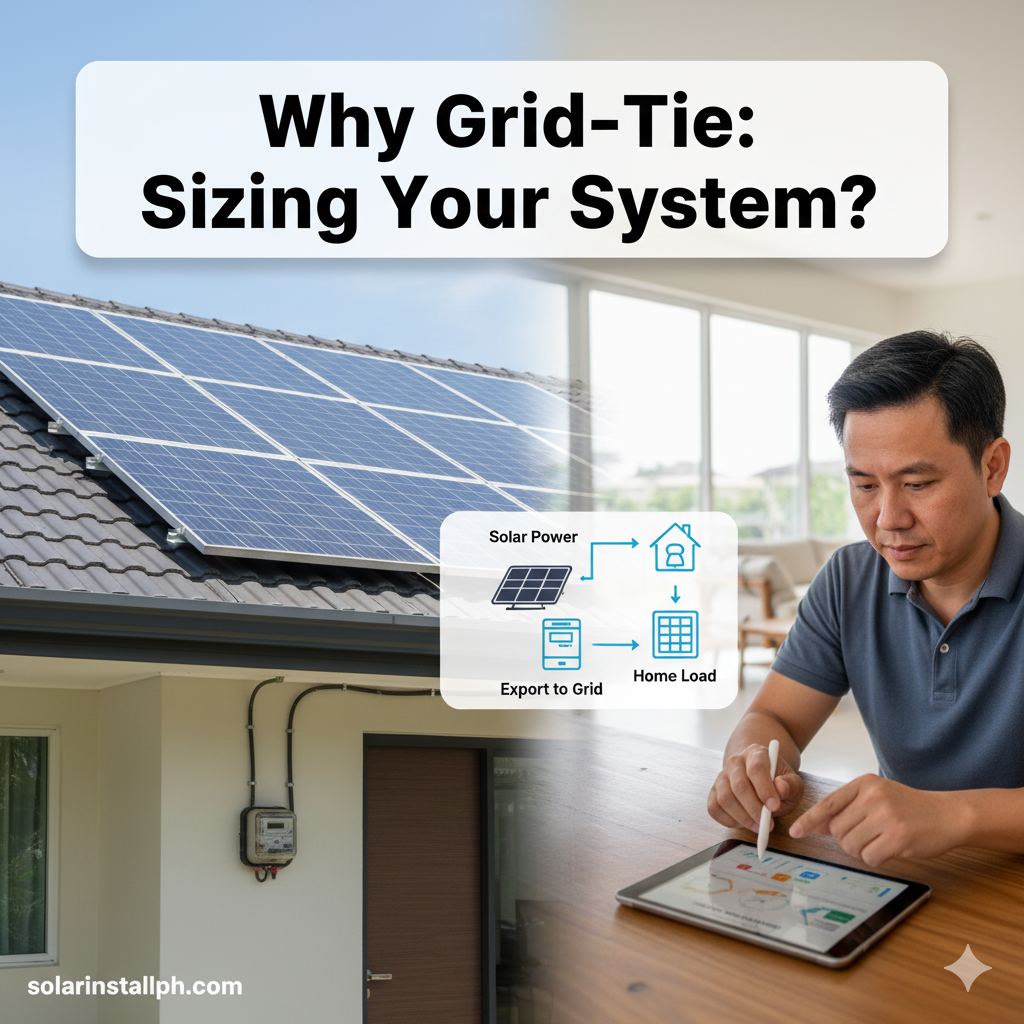
For Filipino homeowners weary of high electricity bills, the move to solar energy represents a powerful declaration of financial and energy independence. Among the available solar technologies, one has emerged as the clear favorite for urban and suburban households across the Philippines: the grid-tie system. Simple, cost-effective, and incredibly efficient, a grid-tie setup allows you to generate your own clean electricity while remaining connected to the utility grid, offering the best of both worlds.
However, the success of this investment—the speed of your return on investment (ROI) and the scale of your monthly savings—hinges on one crucial, often misunderstood, decision: the sizing of your system. It’s a delicate science that goes far beyond simply covering your roof with panels. An undersized system leads to "solar regret" and missed savings, while an oversized one can be a significant waste of money.
This guide will delve into the fundamentals of grid-tie solar systems and provide a comprehensive walkthrough of how to properly size your installation. By understanding the interplay between your energy consumption, your system's production, and the rules of the grid, you can ensure your solar investment is perfectly optimized for maximum financial benefit for decades to come.
The Power of Grid-Tie: Your Personal Daytime Power Plant
Before diving into sizing, it’s essential to understand what a grid-tie system is and how it works. Unlike an off-grid system, which requires a large, expensive battery bank to store power, a grid-tie system is directly connected to your local utility's infrastructure (e.g., the Meralco grid).
Here’s the process in a nutshell:
Generation: During the day, your rooftop solar panels capture sunlight and convert it into Direct Current (DC) electricity.
Conversion: This DC electricity flows to an inverter, the brain of your system, which transforms it into Alternating Current (AC) electricity—the type of power your home appliances use.
Consumption: This solar-generated AC power is used immediately by your home. Your refrigerator, air conditioners, lights, and computers will run on the sun's energy first, before drawing any power from the grid. This is what slashes your daytime electricity consumption.
But what happens when your panels produce more power than your home is using on a bright, sunny afternoon? This is where the magic of "Net Metering" comes in. The excess energy isn't wasted; it's automatically exported onto the grid. Your utility credits you for this power, which you can then use at night or on cloudy days. This symbiotic relationship with the grid is one of the core benefits of solar energy in a residential setting. Because it forgoes the need for expensive batteries, the grid-tie system offers the fastest possible payback period and is the most financially efficient option for the vast majority of Filipino homeowners.
The Golden Rule: Your Meralco Bill is Your Blueprint
The journey to determining the perfect system size begins not on your roof, but at your desk with a stack of your old electricity bills. Your historical energy consumption is the single most important piece of data in the entire process. A professional solar installer won't even begin to design a system without it.
How to Analyze Your Bill:
Gather Your Last 12 Bills: A full year's worth of data is ideal because it accounts for seasonal variations in your consumption (e.g., higher aircon use during the hot summer months).
Find Your Monthly kWh Usage: Look for the "Total kWh Consumption" line on your Meralco bill. This number tells you exactly how much electricity you used in a given month.
Calculate Your Daily Average: Add up the total kWh from all 12 bills and divide by 365 (or add up the monthly totals and divide by 12, then by 30). This gives you your average daily energy consumption in kWh.
Example:
Let's say your monthly bills show an average consumption of 600 kWh.
Average Daily Consumption: 600 kWh / 30 days = 20 kWh per day
This 20 kWh figure is your target. It's the amount of energy your solar panel system should aim to produce on an average day to significantly impact your electricity bill. This data-driven approach removes all guesswork and is the first step in a proper rooftop solar guide.
The Sizing Sweet Spot: Production vs. Consumption
With your average daily energy consumption in hand, the next step is to calculate the size of the solar array needed to generate that amount of power. This calculation involves another key variable: Peak Sun Hours (PSH).
Peak Sun Hours are not the same as total daylight hours. PSH is a measure of the average number of hours per day that the sun's intensity is strong enough for your solar panels to operate at their peak rated capacity. In the Philippines, this number typically ranges from 4.5 to 5.5 hours per day, depending on your specific location and the time of year.
The Sizing Formula:
The basic formula to determine your required system size in kilowatts (kW) is:
System Size (kW) = Average Daily Energy Consumption (kWh) / Peak Sun Hours (PSH)
Continuing our example:
System Size = 20 kWh / 5 PSH = 4 kW
This calculation suggests that a 4-kilowatt (or 4,000-watt) solar panel system would be the ideal size to offset the energy consumption of a household that uses an average of 20 kWh per day. This system would be composed of, for example, ten 400-watt solar panels. Understanding these solar sizing factors is crucial for an informed decision.
The Pitfalls of Sizing: Why Bigger Isn't Always Better
It might seem logical to install the largest system you can afford or fit on your roof. However, when it comes to grid-tie systems in the Philippines, oversizing can be a significant financial mistake, while undersizing leads to disappointment.
The Problem with Undersizing:
This is a straightforward issue. If your analysis showed you need a 4 kW system but you opt for a cheaper 2 kW system to save on upfront costs, you are leaving a massive amount of potential savings on the table. Your smaller system will still make a dent in your bill, but you'll continue to pay Meralco for a large chunk of energy that you could have been generating for free. This is often called "solar regret."
The Hidden Dangers of Oversizing:
This is a more complex issue with serious financial implications. Let's say your analysis points to a 4 kW system, but you are convinced to install a much larger 8 kW system. Here’s why that’s a problem:
The Net Metering Cap: The Philippine Net Metering program, governed by the Energy Regulatory Commission (ERC), has a system size limit of 100 kWp. While this doesn't affect most homeowners, there's a more relevant local limitation. Meralco and other utilities have "hosting capacity" limits based on the size of the local distribution transformer that serves your neighborhood. An installer must verify that your proposed system doesn't exceed this capacity.
Diminishing Returns: The goal is to offset your consumption. A system that consistently generates far more power than your home uses during the day results in excess energy being exported to the grid. While you get credits for this, the financial value of these credits can sometimes be less than the retail rate you pay for electricity. You have essentially spent thousands of extra pesos on panels whose primary job is to sell cheap power back to the utility, dramatically extending your ROI period.
Wasted Investment: Every peso spent on an unnecessarily oversized system is a peso that could have been saved or invested elsewhere. It's the equivalent of buying a ten-wheeler truck to do your weekly grocery shopping. It’s an inefficient use of capital.
Avoiding these solar installation mistakes is paramount. The goal is not necessarily to achieve a "zero bill," but to achieve the fastest possible payback period by precisely matching the system's generation capacity to your home's actual consumption patterns.
Your Most Important Partner: The Professional Installer
While this guide provides the fundamental principles of sizing a grid-tie system, the final design should always be entrusted to a qualified and experienced solar professional. A reputable installer will not just rely on the basic formula; they will conduct a comprehensive assessment that includes:
A Detailed Load Analysis: They will help you itemize your major appliances to understand your peak daytime energy needs.
On-Site Shade Analysis: Using specialized tools, they will map the path of the sun across your roof throughout the day and year, identifying any potential shading from trees, adjacent buildings, or other obstructions that could impact performance.
Roof Assessment: They will evaluate the structural integrity, orientation, and available space on your roof to create the most efficient panel layout.
This professional analysis ensures that the system you invest in is not just theoretically correct but practically optimized for your unique home. Therefore, learning how to choose a solar company with proven engineering expertise is arguably as important as choosing the panels themselves.
In conclusion, the path to a financially successful solar investment is paved with data. By starting with a thorough analysis of your Meralco bills and working with a professional to design a system that meets—but doesn't grossly exceed—your daytime energy needs, you can unlock the full power of grid-tie solar. This intelligent, calculated approach is the key to slashing your electricity costs and achieving energy independence in the most efficient way possible.