
Grid-Tie: Energy Freedom Insights
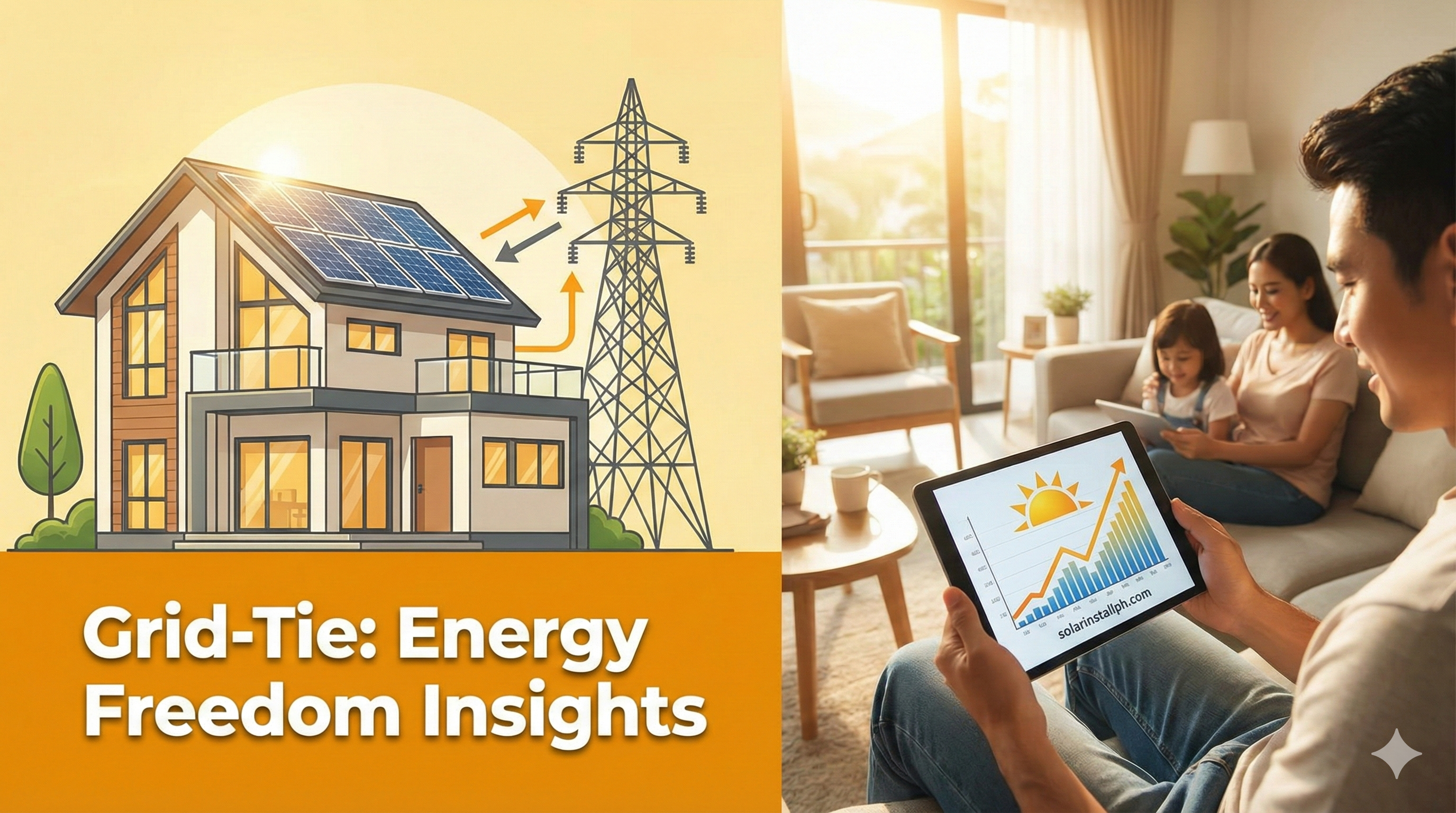
In the Philippines, electricity is not just a utility. It is one of the highest recurring monthly expenses for any household or business. As of early 2026, residential rates from Meralco and various provincial cooperatives continue to hover around ₱13 per kWh. This economic pressure has turned grid-tied solar from a sustainable choice into a necessary financial hedge. Understanding the technical and regulatory landscape of grid-tied systems is the first step toward reducing your dependence on an expensive and often volatile grid.
The Economics of Grid-Tie in 2026
A grid-tied system is the most common entry point for Filipinos because it offers the fastest return on investment. Unlike hybrid or off-grid setups, a grid-tied system does not require expensive battery banks. It uses the utility grid as a virtual battery. When your panels produce more than you use, the excess flows back to the grid. When the sun goes down, you pull power back.
The primary driver for this transition is the "avoided cost" of power. Every kilowatt-hour you generate and consume is a kilowatt-hour you do not buy from the utility at retail rates. Currently, residential solar installation costs have stabilized, making a 5kW system—a common size for middle-class homes—a predictable investment with a clear 25-year lifespan.
Net Metering: The Regulatory Pillar
Energy freedom in the Philippines is anchored in Republic Act 9513, or the Renewable Energy Act of 2008. The Net Metering program allows homeowners to install systems up to 100kW and sell surplus power back to their distribution utility. However, "selling" is a loose term. You receive credits at a rate roughly equal to the generation charge, which is usually about half of the retail price you pay.
Navigating this process requires technical rigor. You cannot simply plug panels into your wall. You must undergo a Distribution Impact Study (DIS) and secure a Certificate of Compliance (COC) from the Energy Regulatory Commission (ERC). For those in the metro, following a detailed Meralco net metering guide is essential to ensure your bi-directional meter is installed correctly and that your exported credits are properly reflected on your monthly bill.
Structural Realities: Engineering for the Archipelago
The Philippines is an island nation defined by its weather. We are hit by roughly 20 typhoons every year. A grid-tied solar system is essentially a collection of glass sails mounted on your roof. If the engineering is substandard, a Signal No. 4 storm will turn your investment into a safety hazard for your neighborhood.
Structural integrity is often where low-cost installers cut corners. To achieve true energy independence that lasts for decades, you must prioritize typhoon-resistant mounting solutions that are rated for wind speeds of at least 250 kph. This involves using stainless steel hardware, proper rail thickness, and enough roof penetration points to distribute the wind load across your rafters rather than just your roofing sheets.
Practical Payback: What the Numbers Actually Show
A common myth is that solar will immediately wipe out your entire electric bill. While possible, it is rarely the most efficient way to size a system. Your ROI is dictated by your daytime "baseload"—the electricity you use while the sun is out.
If you size your system to perfectly match your daytime air conditioning and appliance use, your payback period is usually between four and seven years. There are several solar payback factors to consider, including the efficiency of your inverter, your roof's orientation (South is ideal), and the local weather patterns in your specific province. Once the system pays for itself, the remaining 15 to 20 years of its life represent pure profit in the form of avoided utility costs.
Common Mistakes and Pitfalls
The surge in solar demand has led to an influx of inexperienced installers. One of the most dangerous shortcuts is the "Zero Export" setup installed without proper LGU permits. While technically functional, an unpermitted system exposes the homeowner to legal risks and potential disconnection from the utility grid if power accidentally back-feeds during maintenance.
Furthermore, ignoring maintenance will kill your ROI. Dust from traffic and soot from urban pollution can reduce your output by 15% in just a few months. A quarterly cleaning routine is a small price to pay for maintaining peak efficiency. Before signing a contract, you must verify installer credentials to ensure they have a track record of successfully permitted projects and a commitment to after-sales support.
FAQ
Does a grid-tied system work during a brownout?
No. For safety reasons, grid-tied inverters are designed to shut down immediately when the grid fails. This prevents your panels from sending electricity into a line where utility workers might be performing repairs. If you need power during outages, you must upgrade to a hybrid system with battery storage.
Can I add more panels to my grid-tied system later?
Yes, but it is often more expensive than doing it all at once. You may need to upgrade your inverter, replace your DC wiring, or re-apply for a new Net Metering agreement. It is usually better to size your inverter slightly larger than your initial needs to allow for future expansion.
Is solar worth it if I have a small roof?
Yes. High-efficiency N-type panels produce more power per square meter than older technology. Even a small 1.5kW or 2kW system can significantly reduce the "generation" and "transmission" portions of your bill, which are the largest components of the Philippine electricity rate structure.
Conclusion
Grid-tied solar is the most effective way for Filipinos to take control of their energy costs in 2026. By understanding the balance between upfront hardware costs, regulatory requirements, and structural safety, you can transform your roof from a liability into a high-yielding asset. The goal is simple: stop renting your power and start owning it.