
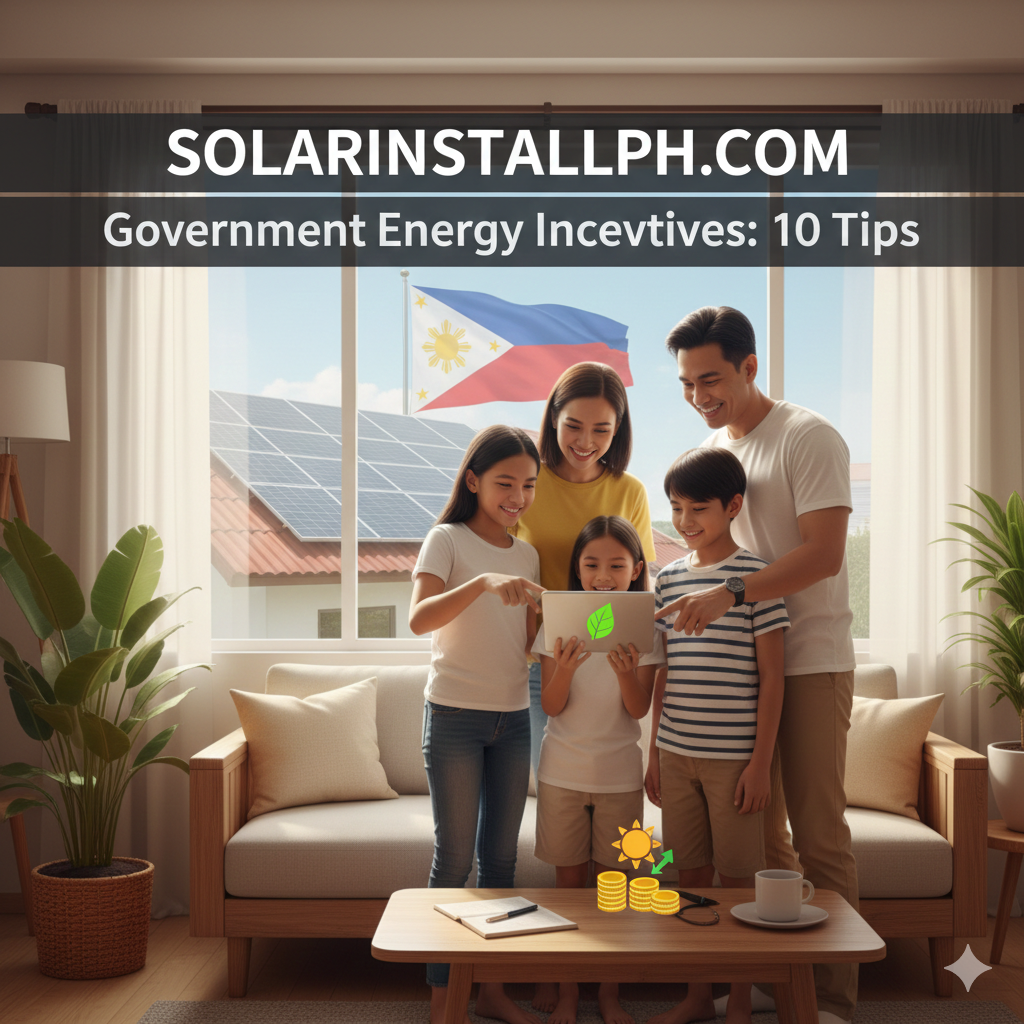
Government Energy Incentives: 10 Tips
The energy landscape in the Philippines has undergone a radical transformation. As of early 2026, the government has moved beyond simple policy statements into a "whole-of-government" push to make renewable energy (RE) the default choice for households and businesses. With electricity prices remains a significant burden for most Filipinos, leveraging state-backed incentives is no longer just for "early adopters"—it is a critical financial strategy.
The passage of new streamlining laws and the digitalization of energy permits mean that what used to take years now takes weeks. If you are looking to slash your power bills or future-proof your business, these ten tips will guide you through the current Philippine incentive ecosystem.
1. Maximize the "Deemed Approved" Rule for Permits
One of the biggest hurdles in the past was the "red tape" at the Local Government Unit (LGU) level. Under new joint directives in 2026, LGUs are strictly required to issue electrical permits within three working days and Certificates of Final Electrical Inspection (CFEI) within seven working days.
If the LGU fails to act within this window, your application is now "deemed approved". This allows you to proceed with your installation based on proof of filing and payment. This reform alone has dramatically reduced the waiting time for rooftop solar permits across the country.
2. Leverage Net Metering for Immediate Bill Credits
Net Metering remains the cornerstone of residential solar savings. It allows you to export surplus electricity back to the grid in exchange for credits that offset your nighttime consumption.
Tip: Don't just install panels; ensure you are officially enrolled in the program to receive these credits.
Update: As of late 2025, the documentary requirements for distribution utilities (DUs) like Meralco have been slashed from over ten documents to just four.
3. Use Multi-Site and Aggregate Net Metering
A game-changing policy launched in late 2025 is "multi-site and aggregate net metering". This allows you to share energy credits across multiple electricity accounts within the same distribution utility area.
If you have a home in Quezon City with a large solar array and a small office in Makati (both under Meralco), you can potentially use the surplus from your home to lower the bill of your office. This is especially useful for business owners with several small facilities.
4. Sell Your Renewable Energy Certificates (RECs)
For the first time, "qualified end-users" (ordinary citizens with rooftop solar) now retain ownership of Renewable Energy Certificates for the power they consume. These certificates represent the "greenness" of your energy and can be sold or traded in the Renewable Energy Market.
This effectively creates a second revenue stream beyond just bill savings. Make sure your installer provides the necessary DOE accredited installer documentation to ensure your system is eligible for REC registration.
5. Claim Your VAT Zero-Rating on Equipment
The Renewable Energy Act (RA 9513) provides a 12% VAT zero-rating on the purchase of RE equipment. For a system costing ₱1,000,000, this incentive can save you up to ₱120,000 upfront.
Critical Action: Ensure your supplier is registered with the Board of Investments (BOI) or the DOE.
Judicial Win: Recent 2024 and 2025 court rulings have removed the need for a per-transaction "Certificate of Endorsement" for this VAT incentive, making it much easier for developers and homeowners to claim at the point of sale.
6. Access Pag-IBIG Solar Home Improvement Loans
For many Filipinos, the upfront cost is the only barrier. The Pag-IBIG Fund now offers a streamlined "Home Improvement" loan specifically for solar installations.
The approval process typically takes 10–14 working days if all documents are complete. This is one of the most accessible financing options for Philippine solar because of its lower interest rates compared to traditional personal loans.
7. Switch to GEOP if Your Demand is Over 100kW
If you run a medium-sized business or a small factory with a peak demand of at least 100kW, you likely qualify for the Green Energy Option Program (GEOP). This allows you to bypass your local utility's standard rates and buy 100% renewable power directly from a licensed RE supplier.
Participants in GEOP often enjoy lower generation charges and are exempt from the VAT usually applied to those charges. It is a powerful tool for renewable energy incentives Philippines business owners can use to lock in long-term energy prices.
8. Utilize Customs Duty Exemptions for Imports
If you are a commercial developer or a business importing your own large-scale solar equipment, you can avail of customs duty exemptions under the Customs Modernization and Tariff Act (CMTA). This significantly lowers the landed cost of high-tier panels, inverters, and batteries.
To benefit, the equipment must be used exclusively for your RE project and must be endorsed by the DOE.
9. Take Advantage of Increased ER 1-94 Benefits
Starting in January 2026, communities hosting energy projects—including large-scale solar farms—receive increased financial benefits under Energy Regulation No. 1-94. The total benefit has risen to ₱0.03 per kilowatt-hour generated.
While this is a community-level incentive, it can lead to optional electricity-rate reductions for residents in host LGUs. If you live near a renewable energy facility, check with your local council to see if your household qualifies for these rate subsidies.
10. Opt for Zero-Export if Net Metering is Delayed
While the "deemed approved" rule has sped up permits, some regional cooperatives still face technical limitations in accepting solar back into the grid. In such cases, businesses can utilize "Zero Export" technology.
While not a direct cash incentive, the government supports this through simplified notification processes. It allows you to consume 100% of what you produce without needing a bi-directional meter immediately, ensuring you don't lose ROI while waiting for full grid integration. You can learn more in our zero export overview.
FAQ
Is the Net Metering credit 1-to-1 with my electricity rate?
No. In the Philippines, you are typically credited at the "blended generation cost" of the utility, which is lower than the full retail rate you pay when buying power. However, the savings are still significant, often covering 30% to 50% of a monthly bill.
Do I need to be a Pag-IBIG member to get a solar loan?
Yes, you must be an active Pag-IBIG member with at least 24 monthly contributions to qualify for their housing or home improvement loan programs.
Are these incentives available for battery storage?
Yes. Recent legislation passed in early 2026 has established a national energy storage framework, which aims to provide similar safety standards and market inclusion for battery systems as those enjoyed by solar panels.