
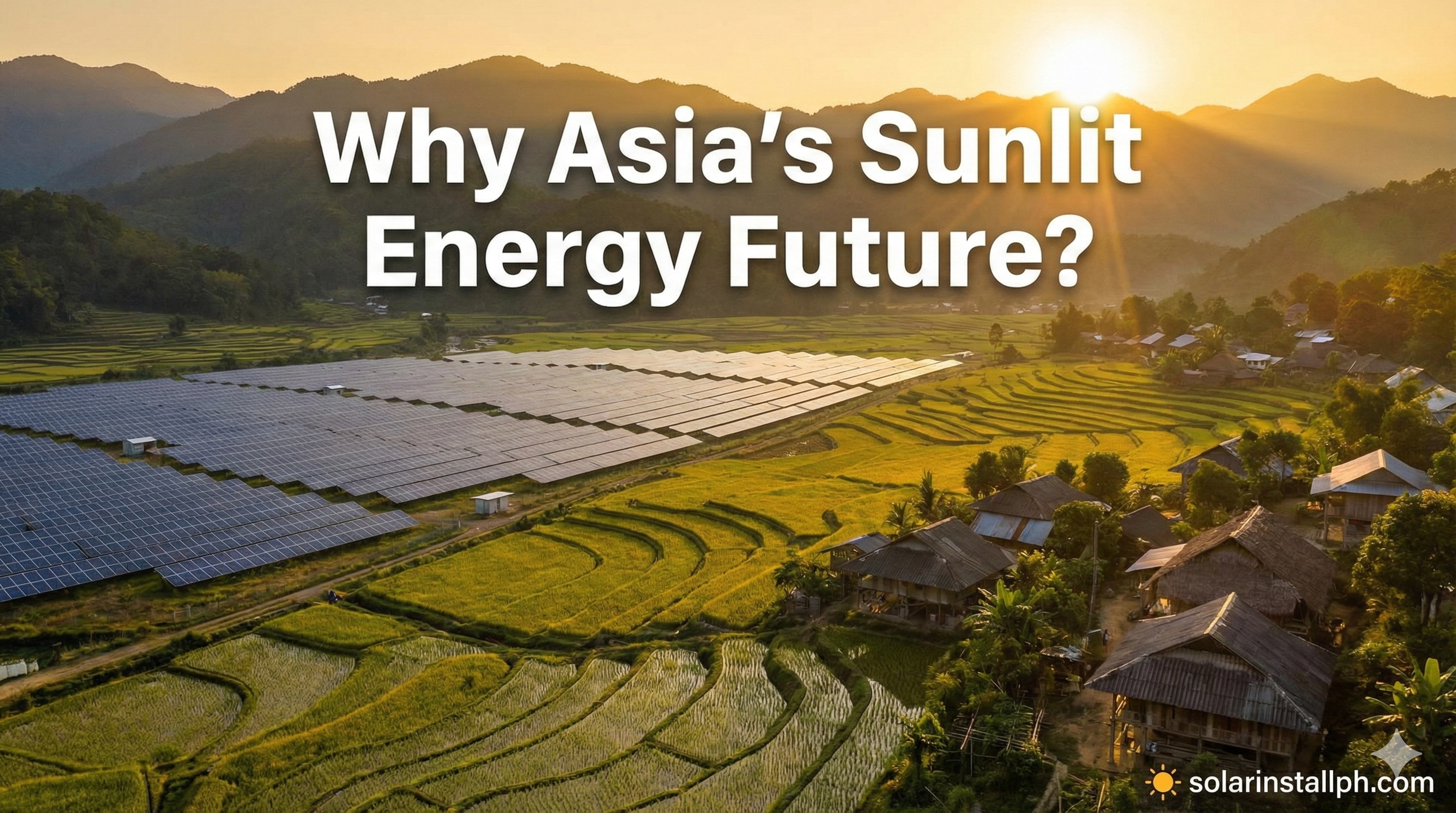
Why Asia's Sunlit Energy Future?
The narrative of global energy is shifting rapidly toward the East. Across the continent, a combination of explosive electricity demand, falling technology costs, and aggressive decarbonization targets has positioned Asia as the primary engine of the global energy transition. In the Philippines, this regional trend is more than just a headline; it is a lived reality driven by some of the highest electricity rates in Southeast Asia and a desperate need for energy security.
Asia’s solar potential is not just about the abundant sunlight hitting the equator. It is about a strategic pivot toward self-sufficiency. For a country like the Philippines, which has historically relied on expensive, imported coal and gas, the transition to a sunlit future is the only logical path to economic resilience.
The Drivers of Asia’s Solar Revolution
The "Sunlit Future" is being built on three main pillars: economic necessity, policy maturity, and technological accessibility. In 2024 and 2025, solar power became the cheapest source of new electricity generation in the Philippines, with costs now ranging between $35$ and $72$ per megawatt-hour. This is significantly lower than the cost of building new coal or gas-fired plants.
Beyond the raw numbers, several regional factors are accelerating this growth:
Energy Security: High reliance on imported fossil fuels exposes Asian economies to global price shocks. By shifting to indigenous solar, countries can stabilize their trade balances.
Rapid Urbanization: Electricity demand in Southeast Asia is growing at nearly double the global average. Solar is the only technology that can be deployed quickly enough to keep pace.
Cost-Competitive Storage: The integration of lithium-ion batteries is reaching a tipping point, making "solar-plus-storage" a viable 24/7 power solution rather than just a midday supplement.
The Philippine Context: Leading the Pack
The Philippines has emerged as the second most attractive emerging market for renewable energy investments in the world, trailing only behind India. This is not by accident. The government has aggressively opened the doors to foreign capital, allowing for 100% foreign ownership of renewable energy projects.
For the average homeowner or business, the push for solar is motivated by a simple truth: the grid is becoming increasingly expensive and unreliable. Many are turning to solar power installation in the Philippines to hedge against Meralco rate hikes and the constant threat of brownouts.
The Role of Net Metering and GEOP
Policies like the Green Energy Option Program (GEOP) and Net Metering are the bridge to this future. They allow consumers to transition from being mere "takers" of energy to active participants in the market. By feeding excess power back into the grid, homeowners can effectively lower their residential solar cost by shortening the payback period to as little as 4 to 6 years.
Large-Scale Ambition
We are also seeing massive utility-scale projects that would have been unthinkable a decade ago. The development of the world’s largest solar farm, paired with 4.5 GWh of battery storage, proves that the Philippines is ready to move beyond fossil fuels. These projects aren't just about clean energy; they are about proving that solar can handle the heavy lifting of a national grid.
Practical Realities of a Sun-Powered Archipelago
While the future is bright, the path involves navigating local complexities. Integrating solar into a grid that was never meant to handle decentralized power is one of the 5 best grid integration challenges we face today. Our geography—7,641 islands—means that a "one-size-fits-all" central grid is often inefficient.
This has led to a boom in microgrids and off-grid solutions, especially in the Visayas and Mindanao. In these areas, solar isn't just an alternative; it is often the only way to provide reliable, 24-hour electricity to remote communities.
Why the Choice of Hardware Matters
As the market grows, so does the range of available technology. To survive the Philippine climate—which includes intense humidity, salt air corrosion in coastal areas, and 20+ typhoons a year—hardware must be top-tier. Investing in premium solar brands ensures that a system actually lasts its 25-year promised lifespan. We often see "budget" systems fail after the first major storm because they lacked proper mounting or used low-grade inverters.
The Economic Impact: Beyond the Bill
The transition to solar is a massive job creator. Estimates suggest that the renewable energy shift could create up to 920,000 "green jobs" in the Philippines by 2050. These range from high-level engineering and grid management to local installation and maintenance crews.
For the business sector, solar has become a mandatory part of ESG (Environmental, Social, and Governance) compliance. Multinational corporations and BPOs are now demanding clean energy as a prerequisite for their office spaces. This demand is pushing developers to integrate solar into commercial rooftops and even building-integrated photovoltaics (BIPV).
Common Pitfalls to Avoid in 2025
As more people rush to join the sunlit future, the risk of substandard installations increases. We have seen a rise in "fly-by-night" installers who offer low prices but skip essential safety steps. To protect your investment, it is critical to verify installer credentials before signing a contract.
A proper installation must include:
Proper Wind Load Engineering: Ensuring the panels won't fly off during a Signal No. 4 typhoon.
Accurate Sizing: Avoiding the mistake of "over-installing" panels that the grid (or your bill) cannot absorb.
Permit Compliance: Skipping LGU or Bureau of Fire Protection (BFP) permits can lead to legal headaches and insurance denials later on.
Conclusion: A Future Already in Motion
The shift toward a sunlit energy future in Asia is no longer a "prospect" for the next decade—it is the baseline for this one. For the Philippines, solar represents the most viable path toward lower bills, fewer brownouts, and a cleaner environment. Whether through a small residential rooftop setup or a massive 3.5 GW solar farm, the country is proving that it can harness its most abundant resource to power its growth.
The technology is ready, the costs have dropped, and the policies are in place. The only remaining question is how fast you want to start saving.