
Sunrise Energy: 3 Tips for a Bright Future
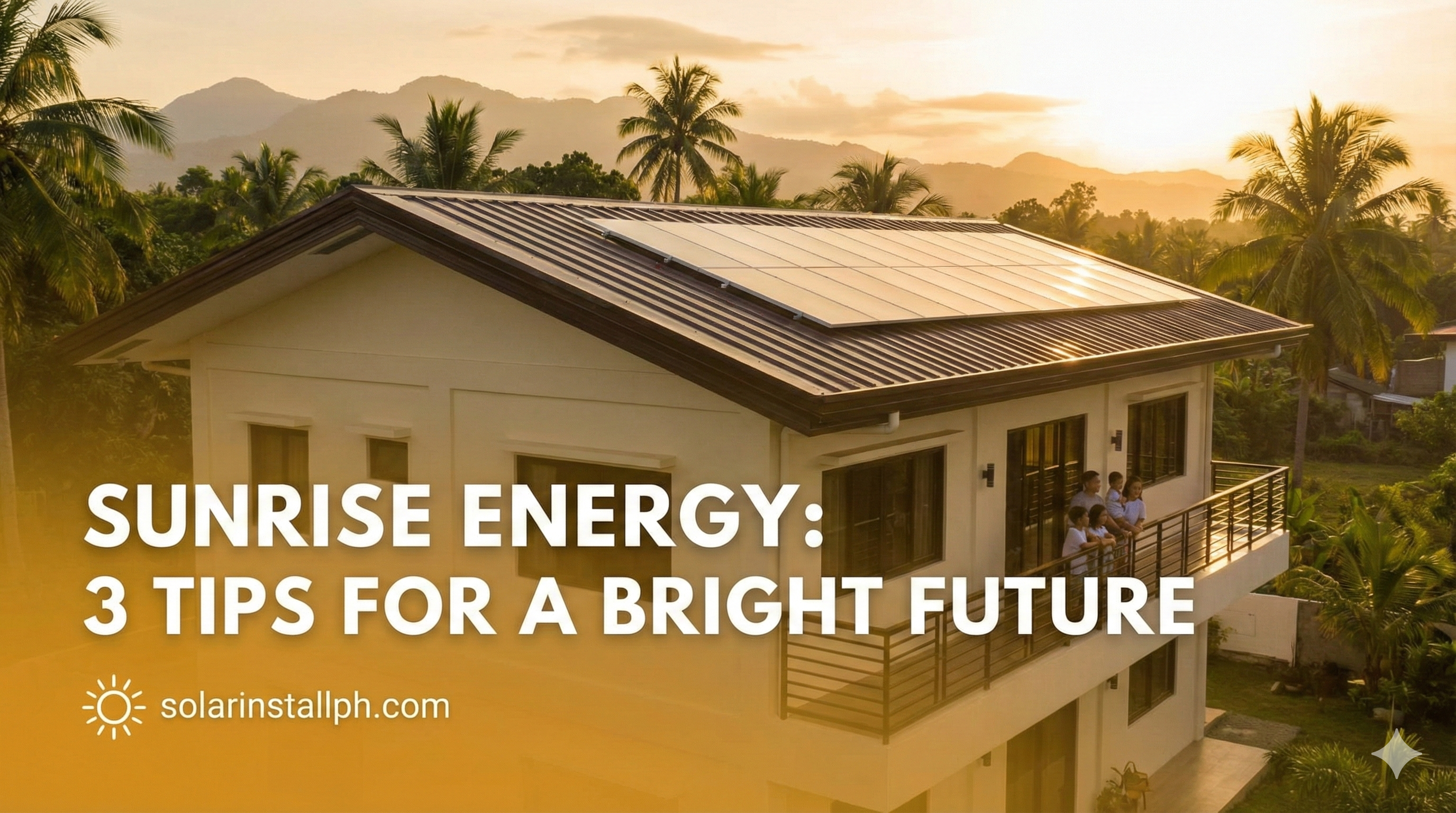
The phrase "sunrise energy" often conjures images of optimism—a clean, green dawn where your electricity bill magically disappears. But in the Philippines, where residential electricity rates from Meralco and local cooperatives consistently rank among the highest in Asia (often hitting ₱12 to ₱13 per kWh in 2025), a "bright future" isn’t about optimism. It is about calculation.
Securing a sustainable future for your home isn't just about buying solar panels; it’s about buying the right assets that survive our harsh tropical reality. If you treat solar as a generic appliance purchase, you will likely end up with a system that underperforms or, worse, becomes a roof ornament after the next super typhoon.
Here are three tips to ensure your transition to renewable energy actually delivers the financial and energy security you expect.
1. Treat Your Roof Like a Bond, Not a Battery
The most common mistake Filipino homeowners make is obsession with "off-grid" dreams before doing the math. They want to cut the wire immediately. But unless you live in a remote island province with no grid access, going fully off-grid is often a financial error.
The Economics of Grid-Tied Solar
For 90% of homes in Metro Manila, Cebu, and Davao, the "brightest" financial future comes from a Grid-Tied System with Net Metering. This setup has no batteries. It treats the grid as your virtual battery.
Daytime: You use your own solar power.
Excess: You sell the surplus to the utility (e.g., Meralco) for credits.
Nighttime: You pull from the grid, using your credits to lower the bill.
This system typically offers a Return on Investment (ROI) of 4 to 5 years. In contrast, adding batteries pushes the ROI to 7–9 years because batteries are expensive and degrade faster than panels.
Calculating Your Real Numbers
To secure your financial future, you need to look at the Levelized Cost of Energy (LCOE).
Grid Power: You pay ~₱12.00/kWh, and this rate rises with inflation and global oil prices.
Solar Power: If you pay ₱300,000 for a system that lasts 25 years, your effective cost per kWh is roughly ₱3.50 to ₱4.50.
By locking in this low rate today, you immunize your household against future rate hikes. This is the core of the "sunrise" strategy: you are pre-paying for 25 years of electricity at a 70% discount. For a detailed breakdown of how to compute these numbers for your specific bill, read our guide on solar ROI.
2. Build for the "Dark" Days (Typhoons and Corrosion)
A solar system cannot give you a bright future if it flies off your roof during a Signal No. 3 storm. The Philippines sits directly in the typhoon belt, and we have high humidity and salt air (especially in coastal areas like Cavite or Batangas).
Many "cheap" installers cut costs on the mounting structure. They use thin aluminum rails or, worse, galvanized iron that rusts within three years. When the rust sets in, the structural integrity fails. When a typhoon hits, the panels don't just break—they become projectiles that can damage your neighbor’s property.
The "Typhoon-Proof" Checklist
To ensure your system survives to see the year 2040, demand the following specs:
Wind Load Rating: Panels and mounting kits must be rated for at least 2400 Pascals (Pa) of wind load. In typhoon-prone zones (Bicol, Samar, Leyte), ask for 5400 Pa.
Mounting Material: Ensure the installer uses Aluminum 6005-T5. It is stronger and more corrosion-resistant than the standard 6063 alloy often used in window frames.
Clamping Strategy: Standard installations use 4 clamps per panel. For high-wind zones, reputable installers will use 6 clamps or verify that the rail positioning hits the optimal zones on the panel frame.
If you are unsure how to evaluate the structural safety of a proposal, review our specific insights on typhoon-resistant mounting.
A Note on Batteries
While I advised against batteries for financial ROI, they are essential for energy security if you live in an area with frequent brownouts (like parts of Mindoro or areas serviced by smaller coops). In this case, you are buying a Hybrid System. The value here isn't monetary savings; it's the ability to keep your fridge running and your lights on when the grid fails.
If you decide to invest in storage, avoid Lead Acid (Deep Cycle) batteries. They look cheap upfront but die in 2–3 years. The industry standard is now Lithium Iron Phosphate (LiFePO4), which can last 10+ years. To understand the cost differences and sizing, check our comparison of solar batteries in the Philippines.
3. Legistimize Your System (Don't Skip Net Metering)
The "Wild West" days of solar are over. The Energy Regulatory Commission (ERC) and Distribution Utilities (DUs) are cracking down on "guerrilla" solar installations—systems connected to the grid without permits.
The Risk of "Colorum" Solar
Some installers will tell you to skip the permits to save money and time. They might install a "zero export" device to hide the system from Meralco.
Financial Loss: Without Net Metering, you throw away 30–50% of your potential savings. Every kWh you generate but don't use at noon is wasted.
Fire Hazard: Unpermitted systems often skip the Certificate of Final Electrical Inspection (CFEI). If your house catches fire (even unrelated to solar), your insurance company can deny your claim because you have an unauthorized electrical modification.
The Correct Process
To have a truly bright future, you need a "Yellow Card" (in Meralco areas) or a Net Metering agreement. This ensures:
Your meter is replaced with a bi-directional one.
Your lines are checked for safety (transformer capacity).
You legally earn credits for exports.
The process involves dealing with the LGU for the electrical permit and the utility for the Distribution Impact Study (DIS). It is tedious, often taking 3–6 months. However, it is the only way to maximize your savings legally. We break down the step-by-step application in our Meralco Net Metering guide.
Choosing the Right Partner
Because the permitting process is complex, the most important decision you make is not the brand of the panel, but the quality of the installer. You need a company that has engineers (PEE/REE) who can sign blueprints and staff dedicated to liaison work.
Do not trust a "man with a van" who promises a system installed tomorrow for half the price. Look for track records and proper accreditation. You can start by verifying if they are on the list of DOE-accredited installers or have a solid portfolio of legal, net-metered projects.
Conclusion
"Sunrise energy" is more than a slogan; it is a description of the opportunity available to every Filipino homeowner right now. You have the chance to pre-buy your electricity at ₱4/kWh while your neighbors pay ₱13/kWh.
But this future is only bright if you approach it with pragmatism. Focus on the ROI of grid-tied systems, demand typhoon-rated hardware, and refuse to cut corners on permitting. Solar is a 25-year relationship with your roof—make sure it’s a happy one.