
Business Sun Power Funding: 3 Ways
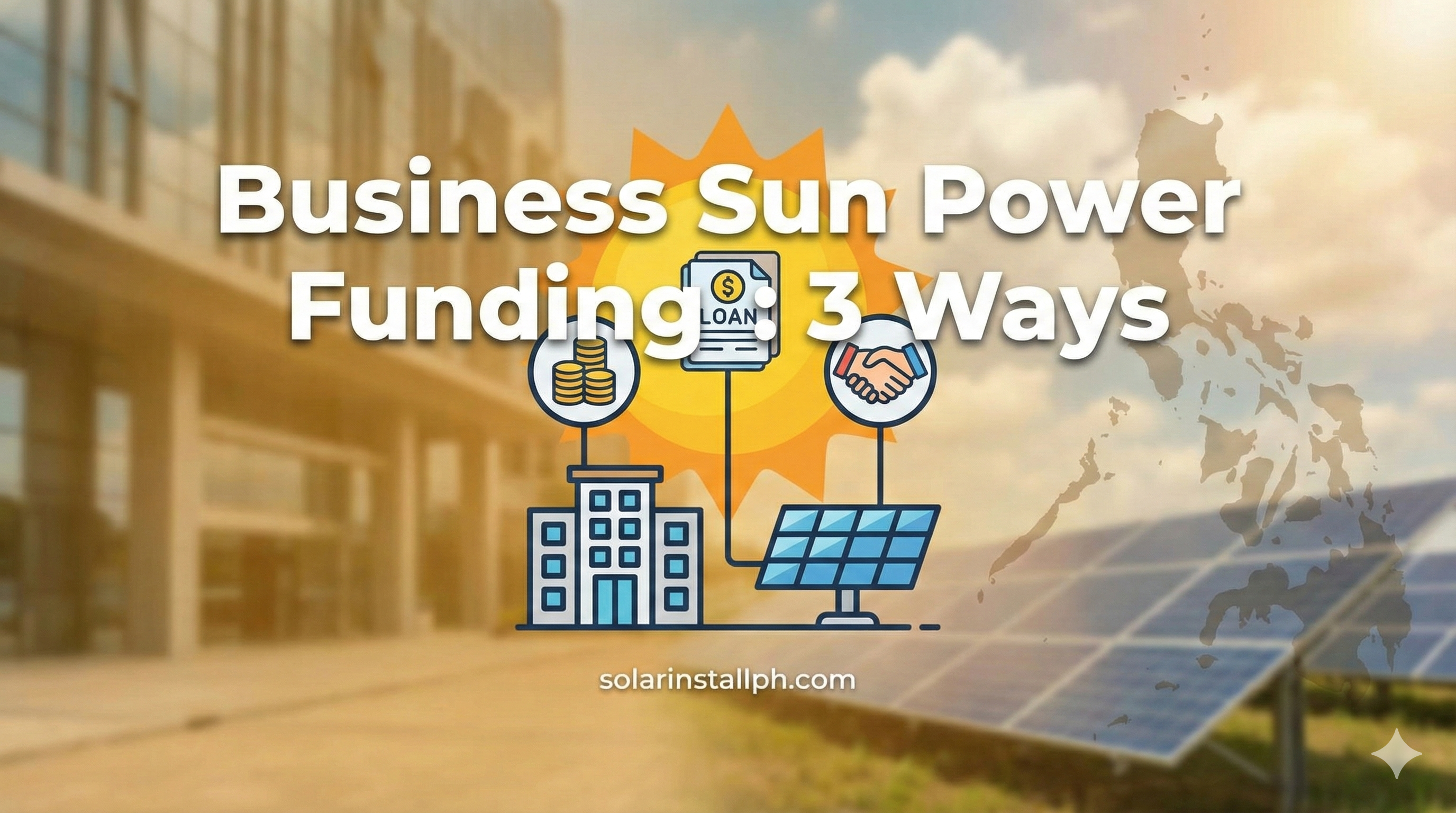
For Philippine business owners in 2025, solar is no longer just a Corporate Social Responsibility (CSR) slide. When you are paying Meralco or your local coop ₱11 to ₱14 per kWh, solar becomes a raw bottom-line strategy.
It is a hedge against inflation and a way to stabilize operating expenses. But the elephant in the room is always the upfront cost. A 100kWp system for a medium-sized factory or warehouse doesn't come cheap, often ranging between ₱3.5 million to ₱5 million depending on the hardware tier.
The good news? You don’t always have to pay cash. The financial landscape for renewable energy in the Philippines has matured. Banks are hungry for green portfolios, and third-party investors are actively looking for rooftops to lease.
Here are the three primary ways to fund your shift to solar, ranked by financial control.
1. The CapEx Route (Cash Purchase)
This is the traditional "buy and own" model. You pay 100% of the project cost upfront—usually in milestones (down payment, delivery, installation, commissioning).
Who this is for: Cash-rich SMEs, established corporations with healthy liquidity, or businesses looking to heavily depreciate assets for tax purposes.
The Math
If you pay cash, your Return on Investment (ROI) is the fastest. With current Philippine electricity rates, a well-designed commercial system often pays for itself in 3.5 to 5 years. After that payback period, the electricity generated is effectively free (minus minimal maintenance) for the remaining 20+ years of the system's life.
Pros:
Maximum savings: You keep 100% of the energy savings.
Asset ownership: The system adds value to your property.
Tax benefits: You can claim depreciation on the equipment.
Cons:
Heavy cash outflow immediately.
You are responsible for Operations & Maintenance (O&M), though most installers offer packages for this.
For a deeper dive into the numbers, read our breakdown of commercial solar costs.
2. Bank Financing (Green Loans)
If you want to preserve your cash flow for inventory or expansion, this is the middle ground. Philippine banks have become significantly more aggressive with "Green Energy" financing products in the last two years.
Who this is for: Businesses that want to own the system but prefer to spread the cost over 5 to 7 years.
Major players like BPI (Green Solutions), BDO, and Landbank have specific renewable energy loan windows. Unlike standard business loans, these often come with:
Longer tenors (up to 7–10 years).
Slightly better interest rates than standard commercial loans.
Grace periods on principal payments (sometimes).
The "Bill Swap" Strategy
The goal here is to structure the loan so that your monthly amortization is equal to or less than your electricity bill savings.
Scenario: Your factory saves ₱100,000/month on electricity with solar.
Loan: If your loan payment is ₱90,000/month, you are cash-flow positive from Day 1 without touching your capital.
Be prepared for the paperwork. Banks will require a feasibility study, a credible installer track record, and sometimes collateral (though some programs now treat the solar equipment itself as partial collateral).
You can check the specific requirements in our guide to solar bank loans.
3. The Zero CapEx Route (PPA or Lease)
This is the "Solar as a Service" model. In a Power Purchase Agreement (PPA) or a Solar Lease, you do not pay for the panels. A third-party investor (the system owner) installs, operates, and maintains the solar system on your roof at their cost.
In exchange, you sign a contract (usually 15 to 25 years) to buy the power generated by that system at a rate lower than the grid.
Who this is for: Large facilities (usually requiring 100kWp+ or 500kWp+ roof space) that want risk-free savings and zero maintenance headaches. Multinational corporations often prefer this to avoid putting assets on their own books.
How it Works
Grid Rate: ₱12.00 / kWh
PPA Rate: ₱9.50 / kWh (fixed or escalating slightly)
Your Savings: ₱2.50 for every kWh the solar system produces.
If the inverter breaks in Year 8, the investor pays to replace it, not you. If the system underperforms, you don't pay for the missing power (in a PPA model).
Pros:
₱0 down payment.
Immediate OpEx reduction.
Zero technical risk or maintenance costs.
Cons:
Long-term contract lock-in (15–20 years).
Lower total lifetime savings compared to owning (since you share the profit with the investor).
Strict credit checks and roof size requirements (most investors won't do this for small 10kW systems).
For a broader look at how these agreements fit into the market, see our article on financing options.
Don't Forget Government Incentives
Regardless of how you fund it, the Philippine government offers fiscal incentives that can sweeten the deal, primarily under the Renewable Energy Act (RA 9513) and the Energy Efficiency and Conservation Act (RA 11285).
If you register your project with the Board of Investments (BOI), you may be eligible for:
Income Tax Holiday (ITH): Exemption from income tax for the first few years of operation.
Duty-Free Importation: Reducing the cost of importing panels and inverters (though many reputable installers handle this).
Navigating BOI registration takes time and effort, but for large commercial projects, the tax savings are substantial. Learn more about tax incentives.
Which Path Is Right for You?
To decide, look at your "Opportunity Cost of Capital."
High Opportunity Cost: If investing ₱5M in your core business (e.g., new machinery, new branches) yields a 30% return, do not spend cash on solar. Use Bank Financing or a PPA.
Low Opportunity Cost: If your cash is sitting in a savings account earning 1-2%, buy the solar system via Cash Purchase. The 20%+ ROI from solar beats the bank rate easily.
The "Hidden" ROI Factor
Remember that solar ROI isn't just about the system cost; it's about the avoided cost of energy. As Meralco rates rise, your savings increase, accelerating your payback period. A system calculated to pay back in 5 years might pay back in 4 if rates spike. Review our return on investment analysis to run your own numbers.
Conclusion
The era of solar being "too expensive" for Philippine businesses is over. Whether you have the capital to buy outright, the credit standing to borrow, or the roof space to attract an investor, there is a funding mechanism that fits.
The most expensive option right now is doing nothing and continuing to pay full price for grid electricity.
Next Step: Gather your last 12 months of electricity bills. Check your peak demand (kW) and total consumption (kWh). This data is the prerequisite for any installer, bank, or investor to give you a quote.