
Why Finance Your Rooftop?
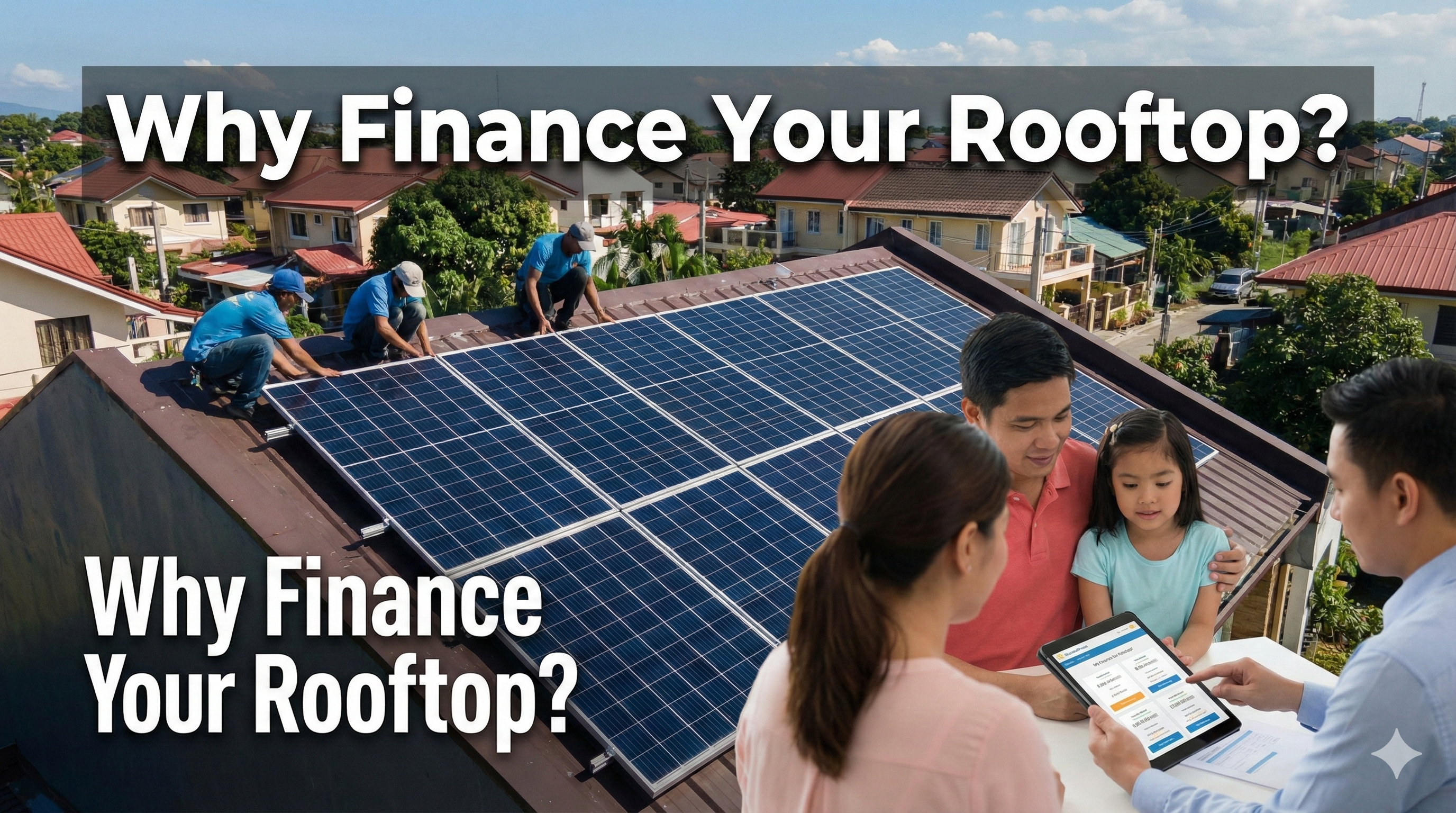
If you have been researching solar for more than a week, you have likely hit the "sticker shock" phase.
You look at a quote for a 5kW hybrid system—maybe ₱350,000 to ₱400,000—and your first instinct is to flinch. It is a massive chunk of change. The natural reaction is to say, "I’ll wait. I’ll save up for a year or two and pay cash so I don't have to deal with interest."
In almost any other purchase—a car, a renovation, a new TV—paying cash is the financially responsible move.
Solar is the exception.
In the Philippines, where electricity rates are among the highest in Asia, waiting to buy solar is often more expensive than paying interest on a loan. When you finance a rooftop system, you aren't just taking on debt; you are swapping a variable, rising expense (your Meralco bill) for a fixed, finite asset payment.
Here is why financing your solar installation is often the smarter mathematical play in 2025.
The "Wait and Save" Trap
Let’s look at the math of waiting.
Suppose you want a system that costs ₱300,000. You decide to save ₱12,500 a month for two years to buy it in cash. That sounds prudent.
But while you are saving that money, you are still paying your electric utility. If your average bill is ₱10,000, over those 24 months, you will hand over ₱240,000 to the utility company. That is money burned. You never get it back.
If you had financed that system on Day 1:
You would have stopped paying the ₱10,000 bill immediately.
Your loan payments would have gone toward owning the hardware on your roof.
By waiting two years to "save money," you actually lost nearly a quarter-million pesos in sunk electricity costs. This is the opportunity cost of delay. In the solar game, time is literally money.
The "Bill Swap" Strategy
The ideal financing scenario is what we call the "Bill Swap."
The goal is to structure your loan so that your monthly amortization is roughly equal to (or lower than) your current electricity bill.
Old Scenario: You pay Meralco ₱12,000/month. That rate will likely go up next year. You have zero equity.
New Scenario: You pay the bank ₱11,500/month for a solar loan. That rate is fixed for 3 or 5 years. After the term ends, you pay ₱0.
Even if the loan payment is slightly higher than your current bill (e.g., ₱13,000 loan vs. ₱12,000 bill), you are still winning. Why? Because the loan payment is finite. It has an end date. Your utility bill does not.
To see if a bill swap is realistic for your specific energy usage, check our guide on residential solar system costs to estimate the upfront price you need to finance.
Inflation-Proofing Your Budget
We all felt the sting of rate hikes in 2024. The generation charge fluctuates wildly based on global coal prices and the foreign exchange rate.
When you stick with the grid, you are exposed to 25 years of inflation. A ₱10,000 bill today could easily be ₱18,000 in ten years.
When you finance solar, you lock in your price.
If you take a 5-year loan, your payment in Year 4 is exactly the same as in Year 1. You have effectively immune-proofed a major part of your household budget against inflation. While your neighbors complain about the latest rate hike, your cost of power remains flat.
Financing Options in the Philippines (2025)
Ten years ago, banks wouldn't touch solar. Today, you have multiple avenues to fund your transition.
1. Bank Loans (Green Financing)
Major Philippine banks like BPI and RCBC now offer dedicated "Green Loans" or solar-specific financing.
Pros: Lower interest rates (often much better than personal loans). Some, like BPI, allow you to "top up" your existing housing loan for solar improvements.
Cons: Strict paperwork. You will need income documents, collateral (sometimes), and patience. The approval process can take weeks.
Best For: Homeowners with good credit who want the lowest possible interest rate.
For a deeper dive into these products, read our breakdown of bank solar loan options.
2. Credit Card Installments
This is the most popular method for systems under 5kW. Many installers partner with major banks to offer 0% interest installment plans for 12, 24, or even 36 months.
Pros: Instant approval. No extra collateral needed. "0% interest" is psychologically easier to swallow (though often the cash price would have been lower).
Cons: Limits are usually lower (₱200k–₱300k). If you miss a payment, the penalties are severe.
Best For: Smaller systems or "starter" setups.
3. Pag-IBIG Home Improvement Loan
Yes, you can use Pag-IBIG. The Home Improvement Loan explicitly covers "installation of solar panels".
Pros: Favorable interest rates and long repayment terms (up to 30 years, though shorter is recommended for solar equipment).
Cons: The process is bureaucratic. You treat it like a house construction loan—permits, bill of materials, and collateral are required. It is not quick.
Best For: Members who are already familiar with the Pag-IBIG ecosystem and have the patience for government processing.
Learn exactly what documents you need in our article on Pag-IBIG solar loan requirements.
4. Installer In-House Financing
Some larger solar companies offer their own payment terms.
Pros: Very easy approval. Seamless integration with the installation contract.
Cons: Often requires a significant down payment (30–50%). The effective interest rate is usually higher than a bank loan.
Best For: Business owners who want to keep their bank lines open for other uses.
Check if this route suits you by reading about installer in-house financing.
When Financing Doesn't Make Sense
I’m a solar advocate, but I’m also a realist. Financing isn't for everyone.
1. Your bill is below ₱5,000.
At this level, the savings are small. If you finance a small system, the bank fees and interest might eat up your entire savings margin. For small bills, cash (or staying on the grid) often makes more sense.
2. You plan to move in 2 years.
While solar adds property value, it’s not liquid. If you sell the house, you might not recoup the full cost of the system immediately, and transferring the loan can be a headache.
3. The interest rate is predatory.
If an installer offers you financing with an effective interest rate of 20%+, run. You are just transferring your payments from Meralco to a loan shark. The math only works if the cost of money is reasonable.
Conclusion
The decision to go solar is no longer just an environmental one; it is a financial leverage play.
Every day you wait to buy solar, you are paying for it anyway—you’re just paying the utility company instead of paying yourself. By using financing smarts, you can stop the bleeding immediately. You trade a permanent, unpredictable bill for a temporary, fixed investment.
Five years from now, when the loan is fully paid and your panels are still producing free power for another two decades, you will look back at the financing paperwork as the best investment contract you ever signed.
Need to run the numbers?
Before you apply for a loan, make sure you know your target payback period. Use our guide on return on investment (ROI) to calculate exactly how fast your system will pay for itself.