
Tropical Inverters: Top 5 Tough Picks
The Philippines is a graveyard for sensitive electronics.
Between the salt spray in Cebu, the 90% humidity in Manila, and the relentless heat of the Tuguegarao sun, standard appliances struggle to survive. But for solar inverters, the environment is even more hostile.
In Europe or the US, an inverter might sit comfortably in a cool basement. Here, it is often mounted on a hot garage wall, exposed to dust, typhoons, and our number one solar killer: the house gecko (butiki).
If you are buying a solar system in 2025, you cannot just look at efficiency ratings. You need armor. You need an inverter designed to survive the "Tropical Test."
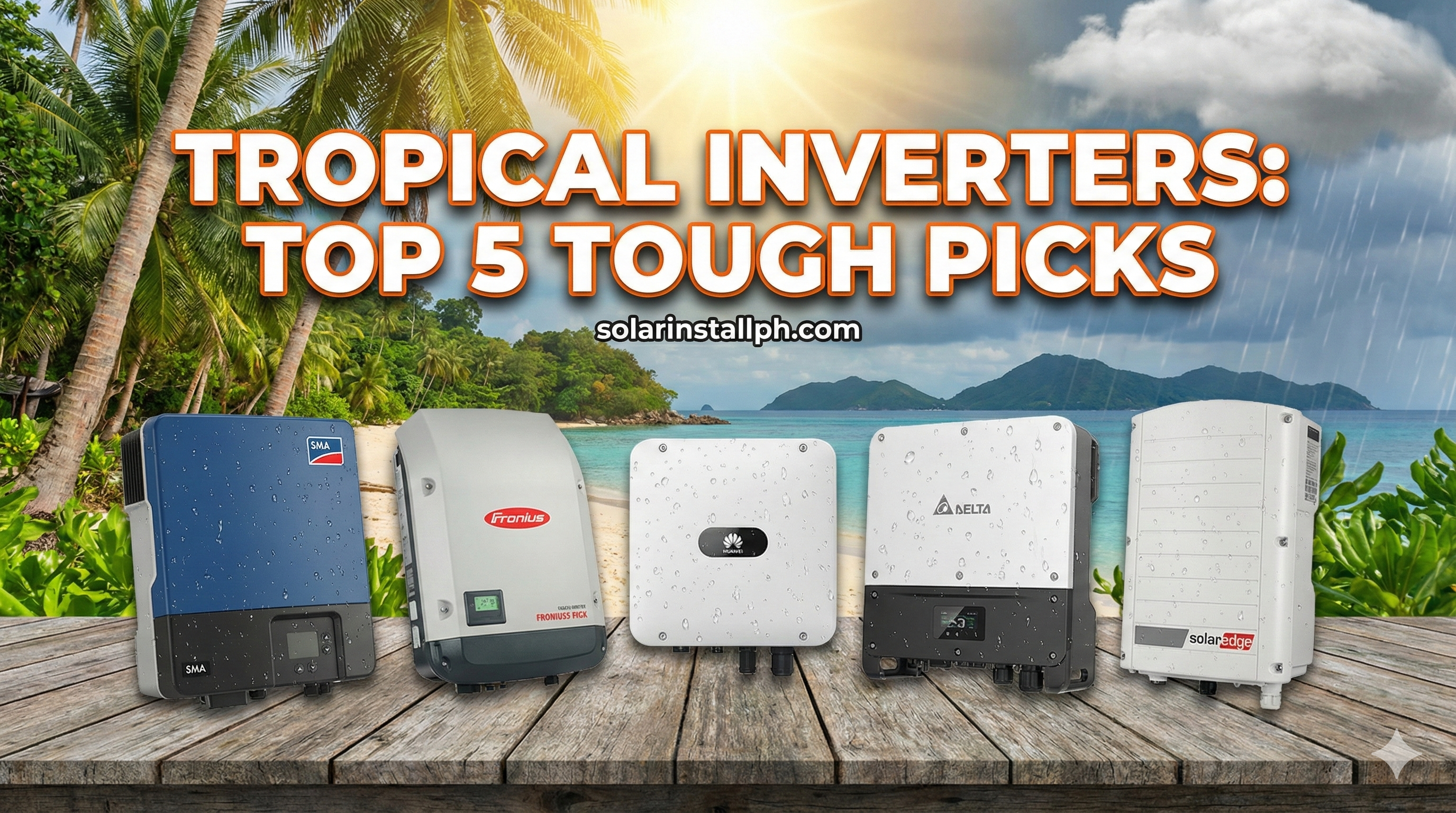
Here are the top 5 toughest inverters available in the Philippines, ranked by their ability to handle our specific environmental threats.
1. Sungrow SG Series (The "Coastal King")
Best For: Beach resorts, coastal homes, and industrial zones.
If you live within 5km of the ocean, salt mist is your enemy. It eats through standard aluminum casings and corrodes internal circuits in just a few years.
Why It Survives:
Sungrow has become a favorite for Philippine commercial installers because of one specific spec: C5 Corrosion Protection.
While most standard inverters are rated C3 (medium protection), Sungrow’s SG series (like the SG5.0RS or commercial SG125CX) is built to the C5 standard. This means the casing and heat sink are coated with specialized anti-corrosion layers designed for "High Salinity" environments.
They also feature a separate chamber design. The cooling channel (where air flows) is physically isolated from the electrical chamber (where the circuits live). This prevents salt-laden air from ever touching the sensitive motherboards.
Learn more about how brands compare in our guide to top inverter brands for 2025.
2. Huawei SUN2000 (The "Sealed Fortress")
Best For: Lizard-prone areas and dusty provinces.
Ask any veteran Philippine solar installer what kills inverters, and they won't say "voltage spikes." They will say "lizards." Geckos love the warmth of an inverter. They crawl inside through ventilation fans, touch two live contact points, and zap—your ₱80,000 investment is fried.
Why It Survives:
Huawei’s residential inverters (SUN2000 L1/M1 series) are fanless and fully sealed. They use natural convection cooling with a massive heat sink on the back.
Because there are no external fans sucking air inside, there are no easy entry points for insects, geckos, or dust. The unit is rated IP66, meaning it is dust-tight and can handle powerful water jets.
Additionally, Huawei includes AFCI (Arc Fault Circuit Interrupter) technology. If a rat chews a wire on your roof and causes a spark, the inverter detects the "electrical noise" and shuts down instantly to prevent a fire—a crucial safety feature for older Filipino homes with wood trusses.
Read our full analysis in this Huawei inverter review.
3. Enphase IQ8 Microinverters (The "Roof Warrior")
Best For: Roofs with complex shading or extreme weather exposure.
Standard string inverters sit on a wall. Enphase microinverters sit directly on the roof, underneath the solar panels. This sounds dangerous—isn't it hotter up there?
Why It Survives:
Enphase units are built differently. They are encased in a double-insulated, corrosion-resistant polymer housing (not metal) and are filled with potting compound. This "potting" means the internal electronics are literally buried in a solid resin.
There is no air inside an Enphase unit. No air means no condensation, no corrosion, and absolutely zero space for a lizard to enter. They are rated IP67 (can be submerged in water) and are tested to withstand the intense heat cycles of a rooftop environment.
If you are worried about a single point of failure (like one main inverter dying), Enphase is the ultimate decentralized tank. If one unit fails, the rest keep working.
Check if this tech is right for you in our Enphase microinverters guide.
4. Fronius GEN24 Plus (The "Heat Beater")
Best For: Hot garages and performance enthusiasts.
While Huawei and SMA rely on passive cooling (no fans), Fronius (Austria) takes the opposite approach: Active Cooling.
Why It Survives:
In the Philippines, passive cooling has limits. If the ambient temperature in your garage is 40°C, a fanless inverter might "derate" (throttle down power) to protect itself.
Fronius uses a microprocessor-controlled fan system to force air over the cooling fins. This keeps the internal components significantly cooler than passive units during peak noon generation. Cooler electronics generally last longer.
But what about lizards? Fronius knows this. Their active cooling intakes are protected by fine mesh screens, and the actual circuit boards are conformal coated to resist humidity and dust accumulation. If you want maximum production on the hottest days of April, active cooling is a proven winner.
For more on system longevity, see our article on solar system lifespan.
5. SMA Sunny Boy (The "Old Reliable")
Best For: Remote areas where reliability is the only metric.
SMA is the German legend. Before the Chinese giants took over, SMA was the only name in town. They are still the go-to for remote off-grid or bad-grid areas because they are virtually indestructible.
Why It Survives:
The Sunny Boy series is famous for its ShadeFix technology and robust build quality. Like Huawei, they often use passive cooling (conformal coating on boards, big heat sinks) to minimize moving parts.
But their "toughness" comes from their grid handling. Philippine grids are "dirty"—voltage fluctuates wildly. SMA inverters have some of the widest operating voltage windows and strongest protection relays in the industry. They don't just survive the weather; they survive the utility company.
Their Secure Power Supply (SPS) feature also allows you to pull up to 2,000W of power directly from the sun during a brownout without batteries—a unique survival feature for daytime outages.
Curious about how warranties stack up? Read our panel warranty comparison which also touches on system reliability principles.
Summary: Which Toughness Do You Need?
Live near the sea? Get Sungrow (C5 protection).
Have a lizard problem? Get Huawei (Sealed IP66).
Want zero single point of failure? Get Enphase (IP67 Potting).
Want max power in 40°C heat? Get Fronius (Active Cooling).
Have unstable grid voltage? Get SMA (Grid Durability).
Don't buy an inverter based on the brochure photos. Buy it based on what is crawling on your ceiling and how salty your air is.