
DOE Project Permitting: 7 Steps
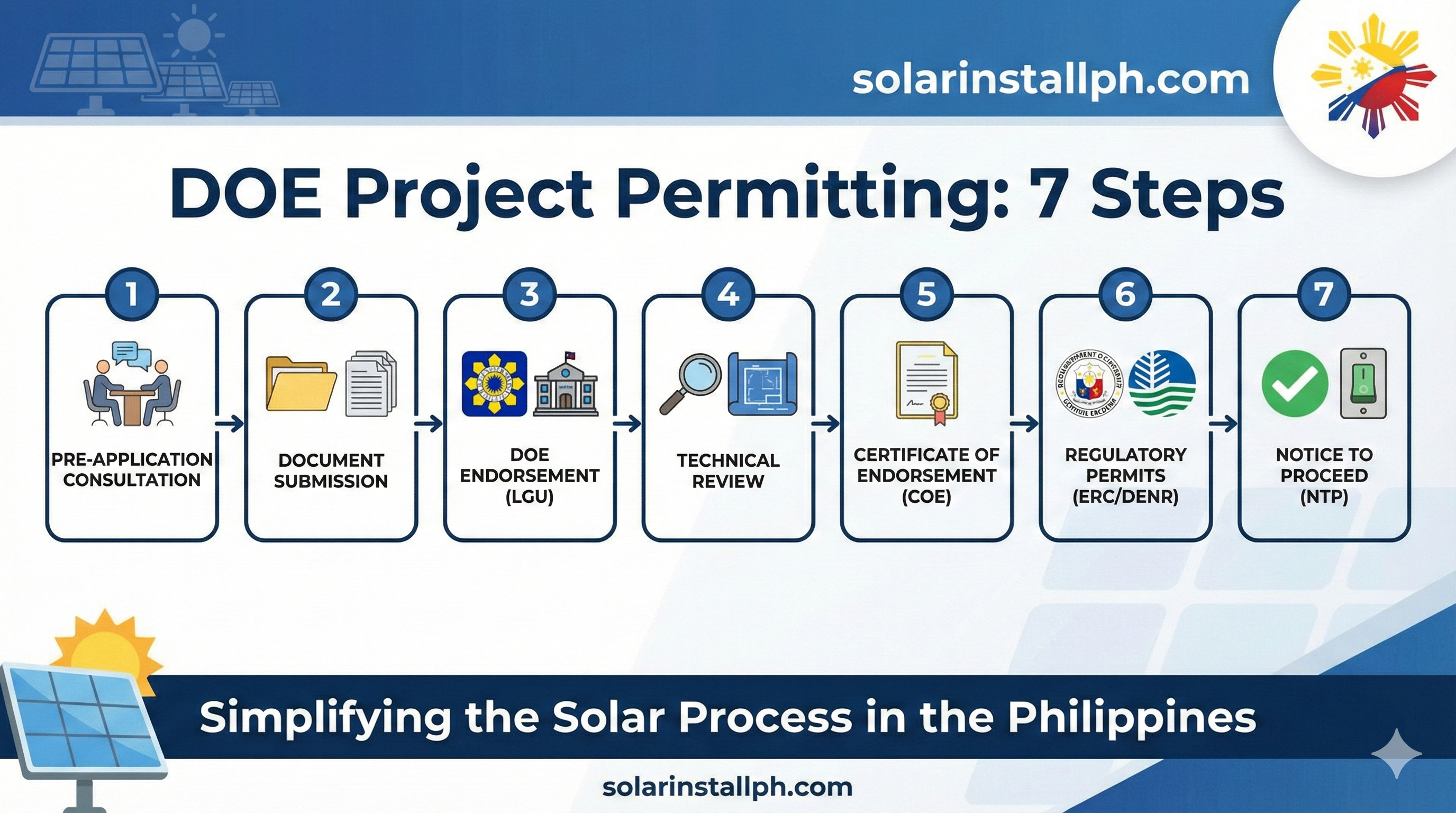
If you are a homeowner looking to put 10 panels on your roof, stop reading. You need an LGU permit, not a DOE service contract. (Go read our guide on LGU solar permits instead).
But if you are a developer, an industrial facility owner, or an investor planning a commercial-scale solar project (Solar Farm, large Floating Solar, or a massive industrial roof >100kW intended for the Spot Market), you are entering a different league. You are not just building a structure; you are applying for the state-granted privilege to harvest a natural resource.
This requires a Solar Energy Operating Contract (SEOC) from the Department of Energy (DOE).
The rules changed significantly in mid-2024. The DOE released Department Circular DC2024-06-0018 (Revised Omnibus Guidelines), which overhauled the old "first-come, first-served" gridlock.
Here is the practitioner’s guide to the new 7-step DOE permitting process in 2025.
The "Game Changer": The Certificate of Authority (COA)
Before we start, you must understand the biggest shift in the 2025 landscape.
Previously, you had to sign the full 25-year Service Contract just to start getting permits. Now, the DOE issues a Certificate of Authority (COA) first. This is a temporary "license to hunt." It gives you 1 year (for land-based solar) to secure all other permits (DENR, NCIP, LGU) before the DOE grants you the final 25-year contract.
This filters out the "paper traders" who hoard contracts but never build. If you don't perform within the COA period, you lose the area.
Step 1: The EVOSS Registration & Letter of Intent
In 2025, you cannot just walk into the DOE records division in Taguig with a box of files. Everything starts digitally.
You must register an account with the Energy Virtual One-Stop Shop (EVOSS). This is the government's centralized portal for tracking energy applications.
The Action: Upload your Letter of Intent (LOI) addressing the DOE Secretary.
The Detail: The LOI must specify the location (tech description) and the capacity you intend to develop.
Practitioner Note: Do not just "guess" the coordinates. If your polygon overlaps by even one meter with an existing contract, your application will be rejected immediately.
Step 2: Area Verification (The "Blocking" Check)
Before you spend money on lawyers and engineers, you need to know if the land is legally available. The Philippines uses a "Blocking System" for renewable energy areas.
The Process: Once your LOI is in EVOSS, the Information Technology and Management Services (ITMS) division checks your coordinates against the Solar Energy Blocking Map.
The Risk: Many prime areas in Luzon (especially near NGCP substations) are already "blocked off" by existing solar farm developers or pending applications.
The Output: If the area is open, you get a "go-signal" to proceed to the full application. If it’s taken, you must find a new site.
Step 3: The "Big Three" Documentation Submission
This is the heavy lifting. You must upload three distinct folders of requirements into EVOSS. If one document is non-compliant, you get a "deficiency notice" that pauses your clock.
A. Legal Requirements
SEC Registration: You must be a registered corporation.
By-Laws & GIS: Latest General Information Sheet.
Ownership Rules: Under the new guidelines, 100% foreign ownership is now allowed for solar development (a massive change from the old 60/40 rule), unless you are buying the land directly.
B. Technical Requirements
Work Program: A 5-year Gantt chart showing how you will develop the project.
Site Analysis: Preliminary solar irradiance data (using software like PVSyst or Solargis) proving the site is viable.
Grid Connection Plan: A rough scheme of how you will connect to the nearest NGCP or DU substation.
C. Financial Requirements
Audited Financial Statements (AFS): You must prove you have the cash.
Working Capital: You need to show available funds (or a credit line) sufficient to cover your Year 1 Work Program.
The Calculation: If your Year 1 plan costs ₱50 Million, your bank certification must show at least ₱50 Million.
For a deeper dive on the costs you need to prepare for, review our breakdown of solar farm investment economics.
Step 4: Financial Evaluation & Fees
Once you upload the "Big Three," the Renewable Energy Management Bureau (REMB) evaluates them.
The Fee: If your docs pass the initial check, you will be issued an Order of Payment. The application fee is roughly ₱1.00 to ₱5.00 per kW applied for, depending on the scale.
The Waiting Game: Under the EVOSS law, agencies have strict timelines. However, "strict" in government terms can still mean weeks of back-and-forth clarifications regarding your financial ratios.
Step 5: Issuance of Certificate of Authority (COA)
If you pass the legal, technical, and financial checks, the DOE Secretary signs your Certificate of Authority (COA).
Congratulations. You now have the exclusive right to that area for 1 year (for land-based solar).
What this means: No one else can apply for a solar project on your land coordinates.
The Clock: Your 1-year countdown starts immediately. You must use this time to get the "downstream" permits.
Step 6: The "Downstream" Permit Hunt
This is where the real work happens. You are not dealing with the DOE here; you are dealing with everyone else. You must secure these to convert your COA into a full contract:
NCIP (National Commission on Indigenous Peoples): You need a Certificate of Non-Overlap (CNO) or, if you are in an Ancestral Domain, full Free Prior and Informed Consent (FPIC). This is often the longest step.
DENR (Environment): You need an Environmental Compliance Certificate (ECC).
LGU Endorsements: Resolutions of Support from the Barangay and Municipal/City Council.
Land Rights: Proof that you own the land or have a lease agreement (Surface Rights).
Warning: Many developers fail here. They get the DOE COA but get stuck in local politics or land disputes. Ensure you understand the DOE solar policies regarding land conversion before you commit.
Step 7: The Solar Energy Operating Contract (SEOC)
Once you upload all the Step 6 permits into EVOSS before your 1-year COA expires, the DOE will convert your status.
The Signing: You will sign the Solar Energy Operating Contract (SEOC).
The Term: This grants you 25 years (renewable for another 25) of incentives, including the 7-year Income Tax Holiday (ITH) and duty-free importation of equipment.
The Performance Bond: You must post a bond (cash or surety) guaranteeing that you will actually build the plant.
A Note on "Own-Use" Projects
If you are a factory owner wanting to install a 500kW rooftop system just for your own consumption (no export to the grid), do you need to do all this?
Generally, no.
For "Own-Use" projects, the process is simplified. You apply for a Certificate of Registration (COR) for Own-Use, not a full commercial SEOC.
You still get the tax incentives.
You skip the intense "Blocking" and "Service Contract" negotiations because you aren't selling power to the public.
However, if you plan to sell excess power via the Spot Market, you revert to the Commercial SEOC rules.
For businesses looking at this scale, checking the commercial solar cost benchmarks is critical to see if the administrative effort of DOE registration is worth the tax breaks.
Conclusion
The DOE permitting process in 2025 is more structured but arguably stricter than in the past. The Certificate of Authority mechanism forces developers to be serious—you can no longer "squat" on a solar service contract for years without permits.
If you are planning a project, your first move is not buying panels; it is hiring a competent liaison or legal team who understands the EVOSS ecosystem. The best hardware in the world won't generate a single watt if your folder gets stuck in Step 2.
To find legitimate professionals who can navigate this, you can consult the DOE solar directory for accredited entities.