
DIY System Care: Collected Wisdom
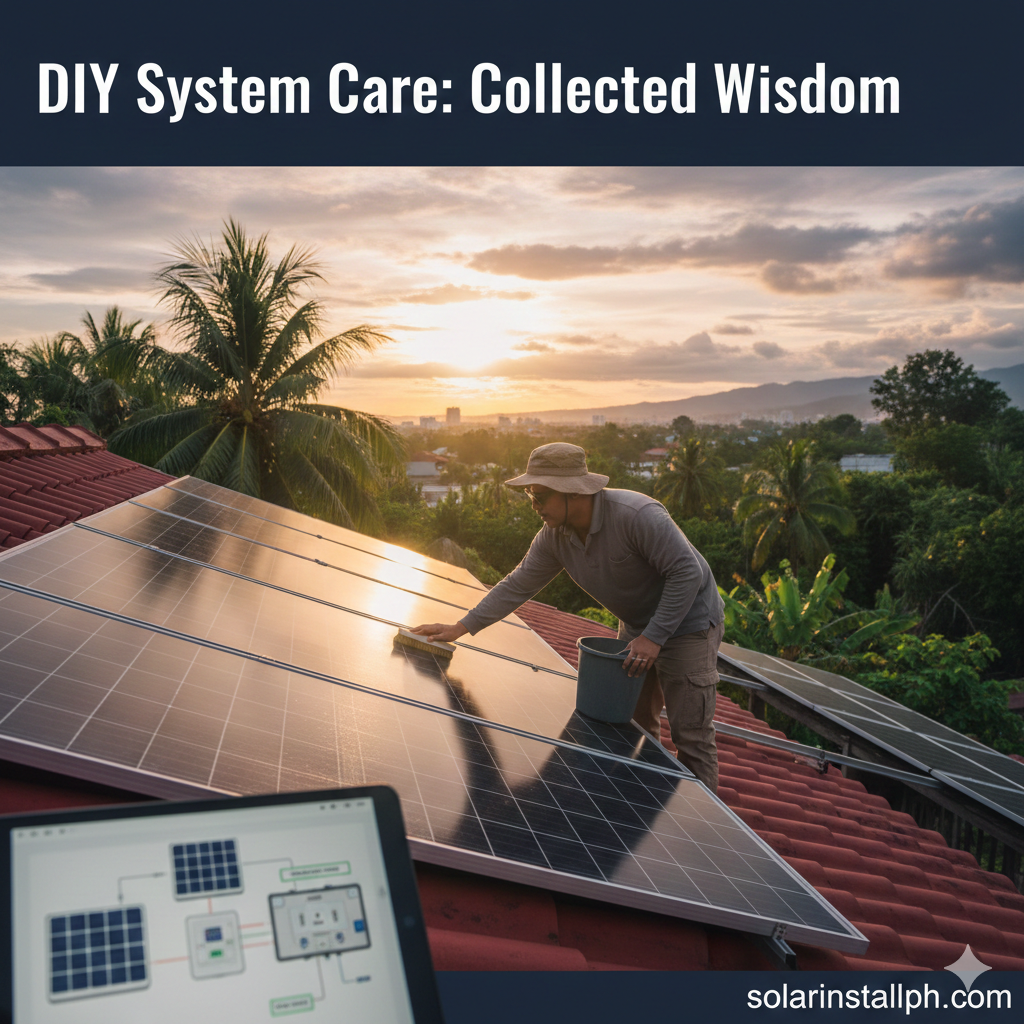
Owning a solar power system in the Philippines is a bit like owning a car. You don’t need to be a mechanic to drive it, but if you never check the tires or change the oil, you are going to have expensive problems down the road.
For many Filipino homeowners, the "install and forget" mentality is tempting. You see the panels on the roof, the Meralco bill goes down, and you assume everything is running perfectly forever. But reality eventually sets in. Dust from the dry season (Amihan) coats the glass. Typhoons rattle the mounting hardware. Geckos and rats explore the cabling.
We have gathered the collective wisdom of installers, long-time solar owners, and technicians to create this guide on caring for your system yourself. This is not a guide on how to rewire your inverter—that is dangerous and illegal for non-professionals. This is a guide on the practical, hands-on maintenance that every owner should know to keep their harvest high and their equipment safe.
The Golden Rule: Know Your Limits
Before you grab a ladder, we need to draw a hard line. Solar systems involve high-voltage DC electricity. Unlike the AC power in your wall outlets, DC power does not easily let go if you get shocked, and it can sustain an arc (a continuous spark) that starts fires.
Green Zone (Safe for Homeowners):
Cleaning solar panels (with proper safety gear).
Visual inspections from the ground or a safe vantage point.
Monitoring app data and checking inverter display lights.
Clearing debris from around the inverter or under the array.
Red Zone (Professionals Only):
Opening the inverter casing.
Tightening or stripping electrical terminals.
Walking directly on the panels.
Modifying the net metering connection.
Violating the Red Zone isn't just a safety risk; it usually voids your warranty immediately. If you are unsure about safety protocols for self-maintenance, err on the side of caution and call your installer.
Panel Hygiene: The Art of Cleaning
In the Philippines, we have two main seasons that dictate your cleaning schedule: the wet season and the dry season.
During the rainy season (roughly June to November), nature does most of the work for you. Frequent downpours wash away loose dirt. However, the dry season (December to May) is different. Dust, pollen, bird droppings, and construction debris can accumulate quickly. A dirty array can lose anywhere from 5% to 15% of its production capacity. That is money you are leaving on the roof.
The "Two-Bucket" Method
You don’t need expensive robotic cleaners. The consensus among practical owners is the simple two-bucket method:
Timing is Critical: Never clean your panels at high noon. The glass is hot. Spraying cold tap water on hot tempered glass can cause micro-fractures or thermal shock. Clean them early in the morning (6:00 AM - 8:00 AM) or late in the afternoon.
Water Quality: If you live in an area with "hard" water (high mineral content), avoid letting it dry on the panels, as it leaves calcium spots. Rainwater collected in a drum is often the best cleaning agent.
Tools: Use a soft sponge or a microfiber mop on an extension pole. Never use abrasive pads (like Scotch-Brite) or high-pressure washers (pressure washers can force water into the seals and damage the panel).
The Process:
Rinse: Gently hose down the panels to remove loose grit.
Soak: Use a mild soap mixture (very diluted dish soap is fine, but dedicated solar glass cleaner is better) if there are oily smudges or bird droppings.
Wipe: Gently wipe with your soft mop.
Rinse Again: Ensure no soap residue remains.
For more specifics on scheduling, check our guide on how often to clean your panels, which breaks down timelines based on whether you live near a highway, a beach, or a farm.
Dealing with "Hard" Debris
Bird droppings and tree sap do not rinse off easily. They create "hot spots." Because solar cells are often wired in series, shading one small spot can disproportionately reduce the output of the whole panel or string. You may need to gently soak these spots with a wet sponge for a few minutes before wiping. Never scrape them with a metal blade.
The Digital Pulse: Monitoring and Data
The easiest maintenance tool you have is your smartphone. Modern inverters (Huawei, Growatt, Sofar, Deye, etc.) come with Wi-Fi dongles that upload data to the cloud.
Developing a Baseline
You cannot know if your system is broken if you don’t know what "normal" looks like.
Peak Power: Know your system’s max generation on a perfectly clear day at noon. If you have a 5kWp system, you might see 4.2kW or 4.5kW at peak. If one day, with clear skies, you only hit 2.5kW, something is wrong.
Daily Yield: Track your average kWh per day. In the Philippines, a good rule of thumb is 3.5 to 4.5 kWh harvested per 1 kW of installed capacity per day (averaged over a year).
Diagnosing via Data
By tracking system performance, you can spot issues before they impact your bill:
Sudden Drop to Zero: usually indicates a grid failure (brownout), a tripped breaker, or an inverter fault.
Gradual Decline: suggests soiling (dirt build-up) or vegetation growth (a tree branch shading the array).
Step-Down Loss: If your production drops by exactly 33% or 50%, you may have lost an entire "string" of panels due to a loose connection or a blown fuse.
Inverter Health
The inverter is the brain of the operation. It will tell you if it is sick. Most inverters have LED indicators:
Solid Green: Normal operation.
Flashing Green: usually standby or starting up.
Red: Fault.
When you see a red light, look at the screen or the app. It will usually display an alphanumeric code (e.g., "Error 403" or "Grid Volt High"). Write this down immediately. It is the first thing tech support will ask for. Learning the basics of interpreting inverter error codes can save you a service call fee, as some errors (like grid voltage fluctuations) are temporary and resolve themselves.
Physical Inspections: The "Walk-Around"
You should perform a physical inspection of your system twice a year. Ideally, do this before the typhoon season begins and again after it ends.
Roof and Mounting
You don't always need to climb the roof to spot problems. Using a pair of binoculars from the ground can reveal a lot:
Loose Clamps: Look for "mid-clamps" (the metal pieces holding the panels down) that have slid out of place.
Sagging Wires: Cables should be tucked neatly under the panels. Hanging loops of wire are susceptible to wind damage and rodent chewing.
Corrosion: If you live near the coast (e.g., Cavite, Batangas, Cebu), salt air is an enemy. Look for rust on the mounting rails or bolts. Stainless steel and anodized aluminum are standard, but cheaper galvanized bolts can rust out, compromising the structural integrity during a storm.
The "Critter" Factor
The Philippines is home to agile rats and geckos. Solar panels provide a nice, warm shelter for them.
Geckos: They love crawling into warm inverters. If your installer didn't seal the cable entry points properly, a gecko can short-circuit the board (this is a very common cause of inverter death in PH). Check that all cable glands into the inverter are tight.
Rats: They chew on UV-resistant wire insulation. During your routine physical inspections, look for droppings near the inverter or frayed insulation on the DC run. If you find chewed wires, do not touch them. Turn off the system and call a pro.
Typhoon Season Protocols
We cannot talk about Philippine solar maintenance without talking about typhoons. Your system is designed to withstand wind, but it needs your help to survive a super typhoon.
Pre-Typhoon Checklist:
Clear the Area: Remove any loose branches or coconuts from trees that overhang the panels. Impact damage is more common than wind lift.
Check Drainage: Ensure your roof gutters are clean. If water backs up, it can submerge roof penetrations and cause leaks.
Torque Check (Optional): If you have safe access to the roof, checking that the end-clamps are tight is wise. If you can move a panel with your hand, it is too loose.
Post-Typhoon Checklist:
Visual Scan: Check for micro-cracks or shattered glass. A shattered panel might still produce power, but it is a fire hazard because water can enter the electrical layers.
Debris Removal: Leaves and branches stuck under the array can trap moisture and cause roof rot.
Inverter Restart: After a long grid outage, ensure your inverter syncs back up with Meralco (or your local coop) once power is restored.
The Battery Question (For Hybrid Owners)
If you invested in a hybrid system with batteries, your maintenance load is higher.
Lead-Acid / Gel Batteries:
These are cheaper but "needy." You must check terminal tightness regularly (heat expansion loosens bolts). If they are flooded lead-acid, you must check water levels. Note that in our tropical heat, lead-acid batteries degrade faster if the room isn't ventilated.
Lithium-Iron Phosphate (LiFePO4):
These are mostly maintenance-free physically, but you need to manage their software.
State of Charge (SOC) Drift: Occasionally, the battery percentage on your screen might be wrong. It helps to charge the battery to 100% and let it balance the cells once a month.
Temperature: Ensure the cooling fans on the battery unit are not blocked by dust. Heat is the number one killer of lithium cells.
Managing the Vegetation
Shade is dynamic. The tree that was 10 feet away when you installed the system three years ago might now be casting a shadow across your bottom row of panels from 2:00 PM onwards.
Solar owners often underestimate "partial shading." They think, "It's just one corner of one panel." But because of how panels are wired (strings), shading 10% of a panel can drop the output of the entire string by 50% or more, depending on whether your panels have bypass diodes engaged.
Action Item: Every 6 months, go outside at 9:00 AM, 12:00 PM, and 3:00 PM and photograph your roof. Compare these photos over time. If a neighbor’s mango tree is encroaching, you need to trim it (or ask them nicely).
Documentation and Warranty
Finally, "maintenance" includes paperwork. Solar warranties in the Philippines are long—typically 5 to 10 years for inverters and 25 years for panels. But claiming them requires proof.
Keep a Log: Create a simple notebook or spreadsheet. Log dates of cleaning, dates of inspections, and any error codes you noticed.
Save the Serial Numbers: Take photos of the serial number stickers on your inverter and batteries. These stickers often fade or peel off after years in the Philippine heat. Having a digital backup is a lifesaver when you need to file a claim.
Summary
You don’t need to be an electrical engineer to be a good solar owner. You just need to be observant.
Clean your panels when the production drops or the dust builds up.
Monitor your app weekly to catch issues early.
Inspect physically for loose wires, rust, or shading twice a year.
Respect the voltage—call a pro for anything involving a screwdriver and a wire.
By following this collected wisdom, you ensure that your ROI calculation remains a reality, not just a sales pitch. Solar is durable, but in our climate, a little care goes a long way.