
5 Best: Battery Storage Costs Revealed
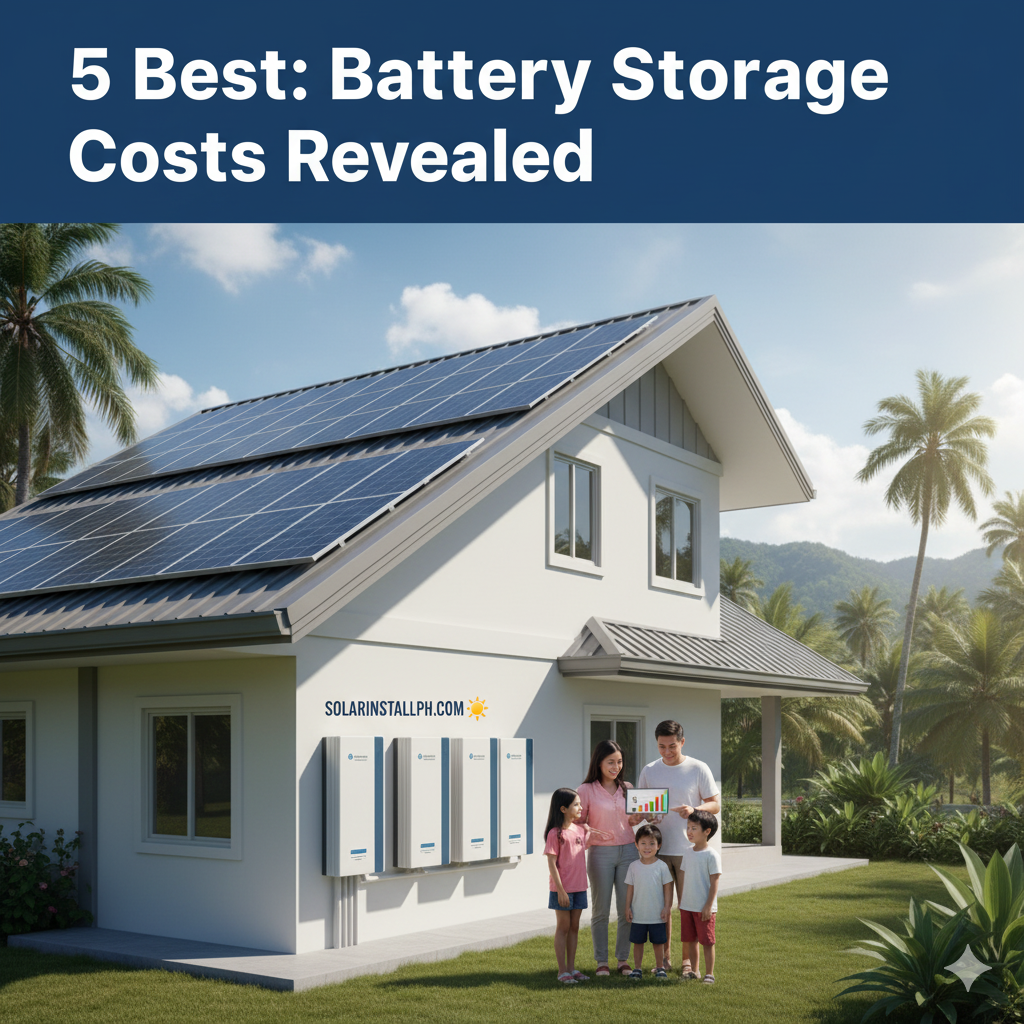
For homeowners and businesses across the Philippines, investing in solar panels has become a familiar strategy to combat the country’s notoriously high electricity rates. It’s a move toward energy independence and environmental responsibility. Yet, as sunny days turn to night, or when typhoons and grid failures plunge neighborhoods into darkness, a standard solar setup goes dormant. This is where the true revolution in personal energy management begins: with battery storage.
Adding a battery to a solar system is no longer a fringe concept for off-grid enthusiasts; it is rapidly becoming the new standard for savvy Filipino consumers. The goal has shifted from simply generating power to controlling it. A battery allows you to store the free, abundant energy you produce during the day and use it precisely when you need it most—during peak evening hours when electricity is most expensive, or during a blackout when the grid fails you. It transforms a solar installation from a part-time energy saver into a full-time fortress of power and savings.
But what does it actually cost to unlock this level of energy security? The price of battery storage can seem daunting, with figures spanning a wide spectrum. This guide will demystify the numbers. We’ll break down the real costs of battery storage solutions in the Philippines, explore the different tiers of investment, and reveal what you get for your money, helping you make an informed decision on the path to true energy independence. A solid understanding of the components begins with a good solar panel guide.
More Than a Price Tag: Understanding What Drives Battery Cost
Before diving into peso figures, it’s crucial to understand that the "cost" of a battery isn't just the number on the invoice. The true value lies in its long-term performance and what it can deliver for your home. Several key technical specifications directly influence both the upfront price and the lifetime value of a battery system.
Capacity (kWh): This is the most cited metric, indicating how much energy the battery can store. Think of it as the size of your energy tank. A 5-kilowatt-hour (kWh) battery can power a 1-kilowatt (kW) appliance for 5 hours. The larger the capacity, the more expensive the battery.
Power Rating (kW): This measures how much electricity the battery can deliver at a single moment. It’s the "flow rate" of your energy tank. A battery might have a large 10 kWh capacity but only a 3 kW power rating, meaning it can’t run too many high-powered appliances simultaneously.
Depth of Discharge (DoD): This percentage tells you how much of the battery's stored energy you can safely use without damaging it. A battery with a 90% DoD is superior to one with a 50% DoD, as it allows you to access more of its stored capacity.
Cycle Life & Warranty: A cycle is one full charge and discharge. The cycle life indicates how many times a battery can do this before its capacity significantly degrades. This is arguably the most critical factor for long-term cost. A battery that costs more but guarantees 6,000 cycles will provide far better value than a cheaper one that only lasts for 500 cycles. The warranty is the manufacturer's promise on this lifespan.
With these factors in mind, the Philippine market is dominated by two primary technologies: the traditional, budget-friendly Lead-Acid and the modern, high-performance Lithium-Ion.
The Contenders: Lead-Acid vs. Lithium-Ion Costs
1. Lead-Acid Batteries: The Budget Entry Point
For decades, lead-acid batteries have been the workhorse of off-grid power systems. Their main advantage is their low upfront cost, making them the most accessible entry into energy storage.
Upfront Cost: The price for lead-acid solar batteries in the Philippines can range from Php 9,000 to Php 40,000. Basic flooded lead-acid types are the cheapest, while more advanced sealed versions like AGM (Absorbent Glass Mat) and Gel batteries sit at the higher end of this range.
The Hidden Costs: This initial affordability comes with significant long-term trade-offs. Lead-acid batteries have a much shorter lifespan, typically 3-5 years, and a low cycle life (300-500 cycles). Their DoD is limited to around 50%, meaning a 4 kWh battery provides only 2 kWh of usable energy. They are also heavy, bulky, and require regular maintenance.
Best For: Small, basic backup systems where cost is the primary concern and the battery will not be cycled daily.
2. Lithium-Ion Batteries: The Long-Term Investment
Lithium-ion, specifically Lithium Iron Phosphate (LiFePO4), has become the gold standard for residential and commercial energy storage, and for good reason.
Upfront Cost: The initial investment is substantially higher. A complete, professionally installed lithium-ion battery system in the Philippines typically starts around Php 90,000 and can exceed Php 300,000 depending on the brand and capacity.
The Long-Term Value: This higher price buys superior performance across the board. Lithium-ion batteries boast a lifespan of 10-15 years or more, backed by warranties guaranteeing thousands of cycles (often 4,000-6,000). Their DoD is excellent, ranging from 80% to 100%. They are lightweight, compact, maintenance-free, and more efficient. Over their lifetime, the cost per kWh discharged is significantly lower than lead-acid.
Best For: Homeowners and businesses looking for a reliable, long-lasting solution for daily use, whole-home backup, and maximizing the financial return of their solar panel system. The high upfront cost can often be managed through a dedicated solar loan guide.
5 Tiers of Battery Storage Costs Revealed
To put this into a practical context, here are five common investment tiers for battery storage in the Philippines, from basic backup to full energy independence.
Tier 1: The Essential Backup System
This setup is designed purely for emergencies, providing enough power to keep critical loads running during a blackout.
Technology: Typically a small Lead-Acid (AGM or Gel) battery.
Capacity: 1 kWh - 2.5 kWh.
What It Powers: Lights, a Wi-Fi router, and device chargers for several hours.
Estimated Cost: Php 20,000 – Php 45,000 (including a basic inverter/charger).
Tier 2: The Entry-Level Lithium System
This is the starting point for modern, high-performance storage. It offers reliable backup for essential appliances and allows for some evening energy use to offset costs.
Technology: Lithium-Ion (LiFePO4).
Capacity: 5 kWh.
What It Powers: Lights, fans, router, TV, refrigerator, and other key appliances through a blackout.
Estimated Cost: Php 50,000 – Php 90,000 (battery only). The total installed cost with a hybrid inverter will be higher.
Tier 3: The Whole-Home Backup Standard
This is the sweet spot for many modern solar homes in the Philippines. A 10 kWh battery provides a robust balance of capacity for both comprehensive blackout protection and significant daily savings.
Technology: Lithium-Ion (LiFePO4).
Capacity: 10 kWh.
What It Powers: Can run most of a standard household's needs, including one or two air conditioning units (inverter-type) for a limited time.
Estimated Cost: Php 90,000 – Php 150,000 (battery only). This is the most popular capacity, so prices are very competitive.
Tier 4: The High-Capacity System for Energy Independence
For larger homes with greater energy needs or those aiming for near-complete grid independence, a high-capacity system is the solution. These are often created by "stacking" multiple battery units.
Technology: Lithium-Ion (LiFePO4), often modular.
Capacity: 15 kWh - 20+ kWh.
What It Powers: A whole home with multiple air conditioners and even high-demand appliances.
Estimated Cost: Php 180,000 – Php 300,000+ (battery only).
Tier 5: The Commercial & Industrial Solution
For businesses, the focus shifts from simple backup to managing operational costs. Large-scale Battery Energy Storage Systems (BESS) are used to combat peak demand charges and ensure continuity.
Technology: Large-scale, modular Lithium-Ion BESS.
Capacity: 50 kWh to several MWh (megawatt-hours).
What It Does: Reduces peak demand charges, provides backup for critical operations, and facilitates participation in grid services.
Estimated Cost: Highly customized, starting from Php 750,000 and running into many millions of pesos. The cost per kWh is generally lower at this scale.
Beyond the Battery: The "All-In" Installation Cost
It's vital to remember that the battery itself is only one part of the total investment. To integrate storage into your home, you must also account for:
The Hybrid Inverter: This is the brain of the system, managing power flow between your solar panels, battery, home, and the grid. A hybrid inverter is more expensive than a standard grid-tie solar inverter.
Balance of System (BOS): This includes all the necessary wiring, breakers, safety disconnects, and mounting hardware required for a safe and compliant installation.
Labor and Expertise: Proper installation is not a DIY job. The cost includes the expertise of certified solar installers who will design the system, handle the complex wiring, and configure the software for optimal performance.
As a rule of thumb, the "all-in" cost for a professionally installed lithium-ion battery system can be 30-50% higher than the cost of the battery alone.
Is the Cost Worth It? The Real Return on Your Investment
While the upfront cost is significant, the decision to invest in battery storage pays dividends that go far beyond simple numbers. The financial payback comes from "time-shifting" your energy use—storing free solar power to avoid buying expensive grid electricity in the evening. This strategy directly attacks the most expensive portion of your Meralco bill and provides a powerful hedge against future price hikes. A detailed solar ROI guide can help you project these savings accurately.
However, the most profound returns are often intangible. What is the value of uninterrupted power for your home-based business or your children's online classes during a brownout? What is the peace of mind worth, knowing your family is safe and comfortable during a typhoon? These solar benefits of resilience and security are, for many Filipinos, the most compelling reason to invest.
The cost of battery storage is no longer a vague and distant figure. With clear price tiers and a maturing market, homeowners can now make data-driven decisions. While the initial investment remains a hurdle, falling prices and the undeniable value of energy control are making battery storage an increasingly essential, and achievable, upgrade for the modern Filipino home.