
Resilient Energy: Typhoon-Proofing Communities
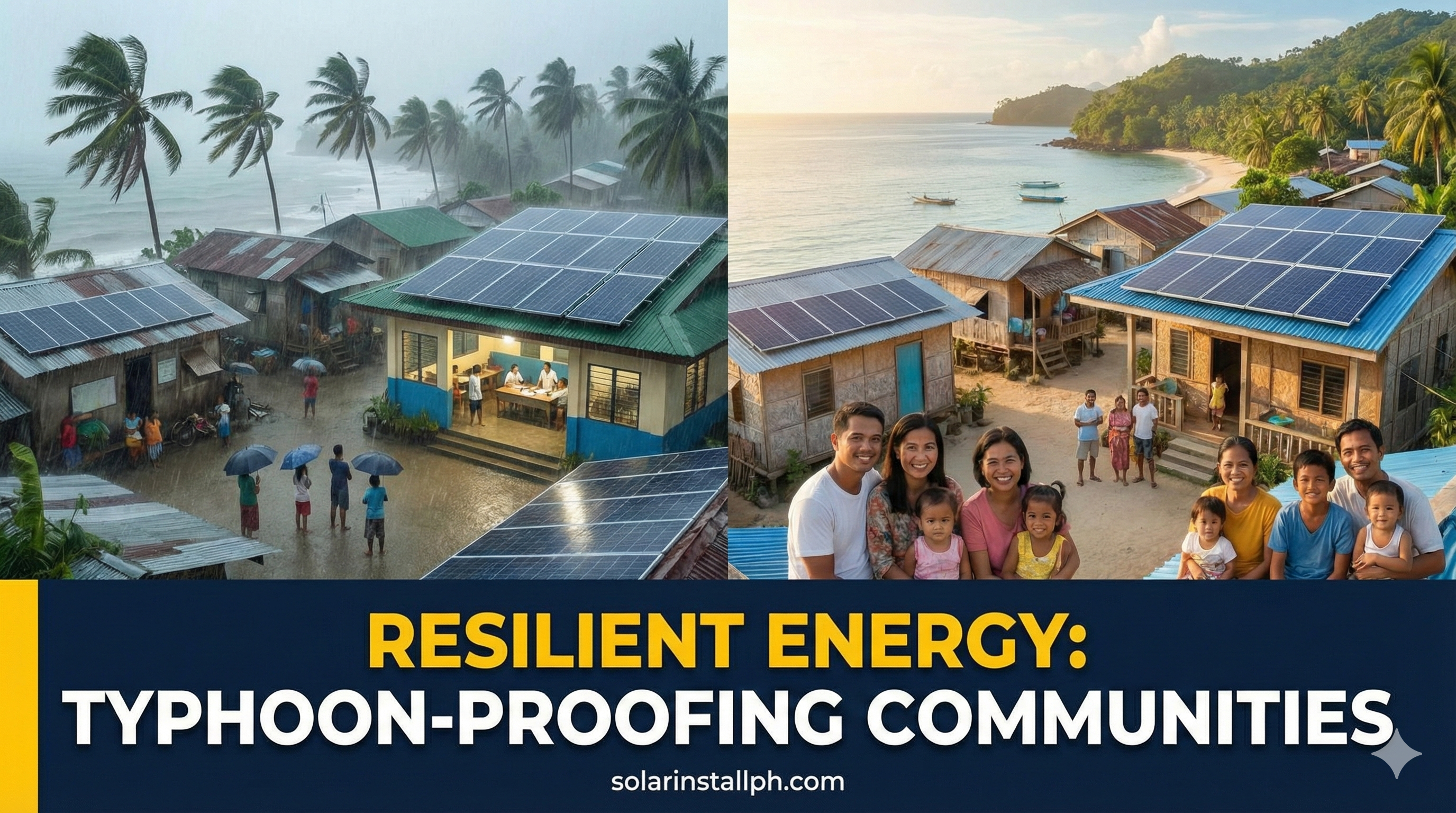
In the Philippines, the aftermath of a Super Typhoon follows a cruel timeline. First comes the wind, then the flood, and finally, the darkness. When the grid collapses in provinces like Leyte, Albay, or Bohol, it doesn't just flicker; it stays down for weeks, sometimes months.
For years, the Filipino response to this darkness has been individualistic: buy a generator, buy a solar kit, secure my own house. But as typhoons become stronger and grid restoration takes longer, the limits of the "every household for itself" model are becoming clear. True resilience isn't about one house having lights while the rest of the street is pitch black; that actually creates security risks and social tension.
True resilience is built at the community level. Whether it is a barangay microgrid, a shared charging hub, or a cooperative water station, typhoon-proofing a community requires a shift in engineering and mindset. It requires moving from "personal backup" to "shared infrastructure."
Here is how Filipino communities are building energy systems that survive the storm and keep the bayanihan spirit alive when the power lines are down.
1. The "Hardened Hub" Strategy
It is financially impossible for every household in a low-income barangay to own a ₱500,000 hybrid solar system. However, it is entirely feasible for the community to invest in one Central Energy Hub.
This Hub—often a Barangay Hall, a covered court, or a designated multipurpose center—becomes the energy sanctuary. But this building cannot just have a standard solar installation. It must be a fortress.
Structural Requirements
A community hub must withstand Signal No. 4 winds (250+ kph).
5400 Pascal Rating: Standard mounting rails are rated for 2400 Pascals (Pa). A community hub must specify 5400 Pa mounting systems, which utilize reinforced rails, double the number of clamps, and 6005-T5 aluminum alloys.
The "Third Rail": To prevent panel glass from shattering under the vibration of 12-hour storms, a third mounting rail is installed across the center of the panels.
If the community hub loses its roof, the entire neighborhood loses its charging station. Investing in typhoon-resistant mounting is the non-negotiable foundation of community resilience.
2. Water First, Lights Second
When a typhoon hits, the immediate crisis is rarely lack of light; it is lack of water. Most municipal water districts rely on electric pumps. When Meralco or the local cooperative goes down, the taps run dry within 24 hours.
A resilient community prioritizes a Solar-Powered Water Station over air conditioning.
Direct-Drive DC Pumps: These systems connect solar panels directly to the pump controller, bypassing the need for expensive batteries or inverters. They pump water whenever the sun shines, filling elevated tanks that provide gravity-fed pressure at night.
Community Taps: Instead of piping water to individual homes (which requires pressure), the system fills a communal tank where residents can fill jerrycans.
By decoupling the water supply from the electric grid, the community prevents the sanitation crisis that usually follows the storm. For technical details on sizing these systems, review our guide on solar-powered water pumps.
3. The Microgrid Systems Act (RA 11646)
In the past, building a shared power system for a neighborhood was legally gray. Distribution Utilities (DUs) held exclusive franchises, effectively banning "mini-grids."
That changed with the Microgrid Systems Act (RA 11646). This law now encourages the development of microgrids in "unserved" and "underserved" areas.
Third-Party Providers: It allows private entities (or cooperatives) to set up localized generation and distribution networks without needing a congressional franchise, provided they are registered.
Barangay Power: This opens the door for remote communities to legally operate their own solar-diesel hybrid grids.
This policy shift moves community solar from a "guerrilla" activity to a formal infrastructure project. Understanding the Department of Energy's solar policies is the first step for any LGU or HOA planning to formalize their energy independence.
4. Storage: The Heart of the Sanctuary
A community hub is useless if it shuts down at 5:00 PM. To support medical nebulizers, emergency radios, and security lighting overnight, you need robust storage.
The days of using car batteries or lead-acid deep cycle batteries for community projects are over. They are too heavy, require too much maintenance, and die after 300 cycles.
Lithium Iron Phosphate (LiFePO4): These batteries are the new standard. They can be discharged to 90% capacity and last for 10+ years. Crucially, they charge much faster than lead-acid, allowing the system to harvest maximum energy during the brief sunny breaks in a storm.
For a community setup, safety is paramount. LiFePO4 is chemically stable and does not catch fire easily, unlike other lithium variants (NMC). We analyze the best options for this heavy-duty use in our review of top solar batteries for 2025.
5. The "Bucket Brigade" Protocol
Once the Hub is generating power, how do you distribute it? Running extension cords across a wet, debris-filled village is dangerous.
The modern solution is the Portable Power Station (PPS) Exchange.
Instead of bringing the power to the house, residents bring their storage to the Hub.
The Workflow: Families drop off their drained portable power stations (or power banks) at the Hub in the morning. The Hub charges them using the massive solar array. In the evening, families collect their "buckets of energy" to power fans and lights in their own homes.
This decentralizes the risk. If one house floods, it doesn't short out the main grid. It allows the community to share the harvest of a large central system without the expense of wiring a microgrid. Learn more about how these units fit into the ecosystem in our discussion on community solar models.
Conclusion: From Victims to Managers
The narrative of the "resilient Filipino" is often used to excuse poor infrastructure. But true resilience is not about enduring suffering with a smile; it is about engineering the suffering out of the equation.
By building typhoon-proof community hubs, utilizing solar water pumps, and leveraging the new Microgrid law, Filipino communities can stop waiting for the grid to return. They can take control of their own survival, turning the barangay into a functional energy island that stands tall even when the rest of the province goes dark.