
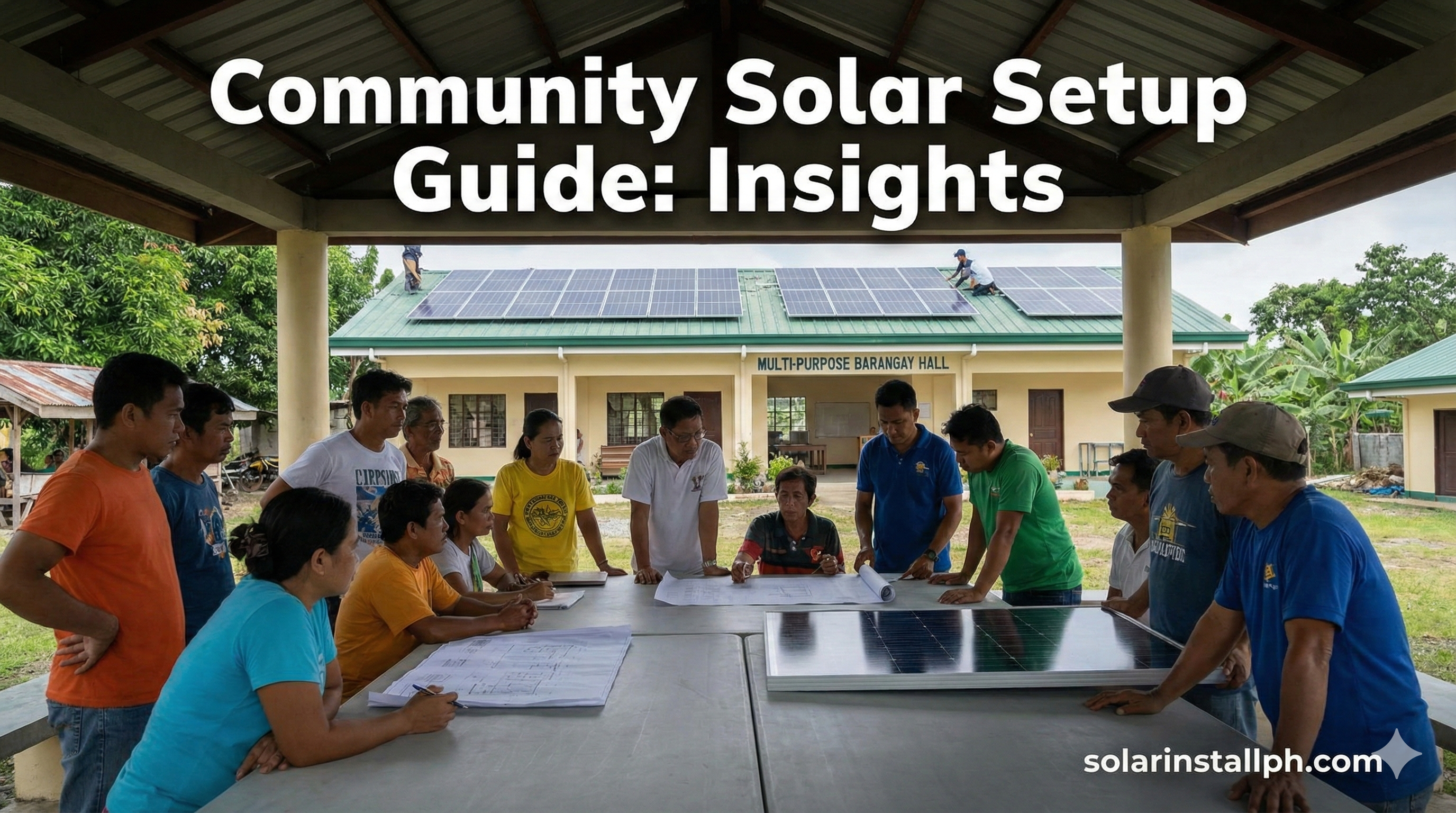
Community Solar Setup Guide: Insights
In the United States, "Community Solar" often means subscribing to a solar farm 50 kilometers away and seeing a credit appear on your electric bill. It is virtual, seamless, and purely financial.
In the Philippines, that model does not exist yet.
Here, Community Solar is physical. It is an act of infrastructure. It is a Homeowners Association (HOA) deciding to stop paying P30,000 a month for streetlights. It is a condominium corporation offsetting the cost of elevator operations. It is a cluster of resorts on an off-grid island pooling funds for a microgrid.
For Filipino communities, setting up a shared solar system is not about clicking a button on a website. It is a construction project that requires navigating LGU permits, HOA politics, and Meralco (or Electric Coop) regulations.
This guide breaks down how to actually build a community solar setup in the Philippine context—what works, what is illegal, and how to make the numbers make sense.
What "Community Solar" Means in the Philippines
Because we do not yet have "Virtual Net Metering" regulations that allow you to credit your home bill from a distant solar panel, "Community Solar" in the Philippines falls into two practical categories:
The "Common Area" Offset (The Easy Path): The community installs a central solar system to power shared amenities (clubhouse, pool pumps, streetlights). This reduces the HOA monthly dues for everyone.
The Microgrid (The Hard Path): A private network where a central solar array distributes power to individual homes. This is mostly seen in remote islands, private resorts, or high-end unserved subdivisions under the Microgrid Systems Act (RA 11646).
For 95% of readers living in grid-connected subdivisions or condos, Option 1 is the viable path.
Step 1: The Audit (Stop Guessing)
The biggest mistake HOAs make is saying, "Let's put solar on the basketball court roof to power the village."
You need to know what you are powering. In most subdivisions, the "pain points" are:
Streetlights: These run 12 hours a night. Solar streetlights are popular, but hardwired lights powered by a central solar system are often more reliable and brighter.
Water Pumps: If your village has its own water tank, this is usually your biggest expense.
Clubhouse AC: Used only during events/weekends.
Before asking for a quote, get your last 12 months of utility bills for these common meters. You cannot design a solution if you don’t know your load profile.
Step 2: Choose Your Model
Once you know your consumption, choose the setup that fits your legal and physical reality.
Model A: The "Common Meter" Net Metering
This is the most straightforward approach. You install a grid-tied system on the clubhouse roof. It connects to the existing Meralco meter that serves the clubhouse.
Daytime: The solar panels power the admin office and the pool pumps.
Excess: Any extra power is sold to the grid via the Net Metering program.
Benefit: The credits earned offset the nighttime cost of streetlights.
Legal Status: Fully legal and standard. You are treated as a single customer (the HOA).
Model B: The "Distributed" Setup
If you don't have a big clubhouse roof, you might look at distributed assets.
Solar Streetlights: Installing standalone solar street lights replaces grid-tied posts. This cuts the "common area" electric bill directly.
Pros: No need for a central permit; easy to install.
Cons: Batteries eventually die (2-5 years) and need replacing.
Step 3: Navigating the Legal Hurdles
This is where Philippine reality hits hard. You cannot simply string wires from a central solar plant to 50 different houses in a subdivision.
The "No Distribution" Rule: Unless you have a franchise or a specific permit, you cannot act as a utility. An HOA cannot sell electricity to its residents by running cables across property lines. That is the job of the Distribution Utility (DU).
Condo Complications: For vertical developments, the roof is common property. The condo corporation can install solar to power hallways and elevators, which is a fantastic way to lower association dues. However, using that roof to power specific penthouse units is legally messy and usually forbidden by the Master Deed. Read our guide on condo solar for the nuances of roof ownership.
Step 4: Financing the Project
The hurdle is rarely technology; it is money. HOAs rarely have P500,000 sitting in cash.
Special Assessment: The fastest way. If a P1,000 one-time fee per homeowner funds a system that lowers monthly dues by P100 forever, the ROI is roughly 10 months.
Green Financing: Banks like BPI and BDO now offer "green loans" for renewable energy projects, though they typically prefer lending to businesses rather than HOAs.
ESCO Model: Some solar companies offer a "lease-to-own" or Power Purchase Agreement (PPA). They install the system for free, and the HOA pays them a rate lower than Meralco for the power generated.
Step 5: Technical Implementation
When you are ready to build, keep these technical "gotchas" in mind:
The Meter Name: For Net Metering, the Meralco bill must match the applicant's name. If the bill is named "Sunrise Village Developers Inc." but the applicant is "Sunrise Village HOA," you will be rejected. Transfer the utility account to the HOA first.
Shading: In dense subdivisions, neighbors' trees or 3-storey houses might shade the clubhouse roof. A shading analysis is non-negotiable.
Security: Community assets are prone to theft. Ground-mounted systems in open parks need fences. Roof-mounted systems are generally safer.
The Future: "True" Community Solar?
Are we ever going to get the subscription model?
There is hope. The ERC’s new rules on Distributed Energy Resources (DER) are opening doors for larger systems (up to 1MW) to export power. While it doesn't yet explicitly allow "virtual wheeling" to your neighbor, it is a step toward a grid where communities can generate their own power at scale.
We are also seeing the rise of shared solar concepts in new developments, where "solar readiness" is baked into the subdivision plan, allowing homes to share a microgrid from day one.
Conclusion
Building a community solar project in the Philippines is an exercise in leadership. It requires an HOA board willing to do the math, a community willing to invest upfront, and the patience to deal with permits.
But the payoff is real. We have seen subdivisions cut their common area bills by 60%, effectively shielding their residents from HOA fee hikes for decades.
If you are an HOA officer or a community leader, start with the audit. Find out how much you are paying to light up empty streets, and realize that money could be paying for a solar asset instead.
For more on the different models available, check our deep dive on community solar projects.