
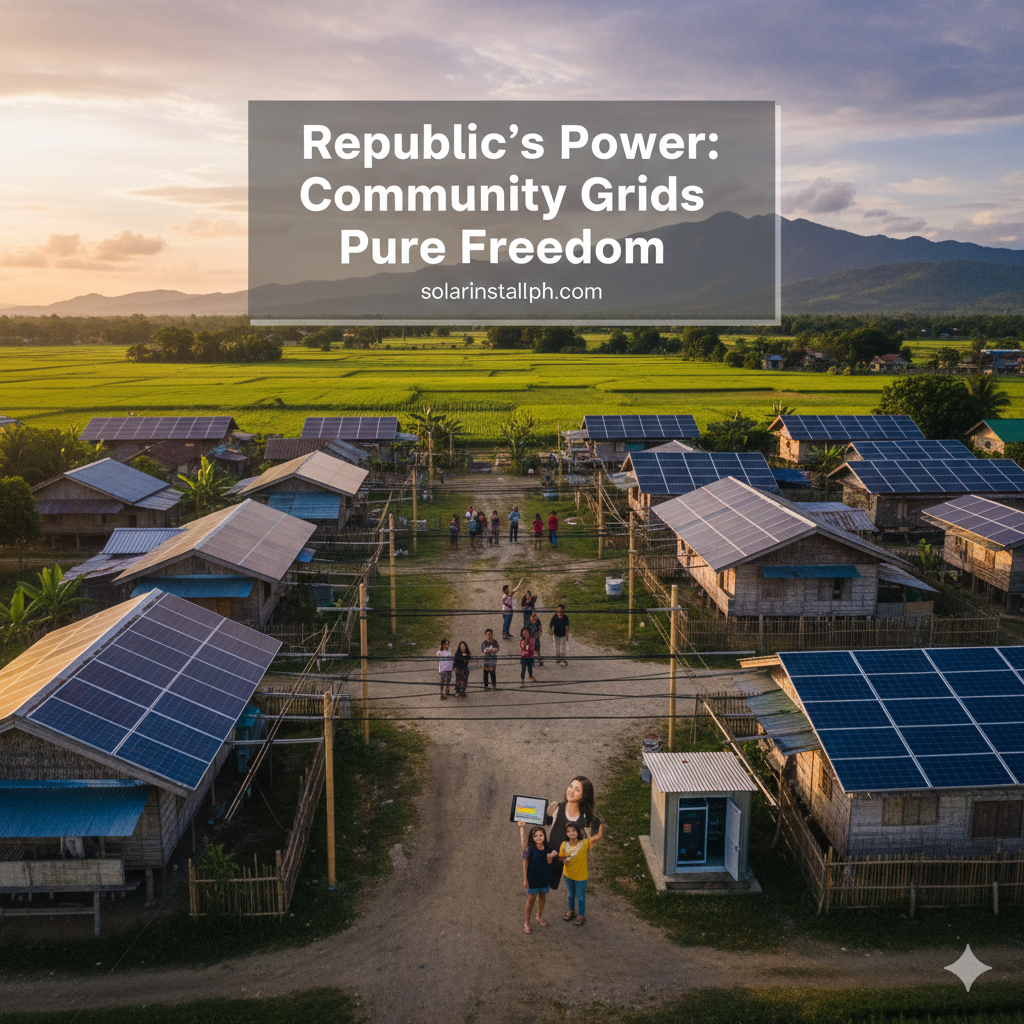
Republic's Power: Community Grids Pure Freedom
In 2025, the Philippine energy sector is undergoing a quiet but profound transformation. For decades, the "Republic's Power" was defined by massive, centralized coal and natural gas plants connected to a fragile national grid. When those plants failed or the transmission lines snapped during a typhoon, entire provinces were plunged into darkness. Today, a new model is emerging: the community grid. This is the shift from being passive consumers of expensive, often unreliable electricity to becoming active participants in a localized energy economy.
Community grids, often called microgrids or shared solar systems, are not just about panels on a roof. They represent a fundamental reclaiming of energy sovereignty. In a country where electricity prices are among the highest in Southeast Asia, the ability for a neighborhood, a cooperative, or a small municipality to generate and manage its own power is the closest thing to pure freedom a consumer can achieve.
The Shift to Shared Energy in 2025
The primary driver for community solar in the Philippines is simple: accessibility. Not everyone has a roof suitable for solar. Many Filipinos live in condominiums, rent their homes, or have shaded properties. Others simply cannot afford the upfront cost of a private system. Community solar solves this by allowing multiple participants to benefit from a single, large-scale installation.
This isn't just a theoretical concept. Under the updated Department of Energy (DOE) circulars in early 2025, the financial benefits for host communities have increased. The Energy Regulation Program No. 1-94 (ER 1-94) now allocates higher per-kilowatt-hour shares to local communities, often used for livelihood programs, healthcare, and even direct electricity rate reductions. When you look at the long-term community solar benefits, it becomes clear that these projects do more than just lower bills; they build local wealth.
The Regulatory Backbone: RA 9513 and Beyond
To understand how a community grid functions legally, we have to look at the legislative framework. The foundation is still Republic Act 9513 (The Renewable Energy Act of 2008), which established the incentives for clean energy. However, the real "teeth" for community projects come from more recent regulations.
The Microgrid Systems Act (RA 11646)
Passed to accelerate total electrification, this law allows Microgrid System Providers (MGSPs) to operate in "unserved and underserved" areas without needing a traditional congressional franchise. This is a game-changer for remote islands and mountain barangays that Meralco or local cooperatives have found too expensive to reach.
ERC’s Distributed Energy Resources (DER) Rules
In 2022, the Energy Regulatory Commission (ERC) released Resolution No. 11, which specifically governs DERs. These rules allow for systems up to 1 MW to export power to the grid. For a community grid, this means the excess energy generated by a shared 500 kW array in a subdivision can be sold back to the utility, creating a revenue stream that lowers the subscription costs for every member. Because these systems are often modular, developers are frequently making a strategic microinverters choice to ensure that the failure of one panel doesn't compromise the entire community's output.
How a Community Grid Operates
A community grid is a group of interconnected loads and energy resources within a defined boundary. It acts as a single entity relative to the main grid.
The Components of Freedom
The Array: A centralized solar farm or a series of interconnected rooftops.
The Hub (Inverter/BMS): A sophisticated brain that balances generation, storage, and consumption.
Storage: Large-scale Lithium Iron Phosphate (LiFePO4) battery banks that provide "firm" power during the night or during grid outages.
The Billing Software: A platform that tracks exactly how much power each "subscriber" uses and credits them for their share of the generation.
For those within the grid, the experience is seamless. You receive a bill that shows your utility consumption minus your community solar credit. This mechanism is similar to how individuals see significant net metering savings on their private bills, but applied at a communal scale.
Economic Realities and Financing
The "Pure Freedom" of a community grid doesn't come for free. The upfront capital required for a 100 kW to 1 MW system is substantial. However, the financing landscape in the Philippines has matured significantly by 2025.
Financing Models
LGU-Led Projects: Municipalities use their internal revenue allotments or special grants to build the grid as a public utility.
The Cooperative Model: Members of an electric coop or a homeowners' association (HOA) pool their resources to co-own the asset.
Third-Party MGSPs: A private company builds and operates the grid, and residents pay a monthly subscription fee that is lower than the standard utility rate.
Many of these projects are now leveraging specialized solar bank loans from institutions like BPI, Landbank, or DBP, which have developed specific "Green Finance" products for renewable energy communities. The typical payback for these larger systems is often faster than residential setups—around 4 to 5 years—because of the economies of scale in procurement and installation.
Case Study: Freedom in Action
Look at Cagbalete Island in Quezon Province. For years, the island relied on expensive, polluting diesel generators that only ran for a few hours a day. In late 2025, the commissioning of a massive hybrid microgrid changed everything. By combining solar, battery storage, and a backup generator, the community now has 24/7 power.
The result wasn't just "lights at night." It was the birth of new ice plants for local fishermen, longer operating hours for resorts, and better charging for students' tablets. This is the "Republic's Power"—energy that serves the people’s economic needs directly where they live.
Similarly, in Malaybalay City, the Sitio Kiito project demonstrated how a community-managed solar system can transform social cohesion. When a community owns the power, they take responsibility for its maintenance, creating local jobs and ensuring the technology transfer actually sticks.
Technical Standards: Avoiding the "Cheap" Trap
One of the biggest risks to community energy freedom is poor engineering. A system designed for 20 households cannot suddenly handle 50 without crashing. Furthermore, the Philippine climate is brutal on electronics.
Communities must ensure they are working with a certified DOE accredited installer who understands local wind load requirements and salt-air corrosion. In a community grid, the failure of a single main inverter can affect hundreds of people. This isn't the place for cutting corners on cabling or using Tier 3 panels with questionable warranties.
Critical Specs for PH Community Grids:
Wind Load: Mounting structures must be rated for at least 250-300 kph to survive super typhoons.
IP Ratings: Inverters and battery enclosures must have high ingress protection to handle the extreme humidity and dust.
Remote Monitoring: The system must be "smart," allowing engineers in Manila or Cebu to troubleshoot issues before they lead to a blackout.
Common Mistakes to Avoid
The path to community energy freedom is littered with failed projects. Most fail not because the technology didn't work, but because the governance or the math was wrong.
Ignoring the Distribution Impact Study (DIS): If you are building a grid-tied community project, you must know if the local feeder can handle the export. Without a DIS, the utility can legally refuse to connect you.
Vague Ownership Agreements: Who owns the panels in 10 years? Who pays if a battery fails? These must be settled in a legally binding HOA resolution or a contract before the first bolt is turned.
Underestimating Maintenance: Solar is low maintenance, but "low" is not "zero." Community grids need a dedicated fund for panel cleaning and biannual electrical inspections.
Poor Load Management: If everyone in the community grid turns on their air conditioning at the same time at 8:00 PM when the sun is down, the batteries will drain too fast. Smart communities implement "Time-of-Use" rules or automated load-shedding for non-essential appliances.
The Future: Virtual Power Plants (VPP)
The ultimate evolution of the community grid is the Virtual Power Plant. By 2026, we expect to see "Republic Power" grids across the Philippines communicating with each other. If one neighborhood has an excess of power and another is experiencing a cloud-induced dip, they can trade credits in real-time. This level of synchronization effectively turns a group of small communities into a single, massive power plant that stabilizes the national grid.
How to Evaluate Your Own Community
If you are a member of an HOA or a local business council, your first step is a feasibility study. You need to map out the total daytime load and identify a central "host" roof or land area.
Checklist for Community Solar:
Survey the Load: Collect 12 months of electricity bills from every participating member.
Site Assessment: Identify at least 1,000 square meters of unshaded space for every 100 kWp of capacity.
Legal Audit: Review your HOA bylaws to see if you are allowed to operate a shared utility asset.
Vendor Selection: Interview at least three installers who have experience with systems larger than 50 kW.
Conclusion
The "Republic's Power" is no longer a top-down mandate from a central utility. It is a bottom-up revolution. Community grids offer the "Pure Freedom" of knowing your electricity price is fixed, your lights will stay on, and your money is staying within your neighborhood rather than flowing to a multinational fuel supplier.
As the technology continues to get cheaper and the PH regulatory environment more welcoming, the community grid will become the standard for modern Philippine living. It is the most resilient way to power a nation that is both a tropical paradise and a frontline of climate change.
FAQ
Can a community grid work in a condo?
Yes. Many condos in BGC and Makati are now using "Shared Solar" where the rooftop array powers common areas (elevators, hallways) first, and then the savings are distributed as a reduction in monthly association dues for all unit owners.
What happens if a member doesn't pay their share?
Most community grids use smart meters that can remotely disconnect a specific subscriber if they fail to pay their maintenance or subscription fees, without affecting the rest of the community.
Is community solar cheaper than residential solar?
Generally, yes. Large-scale procurement of panels and inverters reduces the cost per watt. Additionally, the maintenance costs are split among many members, making the per-person overhead lower than a private system.