
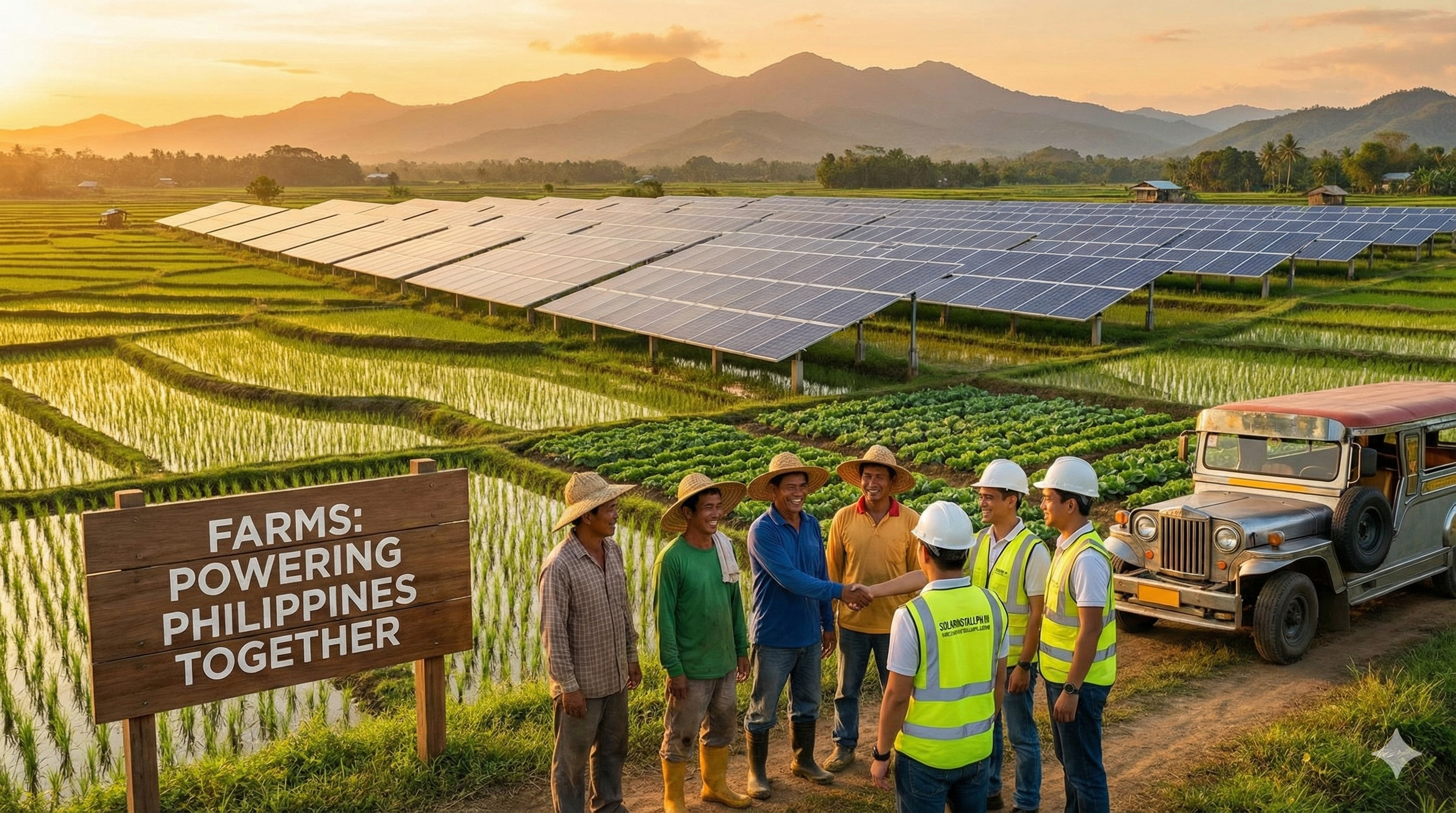
Farms: Powering Philippines Together
Farming in the Philippines has always been a gamble. You gamble on the typhoons, you gamble on the market prices, and lately, you gamble on the price of diesel just to keep your irrigation pumps running.
But there is a shift happening in provinces from Isabela to Bukidnon. The farm is no longer just a place where food grows; it is becoming an energy hub. We are seeing a move from pure subsistence agriculture to "energy-smart" farming, where the sun that scorches the crops is also the fuel that waters them.
This isn't about putting a few solar lights on your perimeter fence. This is about heavy-duty infrastructure—solar irrigation, cold storage, and grid-tied piggeries—that secures the food supply and stabilizes the local electric coop.
The End of the Diesel Era for Irrigation
If you are a rice or corn farmer, your biggest operational expense after fertilizer is likely fuel for the water pump. When diesel hits P60 or P70 per liter, your margins vanish.
The Department of Agriculture (DA) and the National Irrigation Administration (NIA) know this. In 2023 alone, the NIA completed 82 solar-powered pump irrigation projects nationwide to help mitigate El Niño.
Here is the math that matters:
The Diesel Trap: A standard diesel pump burns cash every hour it runs. If you delay watering because you are trying to save fuel, your yield drops.
The Solar Swap: A solar pump runs whenever the sun shines—which is exactly when your crops need water the most.
Studies in Kalinga and Isabela have shown that a one-hectare farm typically requires about 3.3 kWh of energy per day for irrigation. By switching to solar water pump systems, farmers are seeing lower operating costs and improved yields because they aren't rationing water anymore.
You don't need a massive setup. A simple surface pump for a shallow tube well or a submersible pump for deeper aquifers can run directly off panels with no batteries required. The sun comes up, the water flows.
Post-Harvest: The Cold Storage Revolution
The tragedy of Philippine agriculture is not that we can't grow enough; it's that we can't keep what we grow. We have all seen the news reports of onions rotting on the roadside or tomatoes being dumped because prices crashed.
The solution is cold storage, but running a giant freezer on the commercial grid (at P12–P14/kWh) or a generator is financial suicide for a small coop.
This is where Solar-Powered Cold Storage comes in. These are often retrofitted container vans equipped with solar panels and thermal storage or batteries.
Temperature Control: These units can maintain steady temperatures between 3°C and 10°C, which is perfect for extending the shelf life of tomatoes, onions, and leafy greens.
Off-Grid Capability: Because they are self-contained, they can be dropped into remote off-grid solutions in the middle of the harvest area, cutting out the spoilage that happens during transport.
For a cooperative, investing in one of these units means you don't have to sell your harvest the second it is picked. You can store it, wait for market prices to stabilize, and sell when the demand is high.
Agrivoltaics: The Double Harvest
There is a misconception that you have to choose between farming the land or building a solar farm. In the Philippines, we are starting to explore Agrivoltaics—farming under the panels.
The Philippines has an estimated 10 million hectares of land suitable for this dual-use approach. It addresses a critical issue: we cannot afford to lose prime agricultural land to utility-scale solar farms.
The key is matching the crop to the shadow.
Shade-Tolerant Crops: Abaca, taro (gabi), and even banana can thrive under the partial shade of elevated solar panels. The panels actually protect these crops from intense heat stress during the dry season.
Shade-Intolerant Crops: Rice and corn generally need full sun, so they don't mix well with overhead panels unless the spacing is very wide.
If you are looking to maximize your farm’s efficiency, consider using the space between rows or the edges of your fields for vertical bifacial panels. It acts as a windbreak and a power generator.
Poultry and Piggeries: The Hidden Power Plants
If you run a tunnel-ventilated poultry farm or a bio-secure piggery, you are already a heavy power user. You have giant exhaust fans running 24/7 to keep the animals alive. If the grid fails and your generator doesn't start, you can lose your entire stock in hours.
These facilities typically have massive roof spaces that are perfect for solar.
Net Metering: A 50kW to 90kW rooftop system can offset a huge chunk of your daytime consumption. Under the Net Metering program, any excess power you don't use is sold back to the grid for credits.
Real Savings: One poultry setup in the Philippines reported savings of around P167,000 in just eight months after installing solar, while also significantly lowering their carbon footprint.
But there is a bigger picture here. When a large farm exports power to the local Electric Cooperative (EC) during the day, it helps stabilize the voltage for the whole barangay. You aren't just a customer anymore; you are a partner in the grid. We are seeing this trend accelerate, with regions like agri-solar progress in Iloilo showing how agricultural areas can become net exporters of clean energy.
Financing the Shift
The technology is ready, but the upfront cost is the barrier. Fortunately, government financial institutions (GFIs) are finally stepping up with products specifically for this.
Landbank REAL Energy+ Program: This offers financing for renewable energy projects, available to cooperatives, agri-businesses, and even LGUs. They can finance up to 80% of the project cost for private borrowers.
DBP AgriNegosyo: Targeted at micro and small enterprises, this program provides loans for equipment and fixed assets, which can include solar machinery if it's part of the agribusiness expansion.
If you are planning on investing in solar farm infrastructure, do not use your operating cash. Use these long-term loans. The monthly amortization is often lower than the diesel savings, meaning the system pays for itself from Day 1.
Conclusion: The "Prosumer" Farmer
The days of the passive farmer who is a victim of fuel prices and brownouts are ending. The future belongs to the "Prosumer"—a farmer who produces both calories and kilowatts.
Whether it is a simple solar pump that saves you from buying diesel, or a full-blown rooftop array on your poultry house that credits your bill, the technology is here. It is rugged, it is proven, and in the Philippine context of high power rates, it is the only way to stay competitive.
Next Step: Dig out your fuel receipts and electric bills for the last 12 months. Tally up the total cost. If you are spending more than P20,000 a month on energy, it is time to call a solar installer.