
Grid Transition Hurdles (3 Issues)
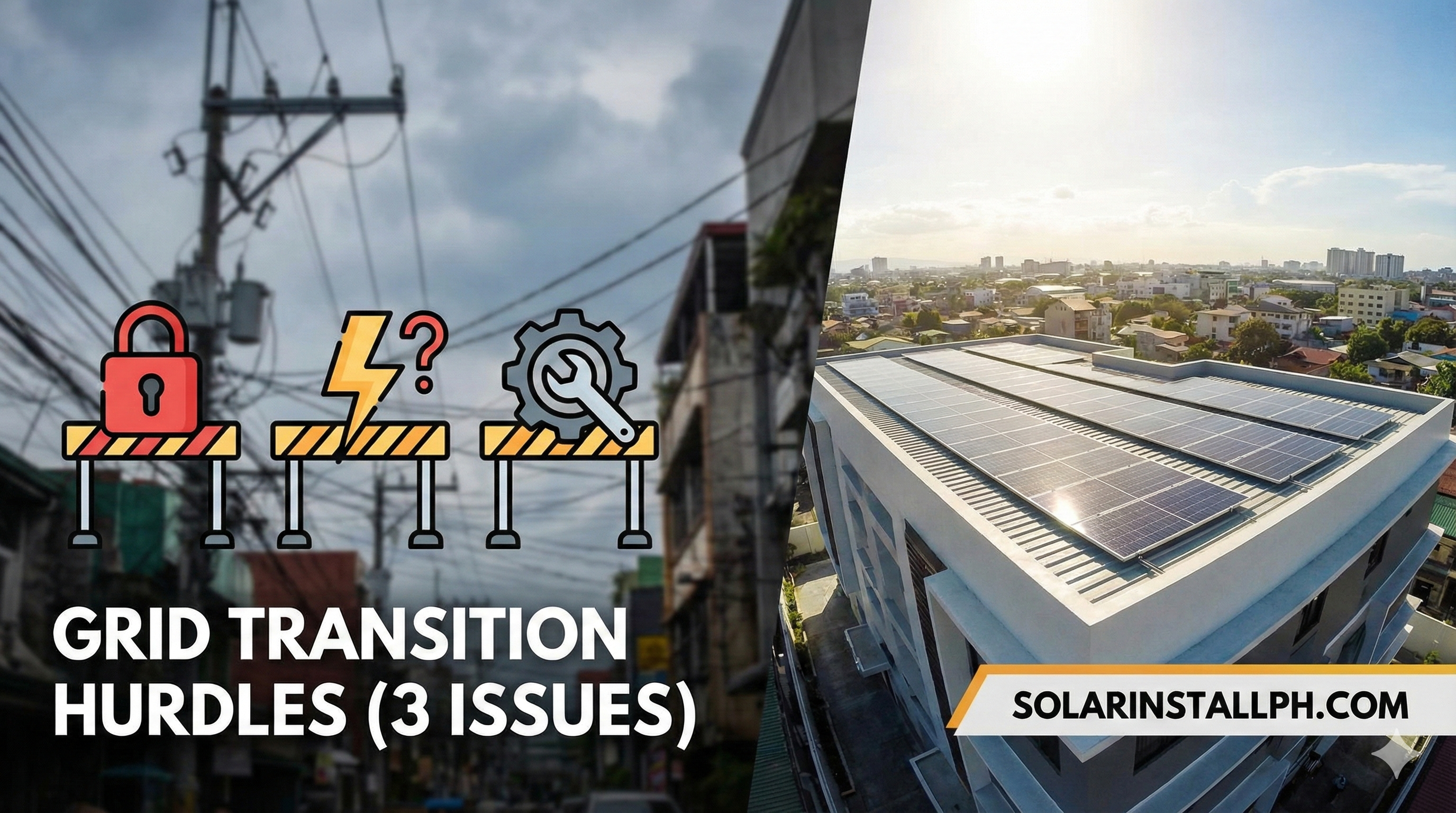
If you follow the energy news in the Philippines, you hear a lot of optimistic talk. The Department of Energy (DOE) has ambitious targets: 35% renewable energy by 2030 and 50% by 2040. We see press releases about massive solar farms in Nueva Ecija and offshore wind projects in Mindoro.
But if you talk to the engineers on the ground—the people actually trying to hook these systems up—the mood is different. It is tense.
The reality is that we are trying to push 21st-century energy through a 20th-century grid. We have plenty of investors willing to build solar plants, but we physically cannot plug them in fast enough. The "pipes" are clogged.
For homeowners and business owners, this isn’t just abstract policy; it affects your approval times, your export credits, and the reliability of the power flowing into your house. Here are the three massive hurdles currently choking the Philippine grid transition.
1. The Transmission Bottleneck (The "Superhighway" Problem)
Imagine you build a factory that produces 1,000 sports cars a day (the solar farm). But the only road leading out of your factory is a narrow, unpaved dirt track (the transmission line). It doesn't matter how fast you can build cars; they are stuck in the parking lot.
This is the situation with the National Grid Corporation of the Philippines (NGCP).
Transmission lines are the high-voltage superhighways that carry electricity from power plants to the distribution utilities (like Meralco or your local coop). In the Philippines, renewable resources are often far from where the power is needed. The best sun is in rural Central Luzon; the best wind is in the north or offshore. The demand, however, is in Metro Manila.
The Congestion Reality
Right now, massive amounts of renewable capacity are sitting in a "queue," waiting for transmission lines to be upgraded.
Visayas Issues: The Cebu-Negros-Panay (CNP) backbone has historically been a choke point. While recent upgrades have helped, the influx of solar in Negros often exceeds the capacity of the submarine cables to export it to Cebu or Panay.
Curtailment: This leads to "curtailment"—a fancy word for waste. Solar farms are told to disconnect or lower their output because the lines cannot handle the surge. Clean, free energy is literally thrown away while we burn coal elsewhere.
For the average user, this manifests as grid instability. When the transmission lines trip due to overload, we get the familiar "Yellow Alert" or "Red Alert," followed by rotational brownouts.
2. The SIS Backlog (The "Paperwork" Wall)
Before any significant power generator can connect to the grid, it must undergo a System Impact Study (SIS).
This is a technical simulation run by the NGCP or the Distribution Utility to ensure that plugging in your system won’t blow up the local transformer or destabilize the frequency. It used to be a routine engineering check. Now, it is a bottleneck that stretches for years.
Why the Logjam?
The explosion of renewable energy applications caught the regulators off guard.
Volume: Thousands of applications for solar, wind, and hydro projects flooded the ERC and NGCP.
Complexity: Modeling a coal plant (steady output) is easy. Modeling a solar farm (variable output that drops when a cloud passes) is mathematically harder and requires more complex grid protection schemes.
The trickle-down effect
You might think this only applies to massive 100MW solar farms, but it trickles down to commercial and even residential users. If you are a factory owner wanting to install a 500kW rooftop system, you are often subject to a simplified version of these studies.
Because the engineering teams at the utilities are overwhelmed, approvals that used to take 2 months now take 6 to 12 months. This delay is the primary reason many businesses are abandoning the idea of "selling" power back to the grid and are instead opting for Zero Export systems. By using smart limiters to prevent export, they can sometimes bypass the most rigorous parts of the study and get energized faster. You can read more about how this technology works in our overview of zero export systems.
3. Grid Inflexibility (The "Baseload" Addiction)
The Philippine grid was designed for "Baseload" power. It likes big, heavy, spinning generators (coal and geothermal) that run at a steady speed 24/7. It acts like a heavy freight train—it takes a long time to speed up and a long time to slow down.
Solar energy is the opposite. It is spiky. It ramps up incredibly fast at 7:00 AM, peaks at noon, and disappears at 5:00 PM.
The Duck Curve
When you inject too much solar into a stiff grid, you get technical chaos.
Voltage Rise: Solar inverters push voltage slightly high to "push" power into the grid. If too many neighbors do this at once, the local voltage spikes, frying appliances or causing the inverters to trip off for safety.
Frequency Instability: If a massive cloud bank covers a solar-heavy region, gigawatts of power can vanish in seconds. The grid needs "flexible" plants (like gas peakers or batteries) to instantly fill that gap. We don't have enough of them.
This inflexibility is why utilities are becoming stricter with Certificates of Compliance (COC). They need to know exactly what is on their lines. The "install first, permit later" cowboy days are over because the grid physically cannot handle unauthorized variability anymore. We discuss the importance of being legal in our article on the Solar Certificate of Compliance.
What This Means for You in 2025
So, the macro grid is congested, the paperwork is slow, and the physics are fighting us. How does this affect your decision to go solar today?
1. Expect Stricter Permitting
If you are applying for Net Metering, prepare for scrutiny. Meralco and other DUs are strictly enforcing standards on inverter settings and disconnect switches. They have to. If they let everyone connect without checks, the local transformers will blow.
2. The Rise of Batteries (Hybrid Systems)
Because the grid is unreliable (brownouts) and becoming harder to export to (permitting delays), the trend is shifting toward self-sufficiency.
Homeowners are increasingly willing to pay the premium for Hybrid Systems (Solar + Battery). Instead of treating the grid as an infinite battery (Net Metering), they use their own lithium-ion banks to store excess noon energy for the evening. This insulates them from grid failures and policy shifts.
It solves the "voltage rise" issue because you aren't pushing as much to the grid.
It solves the "brownout" issue.
It solves the "permitting" delay because you can operate in self-consumption mode while waiting for the paperwork.
If you are considering this route, look at our breakdown of the top solar batteries for 2025 to see what fits your budget.
3. The Financial Calculation Changes
For pure grid-tied systems (no battery), the economics are still unbeatable if you can get the permits. The savings from offsetting your daytime usage are massive, especially with rates above ₱12/kWh.
Pros: Cheapest entry point, fastest ROI.
Cons: You are at the mercy of grid availability. If the grid trips, you have no power.
You need to weigh these risks. Check our honest look at grid-tied solar pros and cons to see if the trade-off makes sense for your area.
Conclusion
The transition to green energy in the Philippines is inevitable, but it will be messy. We are in the "growing pains" phase. The government and NGCP are playing catch-up with transmission upgrades, but steel towers take years to build.
For the consumer, the best strategy is resilience. Do not assume the grid will be perfect. Design your solar system to handle high rates and frequent interruptions. Whether that means sizing your system for Meralco solar savings or investing in backup batteries, the goal is to take control of your own energy security while the national grid sorts itself out.