
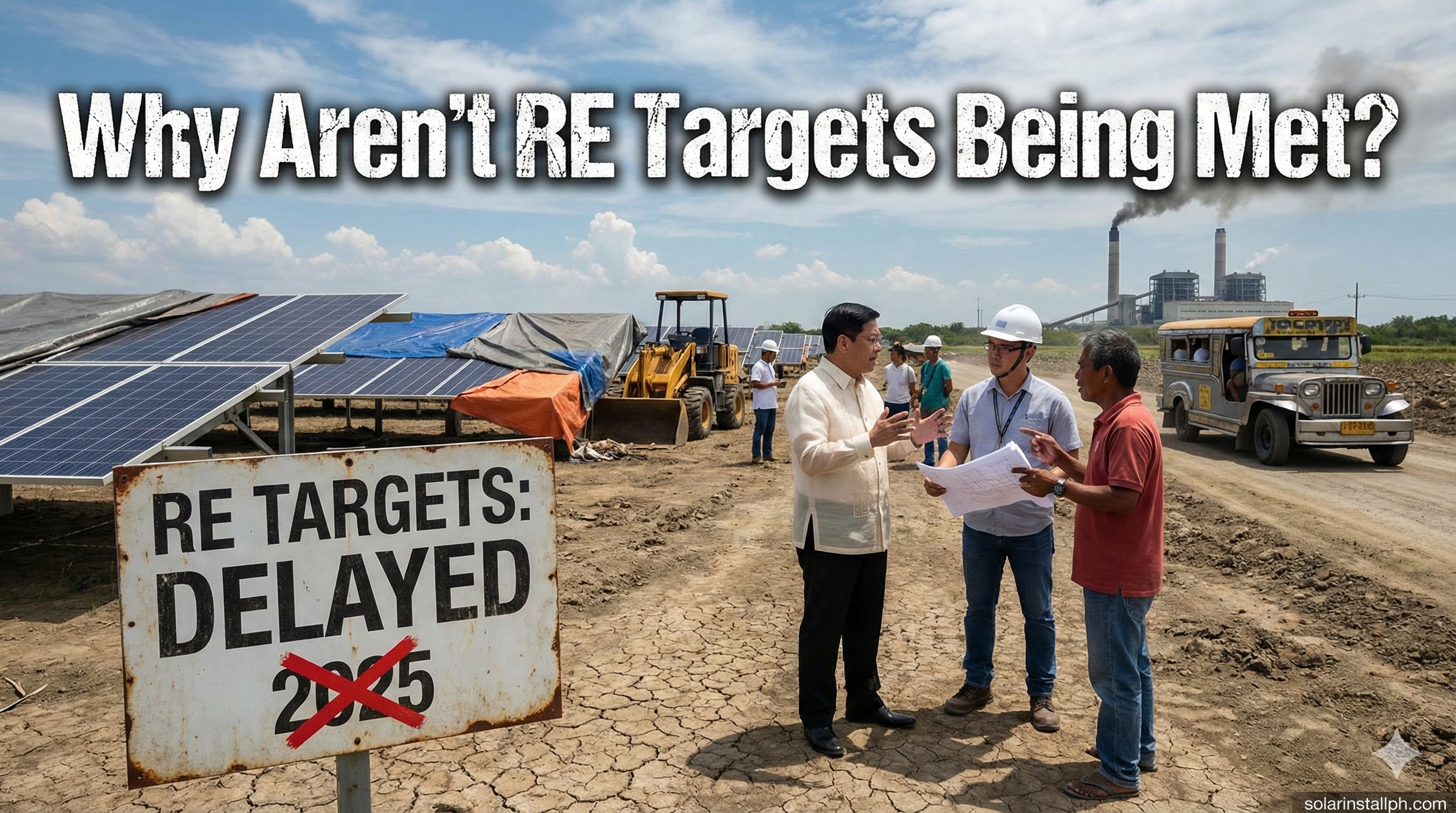
Why Aren't RE Targets Being Met?
The Philippines is currently at a crossroads. While the Philippine Energy Plan (PEP) 2023–2050 boldly targets a 35% renewable energy (RE) share by 2030 and 50% by 2040, the reality on the ground in 2025 and 2026 tells a more complicated story. Despite record-breaking investments and the liberalization of foreign ownership, the country is currently tracking behind these "aggressive" milestones.
For the average Filipino homeowner or business owner, this isn't just a matter of national statistics. It is the reason why electricity rates remain among the highest in Southeast Asia and why brownouts still plague the summer months. To understand why we are missing the mark, we have to look at the practical, structural, and bureaucratic bottlenecks that are slowing down the "green" revolution.
1. The Critical Grid Bottleneck
The most significant hurdle is not a lack of sunlight or wind; it is the infrastructure required to carry that power. The Philippine transmission network, managed by the National Grid Corp. of the Philippines (NGCP), is struggling to keep pace with the influx of variable renewable energy (VRE).
Many awarded solar and wind service contracts are located in provinces far from existing high-voltage transmission lines. This creates a "connection queue" where projects are finished but cannot deliver power to the main load centers like Metro Manila. Furthermore, the intermittent nature of solar requires advanced grid balancing. Without a comprehensive rollout of high-capacity lithium solar batteries at the utility scale, the grid faces stability risks every time a cloud passes over a massive solar farm.
2. The "Paper Project" Crisis
A startling reality surfaced in early 2026: nearly 18,000 megawatts (MW) of energy projects failed to deliver on their commitments. The Department of Energy (DOE) has been forced to initiate a massive "cleanup," terminating over 160 service contracts that were essentially stagnant.
Many developers won bids during the Green Energy Auction Program (GEAP) but failed to commence construction due to financing issues or inability to secure performance bonds. In one high-profile case, a single developer accounted for over 11,000 MW of failed capacity. This "contract chaos" has sidelined legitimate players and delayed the entry of power into the market, directly impacting the long-term solar ROI for the entire industry.
3. Complex Land Acquisition and Permitting
Building a solar farm in the Philippines is a bureaucratic marathon. Even with the Energy Virtual One-Stop Shop (EVOSS) meant to streamline applications, developers often face over 80 different permits across 25 different agencies.
Land acquisition is particularly contentious. Converting agricultural land to industrial use for solar panels involves the Department of Agrarian Reform (DAR), local government units (LGUs), and often indigenous community leaders. These negotiations can take years, pushing project timelines far beyond their original targets. For residential users, while the Meralco net metering guide has simplified things, many still struggle with LGU-specific building and electrical permits that vary wildly from one city to the next.
4. High Upfront Capital Costs
While the cost of solar panels has dropped globally, the Philippines still faces high capital expenditures (CAPEX). High interest rates and a weakening peso make importing top-tier hardware expensive.
For the "little guy," the residential solar cost remains a significant barrier. While businesses can often secure specialized "green loans," many middle-class Filipino families still find the initial PHP 200,000 to PHP 500,000 investment daunting, even if the system pays for itself in five years. The lack of standardized, low-interest financing for the masses is a major reason why rooftop solar hasn't hit the "viral" levels seen in Vietnam or Australia.
5. The Skilled Labor Shortage
You cannot build a 21st-century energy system with a 20th-century workforce. There is currently a substantial gap in the skilled RE workforce in the Philippines. We need thousands of certified solar engineers, wind technicians, and grid specialists, but our vocational and higher education systems are still catching up.
This shortage leads to higher installation costs and, more dangerously, poor installation quality. We frequently see systems that fail within two years because of "cutting corners" on wiring or mounting. If you are planning a system, checking an installer's portfolio and DOE accreditation is now a non-negotiable step to avoid being a victim of this labor gap.
6. The Rise of "Transition" Fuels
There is a policy tension between "Renewables First" and "Reliability Now." To prevent immediate power shortages, the government has allowed for the aggressive expansion of Liquefied Natural Gas (LNG) and even considered requests for "own-use" coal plants despite a moratorium.
While LNG is labeled a "transition fuel," many advocates argue it siphons away the investment and grid capacity that should be going to solar and wind. Every peso spent on a new gas terminal is a peso not spent on the grid upgrades needed to support 100% clean energy.
7. Supply Chain and Typhoon Realities
The Philippines is a unique market. Our archipelagic geography makes logistics expensive, and our typhoon-prone climate requires specialized mounting hardware.
Standard solar mounts designed for the US or Europe often fail during a Signal No. 4 typhoon in Samar or Cagayan. The need for specialized, wind-rated engineering adds a layer of cost and complexity that many regional neighbors don't face. This "local context" means that global hardware drops don't always translate into local price drops immediately.
What This Means For Homeowners
If the national targets are being missed, it means the "grid power" you buy will likely stay expensive for longer. This actually makes the case for self-generation even stronger.
Don't wait for the grid: The targets might be slow, but your roof is ready today.
Prioritize storage: With grid stability being a major target-misser, having your own battery backup is the only way to ensure 24/7 power.
Get legal: As the DOE cleans up "paper projects," they are also getting stricter on unpermitted residential systems.
FAQ
If the targets aren't being met, is solar a bad investment?
On the contrary, it’s a better investment. When national targets are missed, electricity prices usually go up due to supply shortages. Your solar system locks in your price for 25 years.
Is the government doing anything to fix these delays?
Yes. In 2026, the DOE began rebidding 1.35 GW of stalled projects and has shortened the net metering registration to just 20 days to encourage more people to join the "voluntary RE market."
The "Brighter Future" is still coming, but it’s being built house-by-house rather than plant-by-plant for now. By understanding these barriers, you can make a more informed decision on how to protect your own home from the nation's energy growing pains.