
Top-Rated Panel Warranties: An Expert Roundup
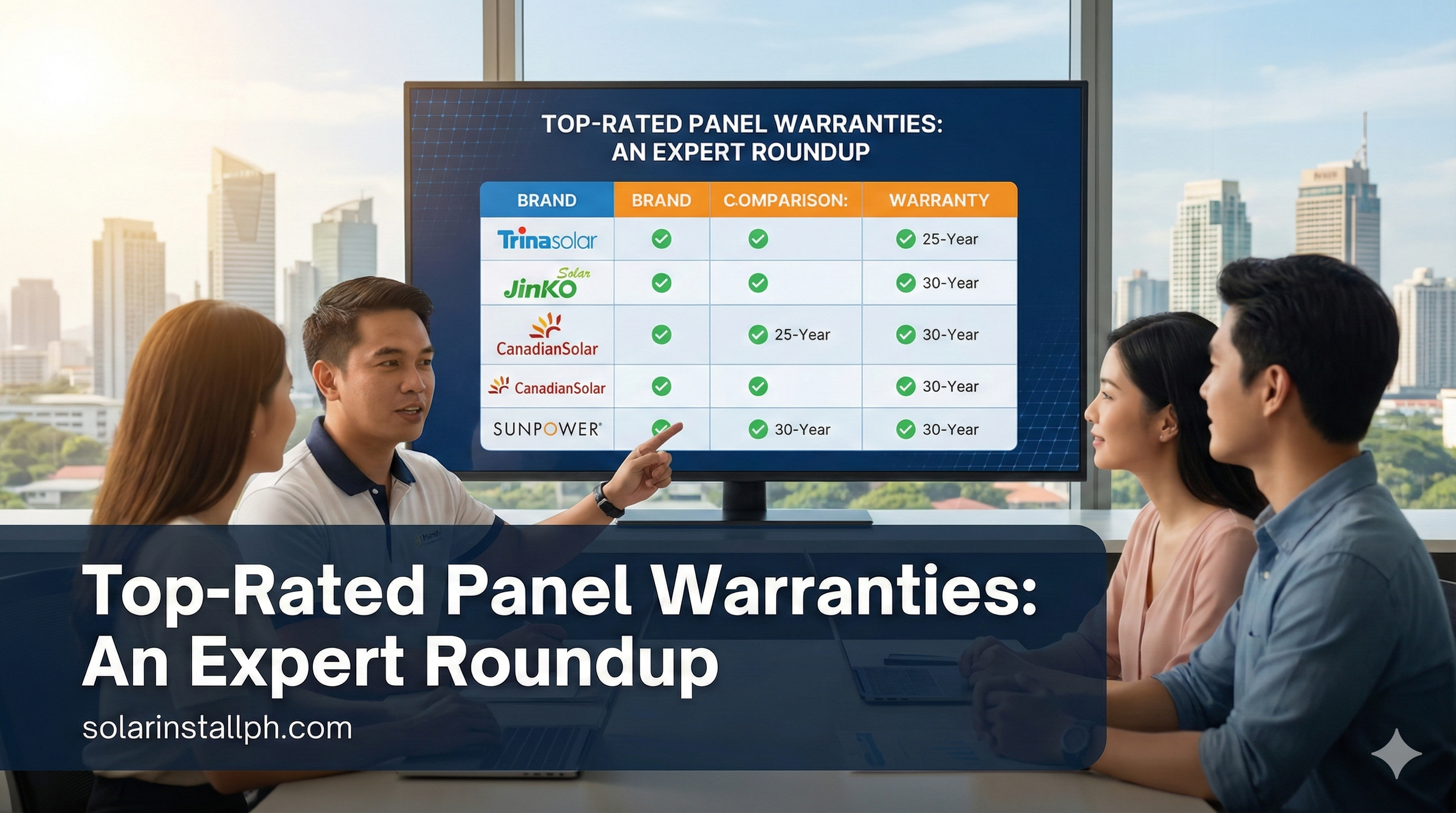
In the Philippine solar market, "25 years" is the magic number everyone throws around. Sales agents use it to justify the high upfront cost, promising you decades of free electricity. But if you actually read the fine print of a standard solar contract, you might find that the "25-year warranty" is not what you think it is.
For Filipino homeowners, the warranty is your only insurance policy against our brutal environment. We have some of the harshest conditions for solar electronics in the world: extreme UV exposure, high humidity, salt spray from our coastlines, and typhoon-force winds. A panel that survives 20 years in Germany might delaminate in 7 years in Cavite if it isn't built for the tropics.
This guide breaks down the best panel warranties available in the Philippines for 2025, distinguishing between marketing fluff and actual protection.
The "Two Warranty" Confusion
Before we list the brands, you must understand the trick manufacturers use. Every solar panel comes with two separate warranties:
1. The Product Warranty (The Important One)
This covers physical defects: the glass shattering, the frame rusting, the backsheet peeling, or water getting inside.
Standard: 12 Years.
Premium: 25 to 40 Years.
Reality: If your panel breaks physically in Year 13, a standard warranty leaves you with zero recourse.
2. The Performance Warranty (The Marketing Number)
This guarantees that the panel will still produce power (usually 80-85% of its original rating) after 25 or 30 years.
The Catch: This warranty is only valid if the panel is physically intact. If the panel has delaminated (peeled apart) in Year 15, the manufacturer can deny the "performance" claim because the product warranty expired in Year 12.
For a deeper dive into how these terms are manipulated, read our guide on comparing panel warranties.
The Gold Standard: Premium Warranties
If you want "install and forget" peace of mind and have the budget for it, these are the brands offering the strongest protection in the Philippines right now.
SunPower (Maxeon)
SunPower has historically been the king of warranties. Their Maxeon line (specifically Maxeon 3 and 6) offers coverage that is almost unheard of.
Product Warranty: 40 Years (if registered).
Performance Warranty: 40 Years.
Why it matters: Their "Interdigitated Back Contact" (IBC) technology uses a solid copper backing. Unlike standard panels that crack under thermal stress (hot Philippine days followed by sudden rain), Maxeon cells are incredibly durable.
The Local Angle: SunPower panels are actually manufactured in Batangas, but they are expensive—often double the price of standard panels. However, for a forever home, this is the safest bet.
REC Group
REC is a favorite among premium installers in Metro Manila. Their "ProTrust" warranty is unique because it includes a labor component, which is rare.
Product Warranty: 25 Years.
Performance Warranty: 25 Years (guaranteeing 92% output, which is very high).
Labor Cover: If you use a certified "REC Solar Professional," they will pay the installer to come out and replace the panel. Most other warranties just ship you a box and tell you to figure it out.
The "Value" Champions: Tier 1 N-Type Panels
In 2024 and 2025, the market shifted. The big Chinese manufacturers (the "Tier 1" giants) moved from older P-Type technology to newer N-Type (TOPCon) technology. This didn't just improve efficiency; it forced them to upgrade their warranties to compete.
If you are looking for top solar brands for 2025, look for these specific models.
Jinko Solar (Tiger Neo N-Type)
Jinko is arguably the most popular brand in the Philippines due to its balance of price and performance.
Product Warranty: 15 to 25 Years (depending on the specific "Tiger Neo" sub-series. The dual-glass versions often carry the longer 25-year product warranty).
Performance Warranty: 30 Years.
Degradation: N-Type panels degrade slower (around 0.4% per year) compared to older panels.
Trina Solar (Vertex S+)
Trina's "Vertex S+" series uses double-glass (bifacial) technology, which makes them much more resistant to moisture ingress—a killer in our humid climate.
Product Warranty: 15 to 25 Years (Series dependent).
Performance: 30 Years.
The Edge: The dual-glass design eliminates the plastic backsheet, which is the most common point of failure in tropical setups.
Longi (Hi-MO 6)
Longi is massive in the utility scale but has aggressive offers for residential rooftops with their Hi-MO 6 line.
Product Warranty: 15 Years (Standard) / 25 Years (some premium versions).
Performance: 25 Years.
Tech: They use a proprietary "HPBC" (Hybrid Passivated Back Contact) technology that removes front busbars for a sleeker look and better shade handling.
For a full list of trusted manufacturers, check our Tier 1 solar list.
The "Grey Market" Risk
This is the most critical section of this article.
In the Philippines, you can find Jinko or Longi panels on Facebook Marketplace for suspiciously low prices. These are often "Grey Market" imports.
These panels were intended for use in China or Vietnam, not the Philippines.
The Risk: If you try to claim the warranty, the local Philippine distributor will reject it because the serial number is not in their database.
You are effectively buying a panel with zero warranty.
Always ask your installer: "Is this panel sourced from an official Philippine distributor?" If they are evasive, walk away.
Reading the Fine Print: "Gotchas" to Avoid
Even with a valid warranty, manufacturers have exclusions that can void your claim.
1. Salt Mist Corrosion
If you live near the beach (Batangas, La Union, Cebu coastal towns), standard panels will corrode. You must check the datasheet for IEC 61701 (Salt Mist Corrosion Testing). Most Tier 1 panels have this, but cheaper generic brands do not.
2. "Return to Base" Policies
Most warranties cover the hardware, but not the logistics.
If a panel fails, the manufacturer will send you a new one.
You often have to pay for the shipping of the defective panel back to the warehouse.
You have to pay your installer to climb the roof, remove the bad panel, and install the new one.
This labor cost can sometimes exceed the value of a single panel (approx ₱6,000).
3. Installation Errors
If the installer walked on the panels during installation (causing micro-cracks), the manufacturer will deny the claim. This is why solar panel degradation often happens faster than the datasheet promises—it's usually bad handling, not a factory defect.
What Happens if Your Installer Disappears?
This is a common scenario: You bought a system with a "25-year warranty," but the installer went bankrupt in Year 3.
If you have Tier 1 panels (Jinko, Canadian, Trina, etc.), you can theoretically contact the country office or a regional distributor to process a claim. It is a hassle, but possible.
If you bought generic, unbranded panels, you are out of luck.
We have a dedicated guide on what steps to take if your solar installer disappears, but the best prevention is buying reputable brands from the start.
Summary: Recommendations for 2025
For the Budget-Conscious: Look for Jinko Tiger Neo or Trina Vertex S+. Ensure you get the "Dual Glass" version if possible, as it naturally lasts longer in our humidity. Aim for at least a 15-year product warranty.
For the "Buy It Once" Homeowner: SunPower Maxeon or REC Alpha Pure. You pay a premium, but you get 25-40 years of actual product coverage, often including labor support.
The Golden Rule: A warranty is only as good as the company honoring it. Prioritize established brands with a physical office in Metro Manila over cheap "direct import" deals.
Don't just look at the price per watt. Look at the price per guaranteed year of energy. A slightly more expensive panel with a 25-year product warranty is cheaper than buying a budget panel twice.