
Commercial Panels: Choosing Top Installers
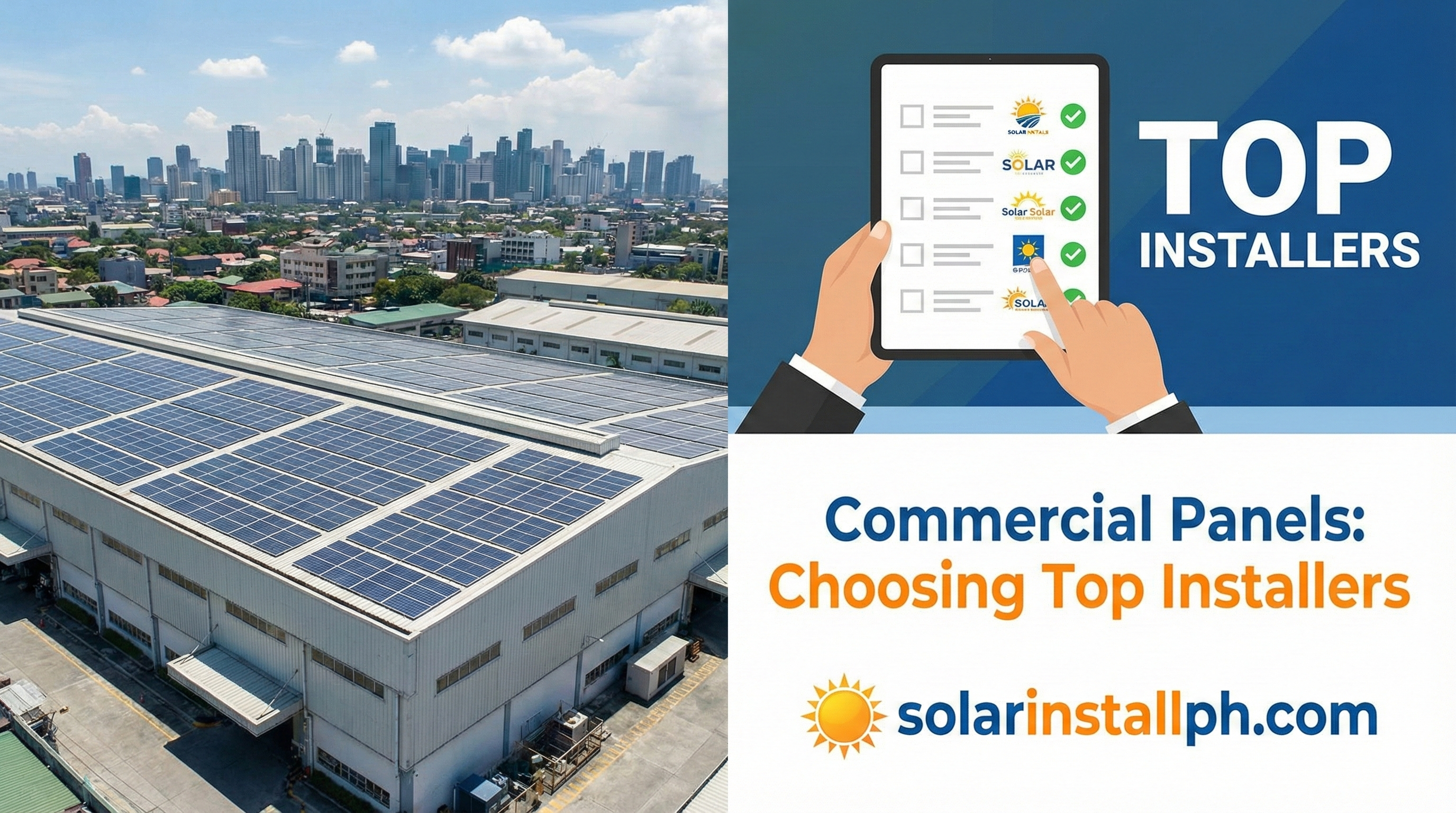
If you are a business owner in the Philippines, installing a commercial solar system is likely one of the smartest capital expenditures you can make in 2025. With grid rates from Meralco and provincial cooperatives averaging between ₱10 to ₱13 per kWh, the ROI math is undeniable.
However, a 100kW commercial rooftop is not just a larger version of a 5kW home system. It involves heavier structural loads, complex three-phase grid integration, and significantly higher financial stakes.
The Philippine solar market is currently seeing a "gold rush" of new installers. While many are legitimate, others are residential installers attempting to punch above their weight class—often with disastrous results for factory roofs. Here is how to filter the noise and choose a partner who can actually deliver a 25-year asset.
The Minimum Legal Barrier: PCAB and DOE
Before you even look at a price tag, you must verify the legal standing of the installer. In the Philippines, this is not just about a Mayor’s Permit.
1. PCAB License
The Philippine Contractors Accreditation Board (PCAB) license is non-negotiable for commercial projects.
Why it matters: A PCAB license ensures the company has the financial capacity and technical experience to handle construction contracts.
The Check: Ask for their PCAB license number and verify it online. Look for "Electrical Work" or "General Building" categories. If they are operating without one, your project is technically illegal, and you have zero recourse if they botch the job.
2. DOE Accreditation
The Department of Energy (DOE) maintains a registry of recognized solar PV installers. While this does not guarantee quality of workmanship, it confirms the company is known to the regulator and has submitted technical requirements.
The Reality: Being on the list is the bare minimum. You can check the latest DOE accredited installers list to see if they are active. For a deeper dive on this, read our guide on verifying installer credentials to ensure they aren't just a paper company.
Inspecting the "Invisible" Technical Specs
Most commercial quotes look identical on the surface: "Tier 1 Panels," "High-Efficiency Inverter," and a total price. The difference between a system that lasts 20 years and one that fails in 3 lies in the details they don't bold in the proposal.
1. Panel Quality Beyond "Tier 1"
"Tier 1" is a Bloomberg finance rating, not a quality score. It just means the manufacturer is bankable.
Ask this: "What is the specific degradation rate of these panels?"
The Standard: You want N-Type TOPCon or HJT panels in 2025. Avoid older Poly or standard Mono PERC if you want maximum longevity.
Warranty: Look for a Product Warranty of at least 12–15 years and a Performance Warranty of 25–30 years. You can read more about comparing panel warranties to understand the fine print regarding salt mist and ammonia corrosion, which is vital if your business is near a coastline.
2. Inverter Cooling for Tropical Heat
Commercial inverters (50kW to 100kW units) generate massive heat.
The PH Factor: In a Philippine summer, your roof ambient temperature can hit 50°C+. If the inverter relies solely on "passive cooling" (heatsinks), it may throttle its output to protect itself, losing you money during peak sun hours.
Recommendation: For large commercial strings, prefer inverters with active cooling (smart fans) or ensure they are installed in a shaded, well-ventilated area.
3. Mounting and Roof Integrity
This is where most "cheap" commercial installs fail. Using a residential installer for a warehouse roof often leads to leaks.
The Risk: A commercial installer must understand "wind load" calculation. The Philippines faces typhoons with gusts exceeding 200 kph. If the clamps aren't specified for that load, your panels could become airborne debris.
The Material: Ensure they use anodized aluminum rails, not galvanized iron that will rust in 3 years.
The Financials: Red Flags in the Quote
When you compare three bids, one will usually be significantly cheaper. Before you sign, check for these common omissions.
Undersized AC Wire: Copper is expensive. Some installers cut costs by using thinner AC cables from the inverter to your main breaker. This causes voltage drop, meaning the energy you generate is lost as heat before it even enters your building.
Excluding Mobilization/Demobilization: Ensure the quote includes all logistics, especially if your site is outside Metro Manila.
Hidden O&M Costs: Does the quote include the first year of cleaning and maintenance? If not, you need to budget for it.
For a realistic baseline, check our breakdown of commercial solar costs to see what a fair market price looks like per kilowatt-peak.
Questions to Ask During the Site Visit
Do not hire an installer who only looks at your roof via Google Maps. A physical site visit is mandatory for commercial projects to assess cable routes, roof condition, and electrical room capacity.
Ask them these direct questions:
"Who is your full-time safety officer?"
Commercial sites require a DOLE-accredited Safety Officer (SO2 or SO3) on-site. If they don't have one, they are cutting corners on safety.
"Do you sub-contract the labor?"
Many sales companies win the bid and then hire freelance electricians to do the work. This nightmare scenario often leads to finger-pointing when things break.
"Can I visit a system you installed 3 years ago?"
Any installer can show you a photo of a brand-new system. You want to see one that has survived a few rainy seasons. Look for rust on the bolts and loose wires.
Be wary of generic generic "5-star reviews" on social media. Learn to spot the red flags in solar reviews to separate real client feedback from marketing fluff.
The "After-Sales" Reality
Commercial solar is a 25-year relationship. If the inverter throws an error code in Year 4, who do you call?
Local Support: Ensure the inverter brand has a local service center in the Philippines (e.g., Huawei, Sungrow, Growatt, SMA). If the unit has to be shipped back to China for repair, your system could be offline for months.
Monitoring: You should have full admin access to the monitoring app. Do not let the installer hold your data hostage.
Conclusion
Choosing a commercial solar installer is a risk management exercise. You are modifying a business asset to save millions in operating costs over the next two decades.
Don't get distracted by the lowest price per watt. Focus on the LCOE (Levelized Cost of Energy)—which depends heavily on the system actually working for 25 years. Verify their PCAB license, check their DOE accredited installer status, and demand a bill of materials that specifies every bolt and wire.
If a deal feels too good to be true, it’s likely because they are using undersized wires or unlicensed labor. In the Philippine commercial sector, you truly get what you pay for.