
Manila Energy Installers: Your How-To Guide
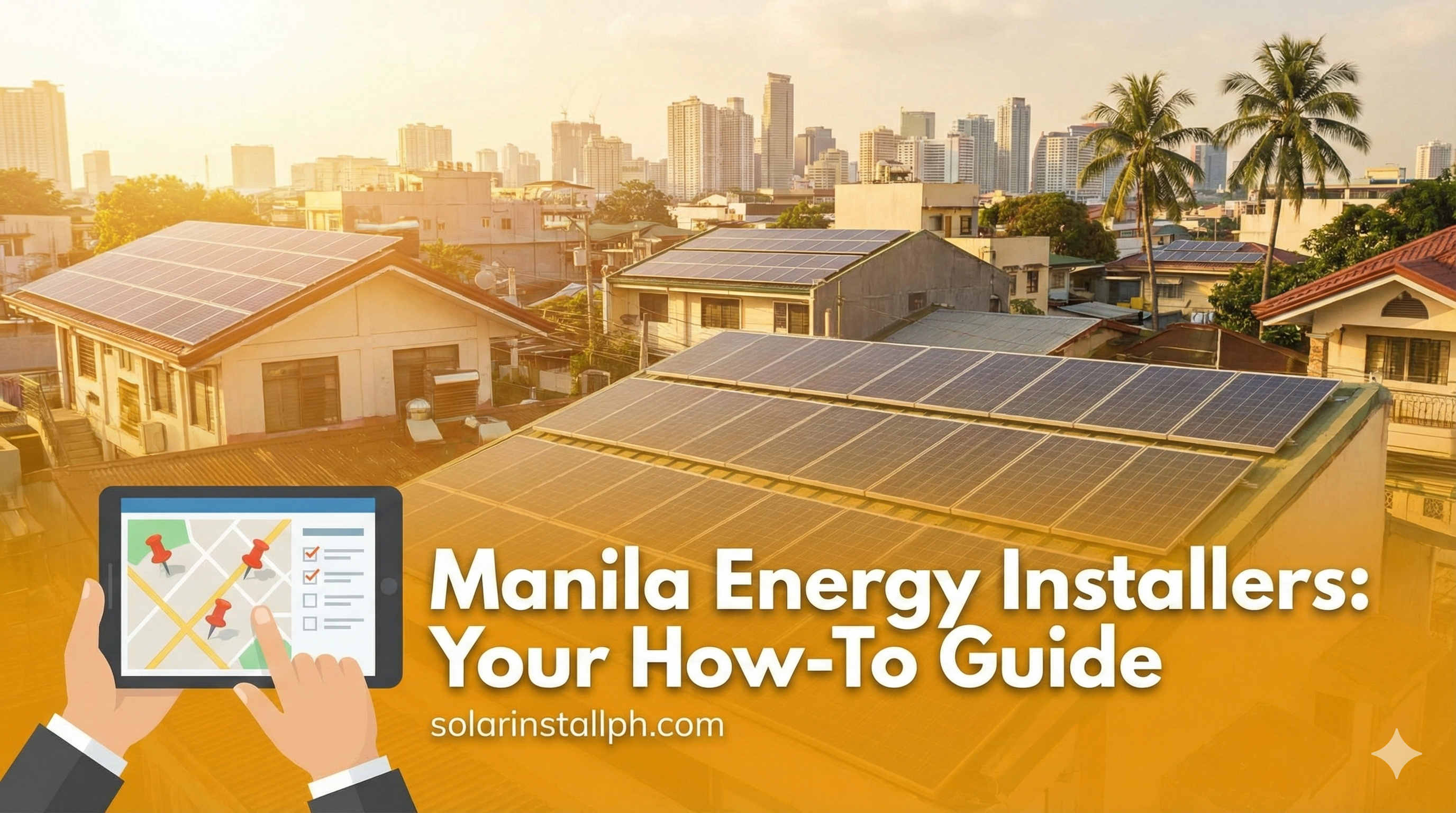
If you live in Metro Manila, you know the specific pain of opening a Meralco bill. Our rates hover between ₱11 and ₱13 per kWh, some of the highest in Asia. Solar isn't just "green" here; it’s a financial survival strategy.
But Manila is also the Wild West of solar installation. For every legitimate engineering firm, there are three fly-by-night operators selling substandard kits on Facebook Marketplace.
Finding a reliable installer in the Metro isn't just about Googling "best solar." It’s about navigating LGU permits in Quezon City vs. Makati, dealing with shading from your neighbor's three-story firewall, and understanding how Meralco actually handles grid connection.
This guide walks you through the practical steps of getting solar done right in the National Capital Region.
The Manila Context: Why It’s Different Here
Installing solar in Metro Manila presents unique challenges compared to a farm setup in Bulacan or a resort in Batangas.
Space is Premium: Most Manila roofs are small or cut up by gables. You don't have the luxury of vast space, so you often need higher-efficiency panels to hit your target generation.
Shading is Real: In dense subdivisions, your neighbor’s roof, a nearby condo, or even Meralco poles can cast shadows. A standard string inverter might fail if just one panel gets shaded.
Permit Variance: The rules in Valenzuela differ from Taguig. Some LGUs are streamlined; others require weeks of back-and-forth for a simple building permit.
Step 1: Define Your Goal (Offset vs. Backup)
Before calling an installer, decide what you are trying to solve.
Scenario A: "I want to lower my bill."
You need a Grid-Tie System. This is the most common setup in Manila. It has no batteries. It powers your house during the day, and you buy from Meralco at night. It offers the fastest ROI (typically 4–5 years).
Scenario B: "I hate brownouts."
You need a Hybrid System. This includes batteries (lithium-ion, usually). It costs 30-50% more than grid-tie. Be honest with yourself: do you really need to run ACs during a blackout, or is that just a nice-to-have? In Manila, brownouts are annoying but usually short. Unless you have critical needs (medical equipment, servers), a grid-tie system is often the smarter financial play.
To understand the financial commitment, check our breakdown on the cost of residential solar to set a realistic budget before you start getting quotes.
Step 2: Finding and Vetting Installers
This is where homeowners get burned. Do not hire based on the lowest price per watt alone. A "cheap" install often means undersized wires, no grounding, or mounting rails that will rust in two years.
Where to Look
Referrals are gold, but verify them. If you don’t have referrals, look for companies with a physical office in the Metro. If they only have a mobile number and a Facebook page, walk away.
The Credibility Check
When you interview an installer, ask for their PCAB license or DTI registration. Ask to see photos of installs they did three years ago, not just last week. You want to see if their work holds up to Manila's pollution and typhoons.
You should also check if they are familiar with the specific permitting requirements of your city. A good installer knows the difference between a permit in QC and one in Pasig. For a more detailed checklist, read our guide on how to verify their credentials.
For a curated list of companies operating in the region, you can browse our directory of installers in Metro Manila.
Step 3: Navigating Permits in the Metro
There is a myth that you don't need permits for "small" solar. This is false.
In Metro Manila, you generally need:
Barangay Clearance: Usually fast.
Building Permit: Requires structural analysis. This proves your roof won't collapse under the weight of the panels (approx 20kg per panel).
Electrical Permit: Requires plans signed by a Professional Electrical Engineer (PEE).
CFEI (Certificate of Final Electrical Inspection): Issued by City Hall after the work is done.
Some installers will offer to "skip" this to save you money. Do not agree to this. Without a CFEI, you cannot apply for Net Metering with Meralco. Without Net Metering, you are leaving money on the table.
The strictness varies. Quezon City is known for being thorough but bureaucratic. Other cities might be faster. For a deep dive on the paperwork, see our article on securing permits in NCR.
Step 4: The Meralco Net Metering Application
In Manila, Net Metering is the secret sauce to solar savings.
Without Net Metering, any excess power your panels produce (like when you're at the office during the day) flows into the grid for free. You get zero credit for it.
With Net Metering, Meralco replaces your meter with a bi-directional one. They pay you (via bill credits) for every kWh you export. These credits can offset your night-time usage.
The Process:
Your installer submits the technical docs (DIS, Yellow Card application) to Meralco.
Meralco conducts a Distribution Impact Study (DIS). For typical residential homes, this is usually straightforward.
You submit the CFEI (from Step 3).
Meralco installs the new meter.
It can take 2-4 months, but it is worth the wait. For a step-by-step walkthrough, refer to our Meralco Net Metering guide.
Step 5: Equipment Selection
You don’t need to be an engineer, but you should know the basics to avoid being upsold or under-served.
Panels: Look for "Tier 1" brands (e.g., Jinko, Longi, Trina, Canadian Solar, JA Solar). In Manila's limited roof space, aim for panels with at least 550W capacity to maximize yield.
Inverters: This is the brain of the system. Brands like Huawei, Sungrow, Growatt, and Deye are common here. If you have significant shading issues (trees, buildings), consider microinverters (like Enphase) or optimizers, though they cost more.
Mounting: Ensure they use aluminum rails and stainless steel bolts. Manila air is humid and polluted; galvanized iron will rust eventually.
Common Mistakes to Avoid
Undersizing the System: Installing 1kW is rarely worth the permit hassle. The "sweet spot" for a typical Manila middle-class home is often 3kW to 5kW.
Ignoring the Roof Condition: If your GI sheet roof is 15 years old and rusting, replace it first. You do not want to dismantle solar panels two years later to fix a leak.
The "Zero Export" Trap: Some installers set systems to "zero export" to avoid getting a Net Metering permit. This stops your meter from spinning forward when you export, but it wastes potential production. It's a temporary fix, not a long-term strategy.
Conclusion
Getting solar in Manila is a project, not a product purchase. It involves engineering, legal paperwork, and financial planning.
The good news? The math works. With Manila's electricity rates, a well-installed system pays for itself in roughly 4 to 5 years. After that, you are essentially generating free electricity for the next two decades.
Start by getting your consumption data (your average monthly kWh). Then, contact 3 reputable installers for quotes. Compare them not just on price, but on their willingness to handle the Meralco permits for you. In this city, a headache-free application process is worth paying a premium for.