
7 Best Business Energy Advantages Now
For Philippine business owners in 2025, the energy landscape is unforgiving. Meralco's commercial rates remain volatile, fluctuating between ₱11.00 and ₱15.00 per kilowatt-hour (kWh) depending on your load profile and generation charges. The days of treating electricity as a fixed, uncontrollable expense are over.
Today, managing your energy isn't just about cutting costs; it's about competitive survival. While most consultants will pitch you on "going green," the real drivers for business renewables in 2025 are purely financial and strategic.
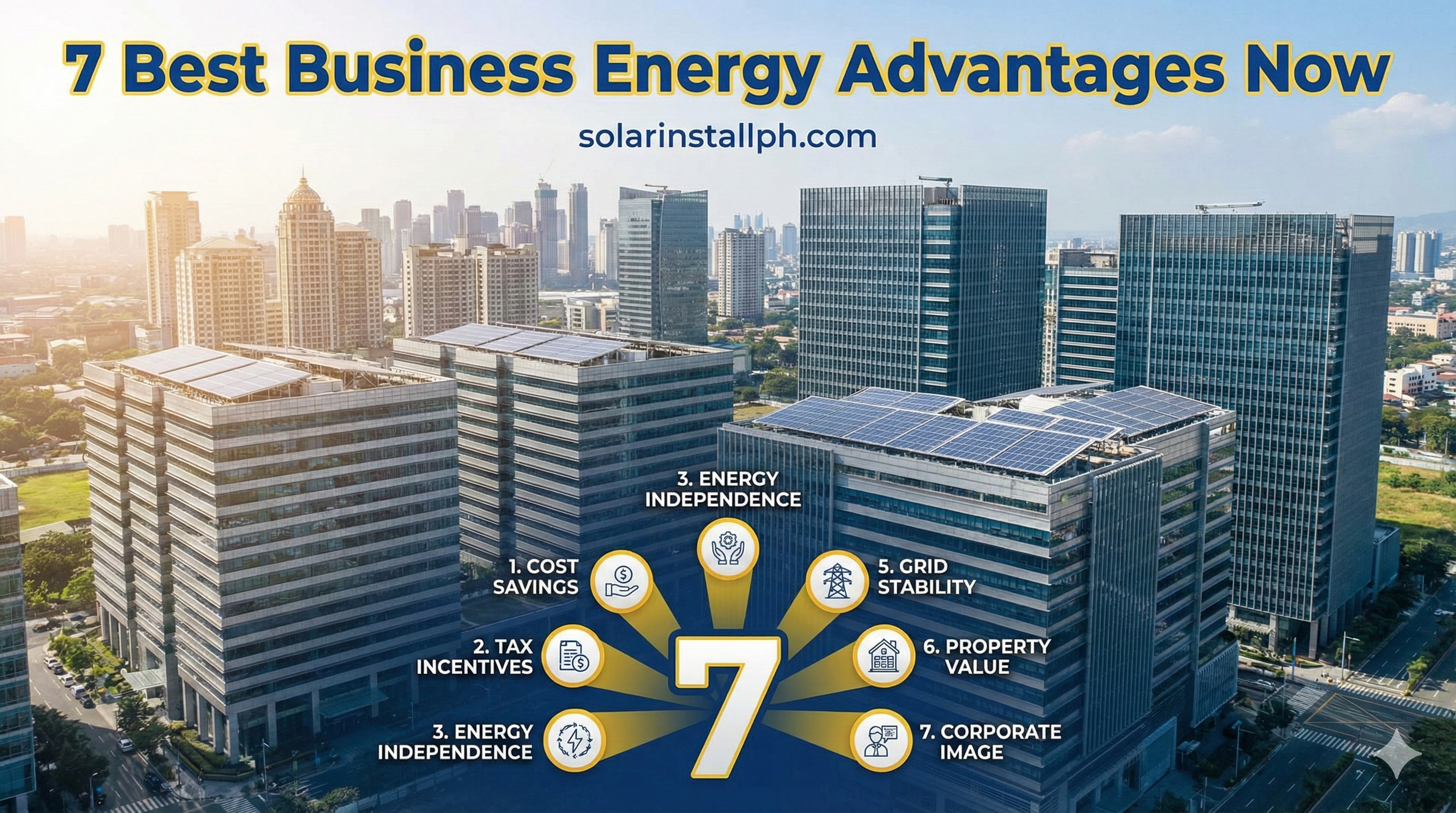
Here are the 7 definitive advantages available to Philippine companies right now—some of which you might be eligible for without even installing a single solar panel.
1. The GEOP "Power Choice" Advantage
If your monthly average peak demand is 100kW or higher, you hold a powerful card: Contestability.
Under the Green Energy Option Program (GEOP) and Retail Competition and Open Access (RCOA), qualifying businesses can fire their default distribution utility (for the generation portion of the bill) and sign a contract directly with a Retail Electricity Supplier (RES).
The Advantage: You move from a volatile, blended grid rate to a negotiated, fixed rate.
The Savings: Often ₱1.00 to ₱2.50 per kWh cheaper than the captive market rate.
No CapEx: You don't need to install rooftop solar. You just need to switch suppliers.
Check if you qualify. If your bill shows a peak demand of 100kW+ (roughly a ₱250k+ monthly bill), you are leaving money on the table by staying captive. Learn more about the program mechanics in our GEOP guide.
2. Inflation Hedging (The 25-Year Pre-Pay)
When you install a commercial solar system, you are essentially pre-paying for your electricity for the next 25 years at a fixed price.
Grid Reality: Historical trends show Philippine electricity rates rising by 3–5% annually.
Solar Reality: Your "Levelized Cost of Electricity" (LCOE) is locked in the moment you commission the system—typically around ₱3.50 to ₱4.50 per kWh.
While your competitors fret over every Meralco rate hike announcement, your energy costs remain flat. This predictability allows for aggressive pricing on your own products.
3. Peak Shaving to Crush Demand Charges
Many factories pay a "Demand Charge" penalty for their highest 15-minute usage spike in a month. This can account for 30% of your total bill.
The advantage in 2025 comes from Hybrid Commercial Systems. By using a battery energy storage system (BESS), you can "shave" these peaks.
How it works: When your facility powers up heavy machinery at 9:00 AM, the system draws from the battery instead of the grid.
The Result: Your "Peak Demand" stays low, slashing the penalty fee on your bill, even if your total energy consumption stays the same.
See how batteries are changing the math in our analysis of top solar batteries for 2025.
4. Fiscal Incentives (Tax Holidays & Duty-Free Imports)
The government is actively subsidizing your transition—if you know how to file the paperwork. Under the Renewable Energy Act (RA 9513), registered projects can access:
Income Tax Holiday (ITH): Exemption from income tax for up to 7 years.
Duty-Free Importation: No tariffs on your solar panels and inverters.
VAT Zero-Rating: On local purchases of RE equipment.
For a large manufacturing plant, these incentives can reduce the ROI period from 5 years down to 3.5 years. However, this requires strict compliance with BOI registration processes. Read our breakdown of renewable energy incentives to see if your project size qualifies.
5. Export Compliance (The CBAM Shield)
If you export goods to Europe, the Carbon Border Adjustment Mechanism (CBAM) is no longer a future threat—it is here. European importers now have to report the carbon footprint of the goods they buy. Soon, they will pay a carbon tax on "dirty" imports.
The Advantage: A Philippine factory running on solar (or GEOP renewable power) has a lower carbon footprint.
The Result: Your products become cheaper for European buyers compared to competitors running on coal-heavy grid power. This is a massive competitive edge for export-oriented zones (PEZA).
6. Asset Monetization (Roof Rental)
If you have a massive roof (e.g., a warehouse or logistics center) but no capital to invest in solar, you can monetize the real estate itself.
PPA Model: Third-party investors will rent your roof to install their own solar panels.
The Deal: They sell the power to you at a discount (e.g., ₱9.00/kWh vs grid’s ₱12.00/kWh).
The Benefit: You turn an idle asset (your roof) into a cost-saving machine with Zero CapEx and zero maintenance liability.
Explore how this ownership model works in our financing options guide.
7. Operational Resilience (Brownout Protection)
Finally, the advantage of uptime. The Luzon grid faces recurring "Yellow" and "Red" alerts during the summer months. For a BPO or cold storage facility, a 2-hour brownout is a disaster.
A Hybrid Solar System acts as a giant UPS. It switches seamlessly to battery power during a grid failure, keeping critical loads (servers, freezers) running without the noise and fuel cost of a diesel genset. In a country where grid reliability is suspect, energy independence is the ultimate insurance policy.
The Bottom Line
Energy is no longer a utility bill; it is a strategic lever. Whether through policy mechanisms like GEOP, financial instruments like tax holidays, or hardware solutions like hybrid storage, the tools to slash your OpEx exist.
Next Step: Don't guess which advantage fits your business. Start with the numbers. Use our commercial solar cost guide to estimate the investment required for your facility size.