
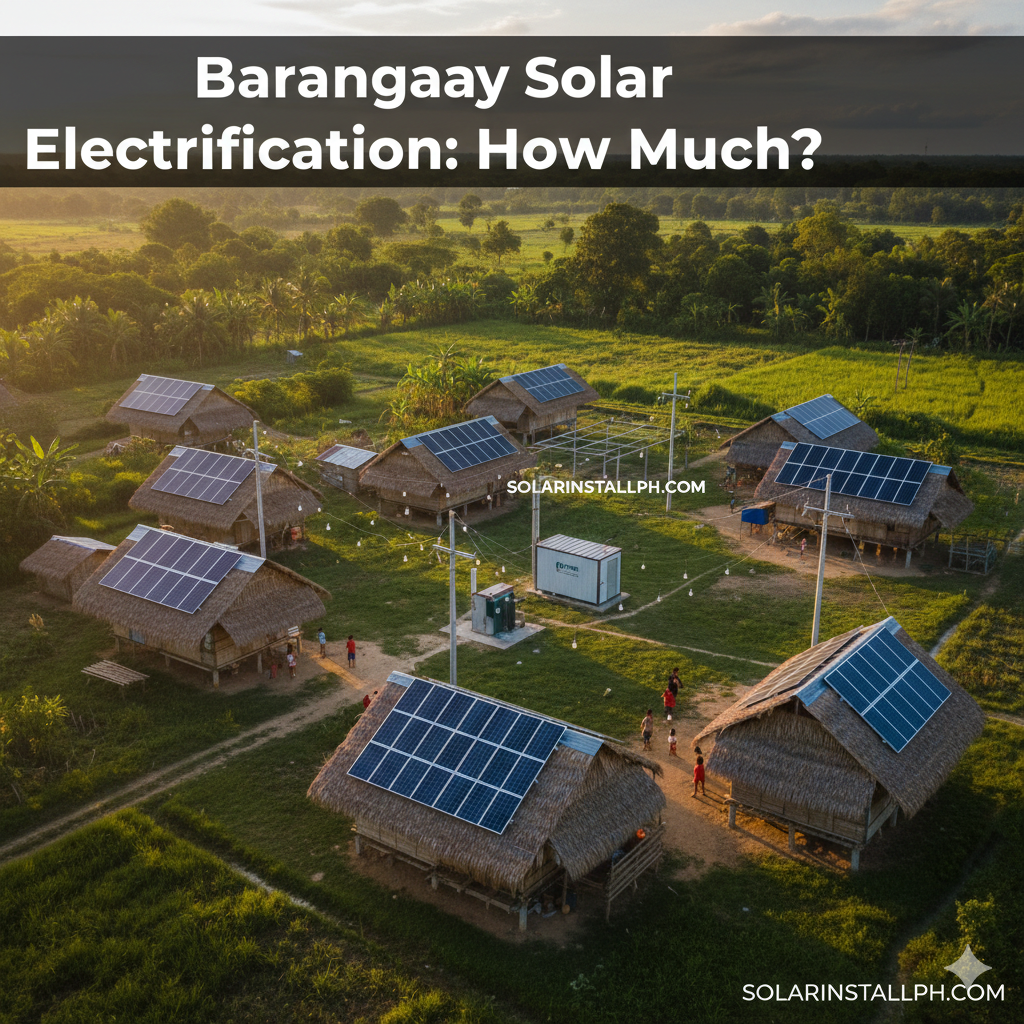
Barangay Solar Electrification: How Much?
Barangay electrification has shifted from a distant government promise to a practical community reality in 2025. With the Department of Budget and Management (DBM) recently approving over ₱3.6 billion for rural electrification, local leaders are no longer asking if they should go solar, but rather how much it will actually cost to light up their halls, health centers, and streets.
The Cost of Powering the Barangay Hall
The barangay hall is the heart of local operations, often housing computers, refrigerators for medicines, and cooling systems for frontline workers. For a typical barangay hall with a monthly electricity bill ranging from ₱15,000 to ₱35,000, a 5kWp grid-tied solar system is the standard recommendation.
In 2025, the estimated cost for a professionally installed 5kWp system in the Philippines is approximately ₱365,000. This investment can generate roughly 22.5kWh of usable daytime power daily, effectively canceling out the hall's daytime consumption. For smaller barangay health centers or daycares with lower energy needs, mid-sized systems around 3.2kWp can start at ₱183,000.
When budgeting for these facilities, it is crucial to understand the residential solar cost metrics, as public buildings often follow similar pricing structures but may require more robust industrial-grade mounting to handle heavier wind loads.
Solar Street Lighting: Safety at a Lower Price
One of the most immediate impacts of barangay-level solar is public safety through street lighting. Transitioning to solar street lights removes the monthly electricity bill usually paid to the local cooperative or distribution utility.
The price for individual units in the Philippine market varies by wattage and build quality:
30W All-in-One units: ₱1,800 to ₱4,500 per unit.
60W Heavy-duty units: ₱2,400 to ₱7,500 per unit.
100W High-output units: ₱3,500 to ₱12,000 per unit.
For larger projects, barangays often source in bulk to reduce unit costs by 30% to 50%. When planning these installations, refer to our guide on solar street lights to ensure the specifications match the road width and safety requirements of your specific area.
Lighting Up Remote Sitios and Islands
For geographically isolated and disadvantaged areas (GIDA), the Department of Energy (DOE) utilizes the PV Mainstreaming Program. This program provides Solar Home Systems (SHS) to remote households under a "fee-for-service" mechanism.
Solar PV Mainstreaming: The government has allocated ₱120 million to distribute 4,000 units in 2025 to provide electricity to communities without grid access.
Microgrids: Small-scale microgrid projects, which provide 24/7 power to entire villages, can have substantial initial investment costs, sometimes exceeding ₱20 million for community-wide systems.
Islands like Cagbalete are now achieving 100% household electrification through hybrid microgrids, proving that off-grid solar is the most viable path for remote barangays that the main grid cannot reach economically.
Government Grants and Funding Sources
Barangay captains do not have to rely solely on their Internal Revenue Allotment (IRA) to fund these projects. Several national programs are active in 2025:
1. Strategized Rural Electrification Program
Administered by the National Electrification Administration (NEA), this program funds the Sitio Electrification Program (SEP) and the Barangay Line Enhancement Program (BLEP). In 2025 alone, ₱3.439 billion was earmarked to energize over 1,750 sitios.
2. Support to Barangay Development Program (SBDP)
Since 2022, the DILG has funded 463 rural electrification projects through the SBDP, benefiting over 3.1 million Filipinos in insurgency-cleared barangays. These projects include both on-grid connections and off-grid solar solutions.
3. ER 1-94 Financial Benefits
Starting January 2026, communities hosting energy projects will see increased financial benefits. The total benefit has risen to ₱0.03 per kWh generated, with a portion specifically allocated for electrification projects. This means a 100MW solar facility could provide roughly ₱5.5 million annually to its host community.
Avoiding Common Budgeting Mistakes
When a barangay prepares its solar roadmap, two major factors often lead to budget overruns or system failure:
Neglecting Mounting and Wind Load
In the Philippines, a "cheap" installation often skips the necessary structural reinforcements. Any barangay project must account for typhoon-resistant mounting to ensure the panels don't become flying debris during a storm. This is especially critical for public buildings that serve as evacuation centers.
Failure to Verify Installers
Government projects are prone to fly-by-night contractors. It is essential to verify installer credentials and ensure they are DOE-accredited. A system that stops working after six months due to poor wiring is a waste of community funds.
Summary of Costs for 2025
Component | Estimated Cost (2025) | Coverage/Capacity |
Solar Street Light (60W) | ₱2,400 – ₱7,500 | 10-15 meter radius |
Hall Solar (Grid-Tied) | ₱365,000 | 5kWp / ~22.5kWh daily |
Health Center (Mid-size) | ₱183,000 | 3.2kWp |
PV Mainstreaming Unit | Gov-Funded | Per remote household |
Conclusion
Barangay solar electrification is no longer an experimental technology; it is a proven financial and social investment. By understanding the real-world costs—from ₱2,400 street lights to ₱365,000 hall systems—local leaders can make informed decisions that bring safety, dignity, and economic opportunity to their constituents.