
Typhoon-Proofing: Your Backup Energy Collective
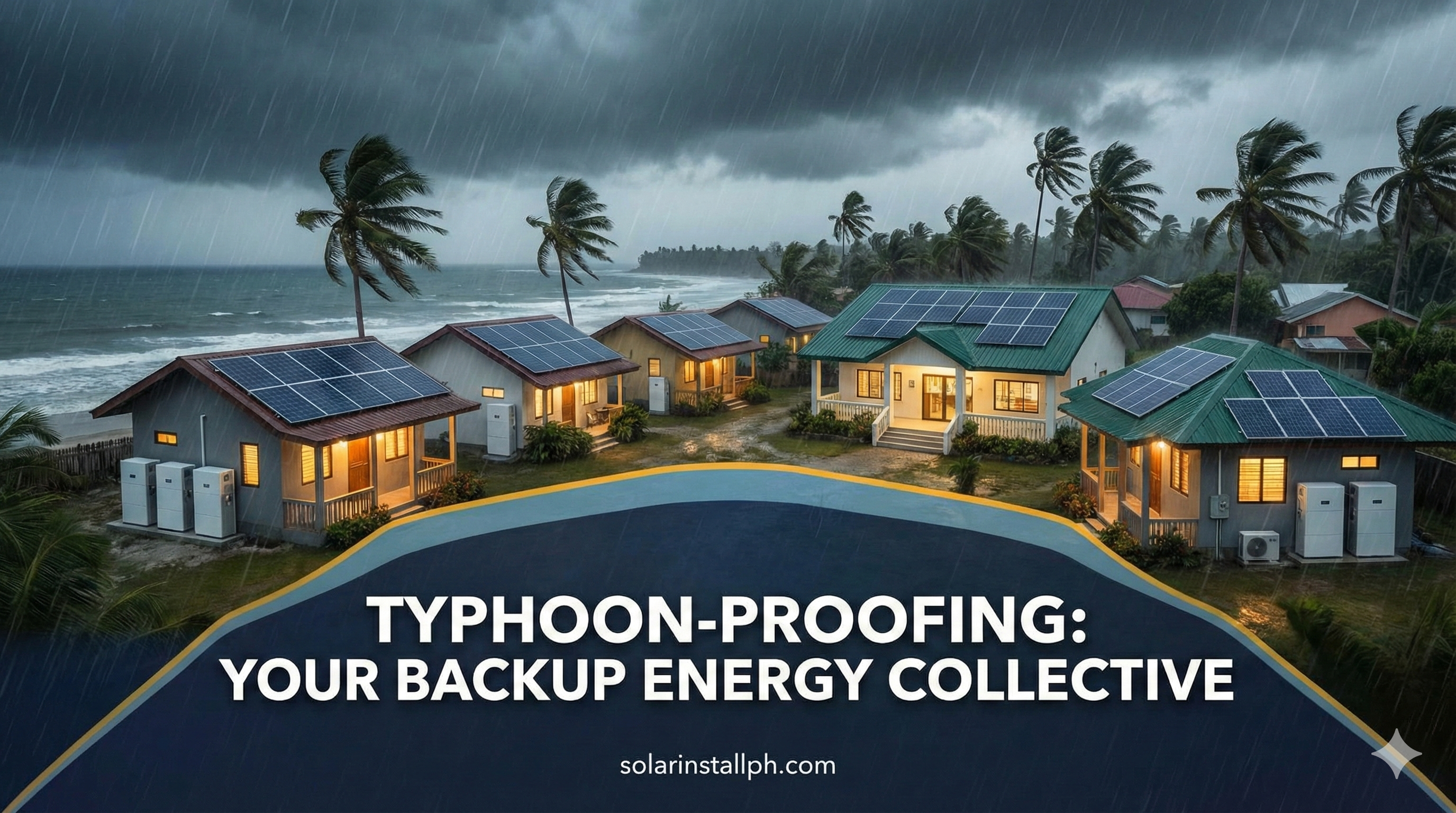
When Super Typhoon Odette slammed into the Visayas or when severe Tropical Storm Kristine submerged Bicol, the aftermath followed a predictable, heartbreaking pattern. The winds died down, the floods receded, and then the silence set in. For weeks, entire provinces were plunged into darkness.
In these moments, the "every man for himself" approach to energy fails. You might have a solar system, but if your neighbors are in the dark, the social pressure—and the security risk—rises. Conversely, if you are the one without power, you are left relying on the kindness of strangers to charge a phone just to tell your family you are alive.
The solution is not just individual resilience; it is collective resilience. In the Philippines, where bayanihan is a cultural reflex during disasters, we are seeing the rise of the Backup Energy Collective. This isn't a formal utility company; it is a practical, neighborhood-level strategy to share power when the grid is dead.
Here is how to structure, typhoon-proof, and manage a shared energy sanctuary for your community.
1. The Anchor: Establishing the "Hub" House
Every collective needs a source. In a neighborhood setting, this is the "Hub House"—usually the residence with the most robust solar setup. If you are reading this, that is likely you.
To serve as a community hub, a standard grid-tie system is useless. As we have discussed before, grid-tie inverters shut down when Meralco goes offline. To support a collective, the Hub House must have a Hybrid System capable of "island mode."
The Hardware Requirement
You need a battery bank that can absorb not just your load, but the "parasitic" load of your neighbors' essentials (phones, emergency lights, nebulizers).
Chemistry Matters: Old lead-acid batteries cannot handle the rapid cycling of a community charging station. You need Lithium Iron Phosphate (LiFePO4) batteries, which can be discharged to 80-90% and recharged quickly when the sun briefly peeks through the storm clouds.
Sizing: A 10kWh battery bank is the minimum for a Hub House. This allows you to run your own fridge while charging 50+ smartphones for the barangay.
For a breakdown of the specific battery brands available locally that can handle this abuse, check our review of top solar batteries for 2025.
2. The "Bucket Brigade": Portable Power Stations
Running 50-meter extension cords across wet streets is a safety hazard and a logistical nightmare. It leads to voltage drop and tripping hazards. Instead of moving the power to the people via wires, move the power via "buckets."
In 2025, the "bucket" is the Portable Power Station (PPS).
The Swap Protocol
A sophisticated energy collective uses PPS units as energy jerrycans.
Charge at the Hub: Neighbors bring their drained PPS units to the Hub House during the peak sun hours (10:00 AM – 2:00 PM).
Transport: Once charged, they carry the unit back to their own homes.
Discharge: They use the PPS to run their own electric fans and lights at night.
This decentralizes the consumption. The Hub House doesn't need to host 20 people sleeping on the floor; it just needs to dispense energy. This method was effectively used in Bicol during recent storms, where microgrids kept essential services running. To see which units are best for this "carry-and-charge" strategy, consult our guide on portable power stations.
3. Typhoon-Proofing the Source
A collective is only as strong as its weakest clamp. If the Hub House loses its panels in the first hour of the typhoon, the entire neighborhood loses its backup plan.
We often see "community solar" projects fail because they focused on battery capacity but scrimped on mounting. In the Philippines, wind loads can exceed 2400 Pascals (standard rating). For a critical infrastructure asset like a Hub House, you must build for 5400 Pascals.
The Reinforcement Checklist
Third Rail: Add a middle rail to support the center of the panels against uplift.
Locking Washers: Use DIN 25201 washers to prevent clamps from vibrating loose during the 12-hour battering of a slow-moving typhoon.
Truss Anchors: Ensure the roof itself is tied down to the house beams.
If you are the designated energy provider for your street, you have a responsibility to structural integrity. Review the specific engineering requirements in our article on typhoon-resistant mounting.
4. The Rules of Engagement: Governance
Technology is easy; sociology is hard. When resources are scarce, tensions flare. A Backup Energy Collective needs clear rules before the storm hits.
The "Voltage Triage"
You must establish a hierarchy of loads. The Hub House cannot power everyone's air conditioner.
Tier 1 (Critical): Medical devices (oxygen concentrators, nebulizers), communications (radios, WiFi routers), and emergency lights. These get priority charging.
Tier 2 (Comfort): Electric fans and laptops. These are allowed only if the battery is above 70%.
Tier 3 (Banned): Air conditioners, rice cookers, and flat irons. These high-draw resistive loads are strictly prohibited for non-residents.
This "triage" approach mimics the disaster response protocols used by LGUs and NGOs. It ensures the battery bank survives the night. For more on structuring these shared agreements, read our insights on community solar models.
5. The Future: Peer-to-Peer (P2P) Trading
Currently, most energy collectives are informal—neighbors helping neighbors. However, the regulatory landscape in the Philippines is shifting. The Expanded Roof-Mounted Solar Program (ERSP) and recent DOE circulars are opening the door for Peer-to-Peer (P2P) Energy Trading.
From Charity to Commerce
In the near future, you won't just be "donating" power to your neighbor; you could be selling it automatically via blockchain-enabled smart meters.
The Vision: Your surplus solar energy is sent to your neighbor's house via the existing secondary lines, and the payment is settled digitally.
The Reality: While the policy framework exists, the technical implementation (smart meters and DU integration) is still in the pilot phase.
Until automated P2P becomes mainstream, the "manual P2P" of charging stations remains the standard. However, this future highlights why investing in oversized off-grid capacity is a smart long-term bet. You aren't just buying backup; you are building a future revenue stream. To prepare your system for this high-capacity future, ensure your components are robust. Check our off-grid solar guide for sizing tips.
6. Safety: The "Octopus" Danger
In the chaos of disaster response, safety standards often collapse. We see "octopus connections"—daisy-chained extension cords overloaded with plugs—causing fires in evacuation centers and homes.
The Collective Safety Protocol
If you are running a Hub House:
No Generic Chargers: Inspect the chargers neighbors bring. Damaged cables spark fires.
Battery Isolation: If you are charging loose 12V batteries for neighbors, do it outside on concrete. Do not charge lead-acid batteries indoors (they vent hydrogen gas).
Temperature Checks: During heavy charging sessions, check your inverter and battery terminals for heat buildup.
A battery fire during a typhoon is a worst-case scenario because fire trucks cannot navigate flooded streets. Strict adherence to safety is non-negotiable. Learn the specific risks in our article on solar battery safety.
Conclusion
The "Backup Energy Collective" is the modern evolution of the Filipino bayanihan spirit. It acknowledges that in the face of climate change, isolation is vulnerability.
By upgrading your home’s solar system to a typhoon-proof Hybrid Hub, you do more than just keep your own lights on. You become a pillar of stability for your street. You provide the power that keeps families connected, keeps medical devices running, and keeps hope alive until the grid returns. That is an ROI that no electricity bill can measure.