
Commercial Lifespan: A How-To Guide
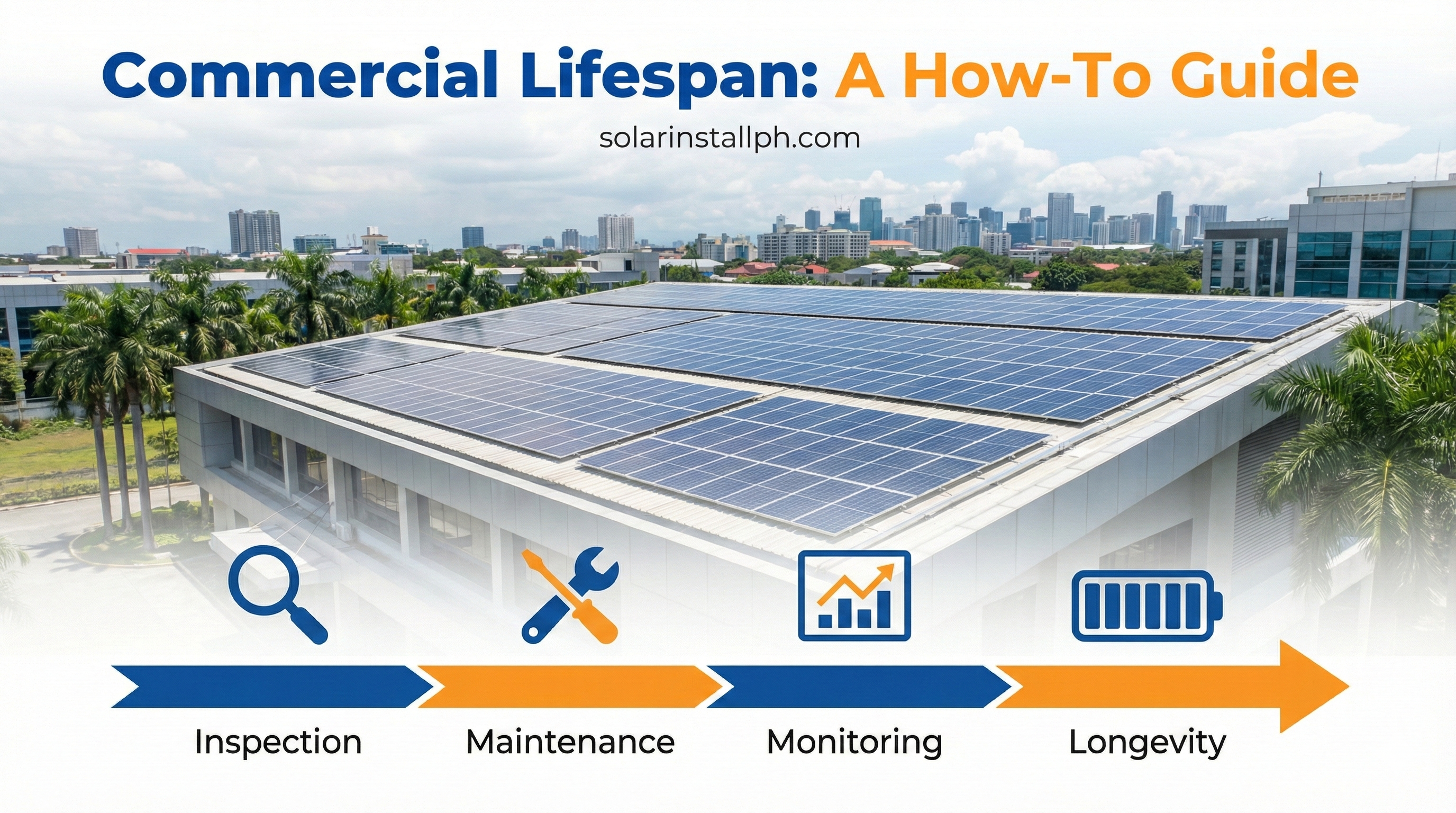
A commercial solar system is not a set-it-and-forget-it appliance. It is a power plant.
If you are a business owner or facility manager in the Philippines, you likely bought your system based on a 25-year financial model. Your ROI calculation assumes the panels will still be producing 80% of their rated power in the year 2050.
But the Philippine environment—characterized by high humidity, salt spray, intense UV radiation, and Category 5 typhoons—is actively trying to shorten that lifespan. A neglected system in Cavite or Batangas can fail in as little as 7 years.
Here is the operational guide to ensuring your commercial solar asset actually survives to hit its ROI targets.
1. Accept the Reality of Degradation
Solar panels degrade. It is a chemical certainty. The silicon wafers slowly lose efficiency over time due to UV exposure and thermal cycling.
In a temperate climate like Germany, panels might degrade at 0.5% per year. In the tropical Philippines, where roof temperatures frequently hit 65°C+, cheap panels can degrade at 1.5% to 3% per year.
The "Heat Death" Factor
Heat is the enemy of voltage. Cheap "poly" panels or lower-tier mono panels suffer from "Light and Elevated Temperature Induced Degradation" (LeTID).
The Fix: When specifying equipment, insist on panels with a low Temperature Coefficient (closer to -0.30%/°C is better).
The Design: Ensure there is an air gap of at least 10cm between the panel and the roof sheet. Flush-mounting panels directly onto a metal roof without airflow cooks the cells and destroys the backsheet.
To understand how hardware choices impact your long-term numbers, review our analysis of solar value vs. cost.
2. Inverters: The 10-Year Weak Link
While panels might last 25 years, string inverters will not. In the Philippine commercial context, the realistic lifespan of a string inverter is 10 to 12 years.
Inverters are full of power electronics and capacitors that dry out and fail under heat. If your inverter room is unventilated or exposed to direct afternoon sun, you might be replacing them in Year 7.
Extending Inverter Life
Ventilation: Never install commercial inverters on a west-facing wall without shade. Ideally, place them in a dedicated electrical room with exhaust fans.
Dust Filters: Commercial inverters have cooling fans. In dusty industrial zones (like cement or feed mills), these fans clog. If the fan stops, the inverter overheats and dies. Clean these filters quarterly.
We compare the durability of different units in our guide to top inverter brands for 2025.
3. Corrosion and Typhoon Proofing
If your business is located in a coastal industrial park (e.g., PEZA zones in Cebu, Subic, or Batangas), salt mist is a silent killer. It corrodes the aluminum frames and, more dangerously, the grounding path.
The "Bimetallic" Risk
A common installer error is mixing metals—using stainless steel bolts on aluminum rails without a separating washer, or connecting copper ground wires directly to aluminum frames. This causes Galvanic Corrosion, which eats away the metal structure.
The Fix: Use anodized aluminum mounting hardware and stainless steel 304 or 316 (marine grade) fasteners.
Wind Load: Philippine code requires withstanding wind speeds of 250kph+. Ensure your installer used the correct number of clamps (often 4 to 6 clamps per panel) and that the rails are screwed into the purlins, not just the roof sheet.
For heavy industrial setups, the structural integrity of the roof itself is critical. See our deep dive into factory rooftop solar.
4. The O&M Schedule (Operations & Maintenance)
You cannot manage what you do not measure. A commercial lifespan strategy relies on a strict maintenance calendar.
Quarterly: The Visual & Cleaning Check
Cleaning: In Metro Manila, pollution settles as a sticky grime that rain cannot wash off. Clean panels every 3 months. In provinces with clean air, every 6 months may suffice.
Visuals: Look for "snail trails" (microcracks) on panels or loose cabling dangling on the roof.
Annually: The Electrical Health Check
Once a year, a licensed electrical engineer must perform:
Torque Check: Vibrations from wind and thermal expansion loosen bolts. Re-tighten AC and DC termination points. A loose connection causes arcs and fires.
Thermal Imaging: Scan the panels and combiner boxes. A "hotspot" on a panel indicates a failed cell or diode.
String Testing: Check the voltage (Voc) and current (Isc) of each string to ensure no hidden failures.
Safety during these checks is non-negotiable. DC voltage is lethal. Review our solar safety guidelines before sending staff up.
5. Budgeting for Replacement (The "Sinking Fund")
A common financial mistake is assuming the project has zero costs after installation. This leads to "shock" expenses in Year 10.
Smart CFOs create a Solar Sinking Fund.
Set aside roughly ₱0.50 per kWh generated or a fixed annual percentage of the savings.
Purpose: This fund pays for the inverter replacement in Year 10-12 and covers unexpected repairs (e.g., a panel shattered by a stray golf ball or typhoon debris).
If you are still in the planning phase, factor these future costs into your initial CapEx model. Our commercial solar cost guide breaks down what you should expect to pay upfront versus over time.
6. Monitoring is Your Pulse
Finally, use the technology you paid for. Modern commercial inverters come with app-based monitoring (Huawei FusionSolar, Sungrow iSolarCloud, etc.).
Assign someone in your admin or engineering team to check this app weekly.
Look for: One inverter producing significantly less than the others.
Look for: Daily yield dropping gradually (indicates soiling) or suddenly (indicates a blown fuse).
Conclusion
A 25-year commercial lifespan is achievable in the Philippines, but it is not guaranteed by the warranty paper alone. It is earned through correct equipment specification (heat tolerance, corrosion resistance) and disciplined maintenance.
Treat your solar system like you treat your generator sets or delivery trucks. Service it, clean it, and protect it from the elements.
Next Step: Audit your current O&M process. If your panels haven't been cleaned in 6 months or your inverters are screaming with clogged fans, you are already shortening your asset's life. Schedule a preventative maintenance check immediately.