
Pinoy Bills Down: Budget Panels
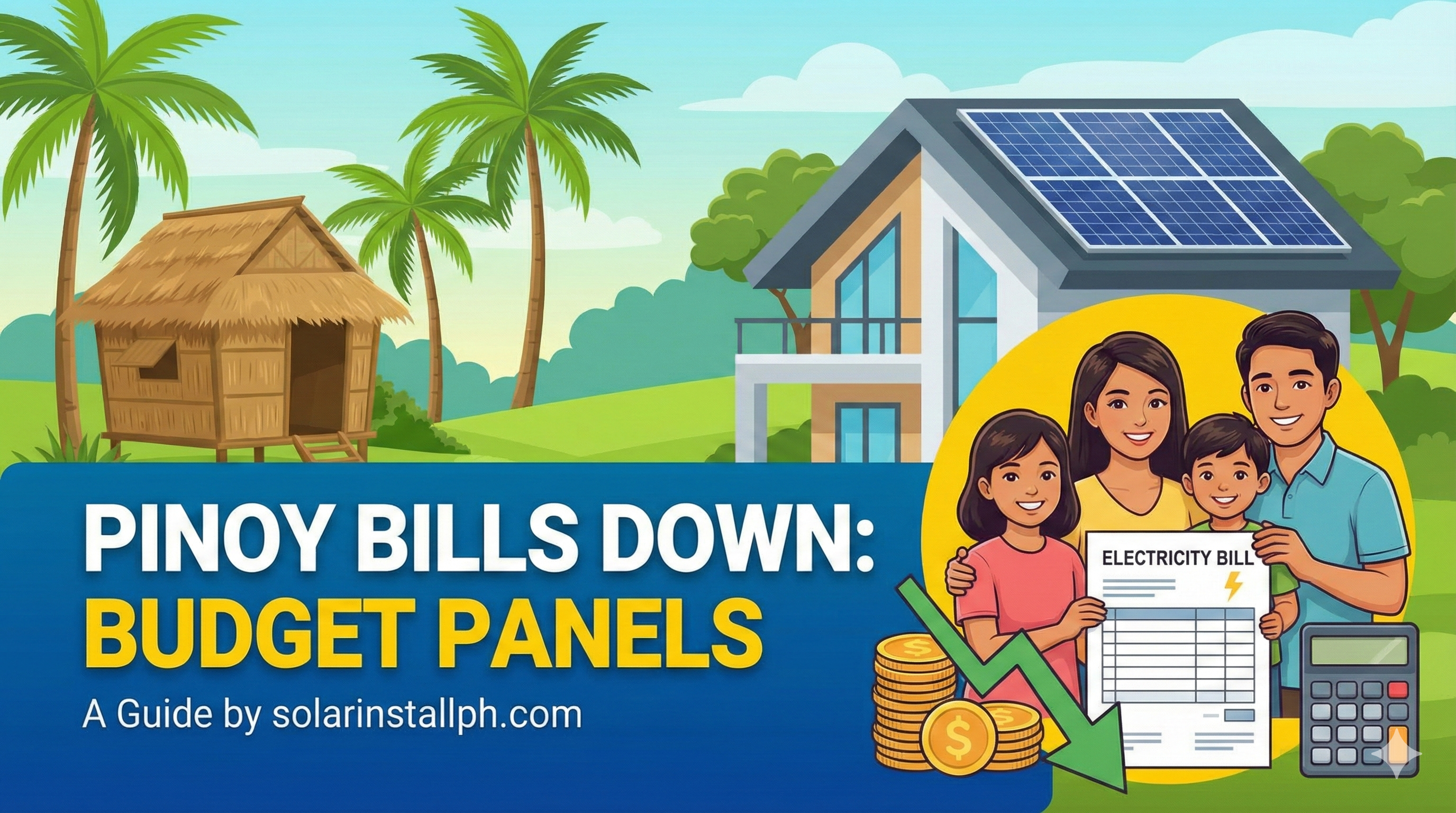
For the last decade, solar power in the Philippines had a reputation: it was a rich man's toy. If you had ₱500,000 lying around, you could put panels on your roof to signal your virtue to the neighbors in Alabang or Forbes Park.
That era is dead.
In 2025, the solar market has crashed—in a good way. A global oversupply of photovoltaic components, primarily from China, has driven the price per watt down to historic lows. At the same time, Meralco rates remain stubbornly high, hovering between ₱11.70 and ₱13.50 per kWh depending on the monthly generation charge fluctuations.
This divergence has created a unique window for the Filipino middle class. You no longer need half a million pesos to kill your electric bill. You can now do it with "budget" panels—provided you know the difference between "affordable quality" and "dangerous junk."
Here is the practitioner’s guide to navigating the 2025 budget solar landscape without getting burned.
The Price Crash: What Happened?
To understand why prices dropped, you have to look at the manufacturing side. The giants of the industry—Jinko, Longi, Trina, and Canadian Solar—scaled up production massively. They flooded the market with high-efficiency Monocrystalline PERC and N-Type panels.
The result?
2020 Pricing: A 5kW grid-tied system cost roughly ₱450,000.
2025 Pricing: That same 5kW capacity, often using better tech, can now be found for ₱250,000 to ₱300,000 from reputable installers.
That is a 40% drop in capital expenditure (CAPEX). Meanwhile, the electricity savings remain the same or higher. This essentially cuts the Return on Investment (ROI) period from 7 years down to roughly 3.5 to 4 years.
For a detailed breakdown of current market pricing, review our updated data on residential solar costs in the Philippines.
Defining "Budget": Tier 1 vs. The Scrap Yard
This is where Filipino homeowners get in trouble. When I say "budget panels," I am referring to Tier 1 brands that are mass-produced and priced competitively. I am not referring to unbranded surplus.
The Good Budget (Tier 1)
These are brands listed on the BloombergNEF Tier 1 list. They are bankable, have 25-year performance warranties, and have official distributors in the Philippines.
Examples: Jinko Tiger Neo, Longi Hi-MO 6, Trina Vertex S, Canadian Solar HiKu.
The Cost: You might pay ₱7,000 to ₱9,000 per 550W panel.
The Value: These panels are efficient (21–22%), durable against typhoons, and backed by real companies.
The Bad Budget (Class B / Surplus)
Open Facebook Marketplace, and you will see ads for "Japan Surplus" or "Class B" panels selling for ₱3,500.
The Risk: These are often factory rejects (micro-cracks, bad lamination) or used panels ripped off solar farms in other countries.
The Reality: They might work for a year. Then, moisture seeps in, "snail trails" appear, and the output drops by 50%. Even worse, they are prone to hotspots, which can melt the backsheet and start a roof fire.
Do not put fire hazards on your family’s roof just to save ₱50,000. It is not worth it. To understand how to spot quality differences, read our comparison of Tier 1 solar panel brands.
The Math: 5kW for the Price of a Used Sedan
Let’s run the numbers for a typical household in Cavite or Bulacan with a monthly bill of ₱8,500.
The Scenario
Consumption: ~650 kWh/month.
System Size: 5kWp (approx. 9–10 panels of 550W).
Total Installed Cost: ₱280,000 (standard grid-tie package).
The Savings
A 5kW system in Luzon produces roughly 600–750 kWh per month (averaging out rainy days and summer peaks).
Daytime Load: You shift your laundry, ironing, and AC use to the day. You consume 50% of your solar directly.
Net Metering: You export the rest to Meralco. Even with the lower export rate, you crush the remaining bill.
Net Monthly Savings: Approx. ₱6,500 to ₱7,500.
The Payback
₱280,000 cost ÷ ₱7,000 savings/month = 40 months.
That is 3.3 years.
After 3.3 years, you have your money back. For the next 21+ years of the panel's warranty, your electricity is virtually free. If you want to dive deeper into these calculations, check our 2025 analysis of solar ROI and payback periods.
Common Mistakes When Buying "Budget"
Going for a budget-friendly install doesn't mean cutting corners on safety. Here are the three areas where you must not compromise:
1. The Mounting Structure
Cheap installers use substandard aluminum rails or, worse, angular bars that rust. In the Philippines, we have typhoons. A budget panel becomes a very expensive kite if the mounting fails during a signal number 3 storm. Ensure your installer uses 6005-T5 anodized aluminum and stainless steel bolts.
2. The Inverter
The panels are dumb glass; the inverter is the brain. If you buy a no-name inverter to save money, expect it to die in year 3. Stick to reputable "value" brands like Growatt, Solis, or Huawei. They are cheaper than European brands (like Fronius) but have solid track records in PH conditions.
3. The Workmanship
You can buy the best Jinko panels, but if the installer uses undersized wires or loose connections, you will get DC arcs. This is the leading cause of solar fires. Never hire a "handyman" to do a solar job. Hire a specialist.
Before signing a contract, you need to vet your provider. We have a guide on how to verify installer credentials and spot red flags.
Why Now? The "Green Energy Auction" Factor
There is a macro reason to move now. The Philippine government is aggressively pushing for renewable energy, but grid constraints are real.
Grid reliability: As we saw with the recent red alerts, the grid is fragile.
Future Rates: While rates dipped slightly in Jan 2025, the long-term trend for fossil-fuel-based power is upward due to global volatility.
By installing a budget system now, you lock in your price of power at roughly ₱2.50/kWh (the levelized cost of your system over 25 years) versus Meralco’s ₱12.00+.
Conclusion: The "Good Enough" Revolution
You don't need the Mercedes-Benz of solar panels. You don't need 40-year warranty Maxeon panels to save money (though they are excellent if you can afford them).
For the average Pinoy family, a "Toyota Vios" system—standard Tier 1 panels, a solid Chinese inverter, and professional mounting—is the financial sweet spot. It gets the job done, it pays for itself in under 4 years, and it frees you from the monthly anxiety of opening the Meralco envelope.
The era of "Pinoy Bills Down" is here, but it requires you to be a smart shopper. Ignore the surplus junk, focus on Tier 1 budget options, and get your roof working for you.
If you are ready to see how fast your specific system will pay for itself, look at our breakdown of 5-year solar payback scenarios to set your expectations.