
Local Power Deals: Affordable Installs
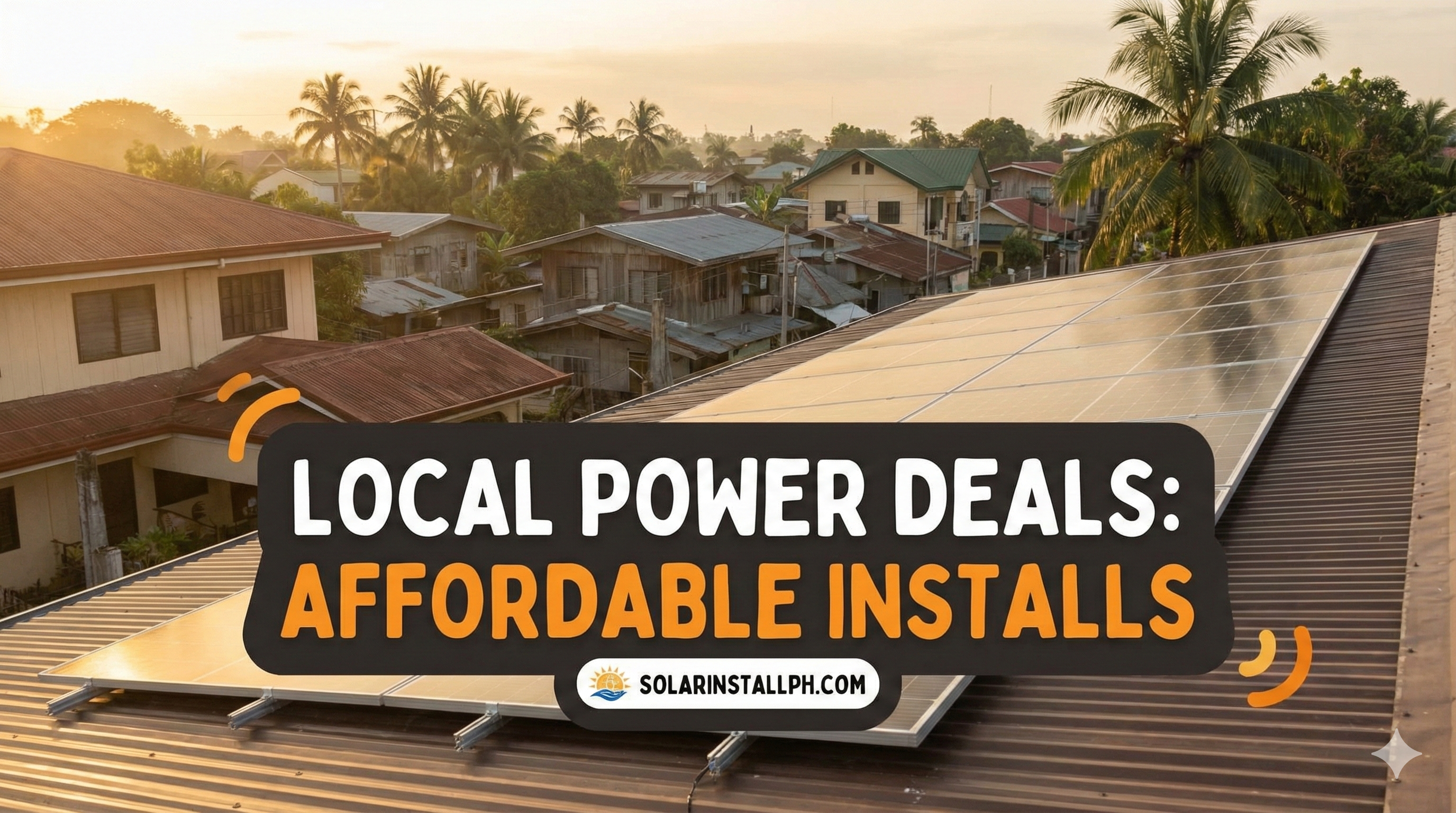
Solar power in the Philippines has moved past the "early adopter" phase. Walk through any subdivision in Cavite, Pampanga, or Cebu, and you will see panels on roofs. The driver isn't just environmentalism; it is the brutal reality of Philippine electricity rates. With prices fluctuating between Php 12 to Php 16 per kWh depending on your region and the time of year, solar is a financial defense strategy.
However, the initial cash outlay remains a massive hurdle. A standard 5kWp system can cost upwards of Php 300,000. This high barrier to entry has created a market for "budget solar" and aggressive package deals. Homeowners are constantly asking: "How do I get an affordable install without getting scammed?"
The answer lies in understanding where the costs come from, leveraging local installers, and knowing the difference between a discount and a defect.
The Reality of Solar Pricing in 2025
Before you can spot a deal, you need a baseline. If you don't know what a legitimate system costs, you are vulnerable to predatory pricing.
In the current Philippine market, reputable grid-tied solar installations typically range between Php 55,000 to Php 75,000 per kilowatt-peak (kWp). This price usually covers:
Tier 1 Solar Panels: Brands with bankable warranties.
Reputable Inverter: The heart of the system (e.g., Huawei, Growatt, Deye, SMA).
Mounting Structure: Aluminum rails and stainless steel brackets designed for wind loads.
Labor and Engineering: Professional installation and design.
Permitting Processing: Assistance with LGU and Distribution Utility (DU) requirements.
If you see a quote for Php 35,000 per kWp for a turnkey system, alarm bells should ring. At that price point, the installer is likely cutting corners on wire thickness, grounding safety, or using "B-grade" panels that failed quality control.
For a deeper dive into what you should expect to pay for specific system sizes, check our guide on standard residential solar pricing.
Why "Local" Often Means Better Value
One of the most effective ways to lower your installation cost without sacrificing quality is to look for a local installer rather than a national giant.
In the Philippines, logistics is a major cost driver. Shipping twenty 550W solar panels and heavy mounting rails from Manila to Mindanao, or even just from Quezon City to a remote area in Batangas, adds significant overhead.
1. Reduced Logistics Costs
A local installer in Iloilo or Davao likely stocks inventory in that region. They do not need to factor in inter-island shipping or long-distance trucking for every single project. These savings can often be passed down to the homeowner.
2. Faster After-Sales Support
Solar systems are generally low maintenance, but when an inverter trips or a connection loosens, you need help fast. A Manila-based crew might take weeks to schedule a service visit to Leyte. A local team can often drive over the next day. This proximity reduces system downtime, ensuring your savings continue uninterrupted.
3. Familiarity with Local Bureaucracy
Every Distribution Utility (DU) and Local Government Unit (LGU) operates differently. Meralco’s Net Metering requirements might differ slightly in practice from VECO in Cebu or DLPC in Davao. Local installers deal with these specific engineers and city halls daily. They know exactly which documents get approved and which ones cause delays.
We explore how location impacts your final quote in our analysis of regional pricing differences.
How to Spot a Genuine Deal vs. A Trap
"Affordable" becomes "expensive" very quickly if the system fails or causes a fire. When evaluating a quote that seems lower than average, you must investigate why it is cheaper.
The "Package Deal" Trap
Many installers offer pre-packaged "3kW Promo" or "5kW Promo" deals on Facebook. While some are legitimate volume discounts, others achieve that low price by stripping away essentials.
Watch out for:
Exclusion of Permitting Fees: The quote looks cheap because they haven't included the Php 15,000–30,000 cost for LGU permits and Net Metering applications.
Undersized Wiring: Using 2.0mm wire where 4.0mm is required poses a fire risk but saves the installer money.
Generic Mounting Kits: In a typhoon-prone country, the mounting structure is critical. Cheap galvanized iron (GI) rails will rust quickly in coastal areas compared to anodized aluminum.
The "B-Grade" Panel Scam
Solar panels are graded during manufacturing. Grade A is perfect. Grade B has visual defects or slight electrical mismatches. Unscrupulous installers buy Grade B panels at a massive discount and sell them as new. These panels may degrade faster or suffer from "hot spots" that can crack the glass.
You can learn more about spotting these issues in our article on red flags in solar quotes.
Strategies for Affordable Installs
If you have a tight budget, you don't need to resort to low-quality equipment. Use these strategies to negotiate a better deal legitimately.
1. The "Neighborhood" Bulk Buy
Installers love efficiency. If you and two neighbors in the same subdivision want solar, approach an installer as a group.
Why it works: The installer saves on marketing, site visits, and logistics. They can deploy one team to work on three roofs continuously.
Potential Savings: You can often negotiate a 5–10% discount on the total project cost.
2. Design for Expansion (Future-Proofing)
If you can't afford the 10kW system you need right now, don't buy a cheap 10kW system. Buy a high-quality 5kW system, but ask the installer to use a larger inverter (e.g., a 10kW inverter).
Why it works: Panels are easy to add later. Swapping an inverter is expensive. By oversizing the inverter now, you secure the infrastructure. You can add more panels in a year or two when you have the budget.
Note: This increases the initial cost slightly relative to a 5kW inverter, but it is cheaper than buying a whole new system later.
3. Cash vs. Financing
Bank loans for solar are becoming more common in the Philippines (BPI, RCBC, etc.), but "in-house financing" from installers often carries high interest rates hidden in the monthly payments.
The Cash Discount: Most installers offer a significant discount (sometimes 5-10%) for straight cash payments because it improves their cash flow and eliminates bank fees.
4. Direct Material Sourcing (For the Advanced)
Some homeowners try to buy panels and inverters themselves and just hire labor.
Warning: This is risky. If the equipment fails, the installer will blame the supplier, and the supplier will blame the installer. You are left in the middle with no warranty. It is usually safer to hold one entity accountable for both supply and labor.
The Importance of Installer Verification
The single biggest factor in the long-term affordability of your system is the quality of the installation. A bad crimp on a connector can cause an arc fault and a fire. A roof penetration that isn't sealed properly will cause leaks that cost thousands to repair.
Before signing any "affordable" deal, you must vet the company.
Checklist for Vetting:
DOE Accreditation: Are they listed with the Department of Energy?
PCAB License: Do they have a Philippine Contractors Accreditation Board license? This is a legal requirement for construction contracting.
Office Address: Do they have a physical office, or are they just a Facebook page?
Portfolio: Do not just look at photos of finished roofs. Ask for photos of their wiring and inverter setups. Neat wiring usually indicates a disciplined installer.
For a step-by-step process on how to check these documents, read our guide on verifying installer credentials.
Net Metering: The Key to Real Savings
An "affordable install" isn't just about the upfront price; it's about how fast the system pays for itself. In the Philippines, the fastest payback period comes from Net Metering.
This program allows you to export your excess power to the grid (e.g., Meralco) in exchange for peso credits. These credits offset your nighttime usage. Without Net Metering, any solar energy you don't use instantly is wasted (or you are forced to buy expensive batteries).
The "Zero Export" Deal Breaker
Some cheap installers will encourage you to skip Net Metering and install a "Zero Export" device instead. They do this because permitting is "hassle" for them.
The Reality: While Zero Export saves you the permit fees, it extends your ROI significantly because you are throwing away excess power. A slightly more expensive installer who handles Net Metering for you will usually save you more money in the long run.
Calculating Your Real ROI
When you are comparing quotes, look at the Return on Investment (ROI), not just the total contract price.
Scenario A (The Cheap Option):
Cost: Php 200,000
System: 5kW, No Net Metering (Zero Export), Generic Inverter.
Monthly Savings: Php 4,000 (Daytime use only).
Annual Savings: Php 48,000.
Payback: ~4.2 years (Risky warranty).
Scenario B (The Quality Option):
Cost: Php 300,000
System: 5kW, With Net Metering, Tier 1 Equipment.
Monthly Savings: Php 6,500 (Daytime + Export Credits).
Annual Savings: Php 78,000.
Payback: ~3.8 years.
Even though Scenario B costs Php 100,000 more upfront, it pays for itself faster and yields higher savings for the next 20 years. This is the difference between price and value.
To run these numbers for your specific household consumption, use the methods outlined in our calculating your real return on investment guide.
Conclusion
Finding an affordable solar deal in the Philippines is possible, but it requires diligence. The market is flooded with offers, and the gap between a bargain and a burden is often invisible to the untrained eye.
Focus on local installers who understand your region's logistics and permitting landscape. Be skeptical of prices that undercut the market average by more than 20%. prioritize Net Metering over batteries for quicker ROI, and never skip the background check on your installer.
Solar is a 25-year relationship with your roof. The best deal isn't the one that is cheapest on day one; it's the one that is still working efficiently on day 9,000.