
Home Solar: Pros & Cons (3 Must-Knows)
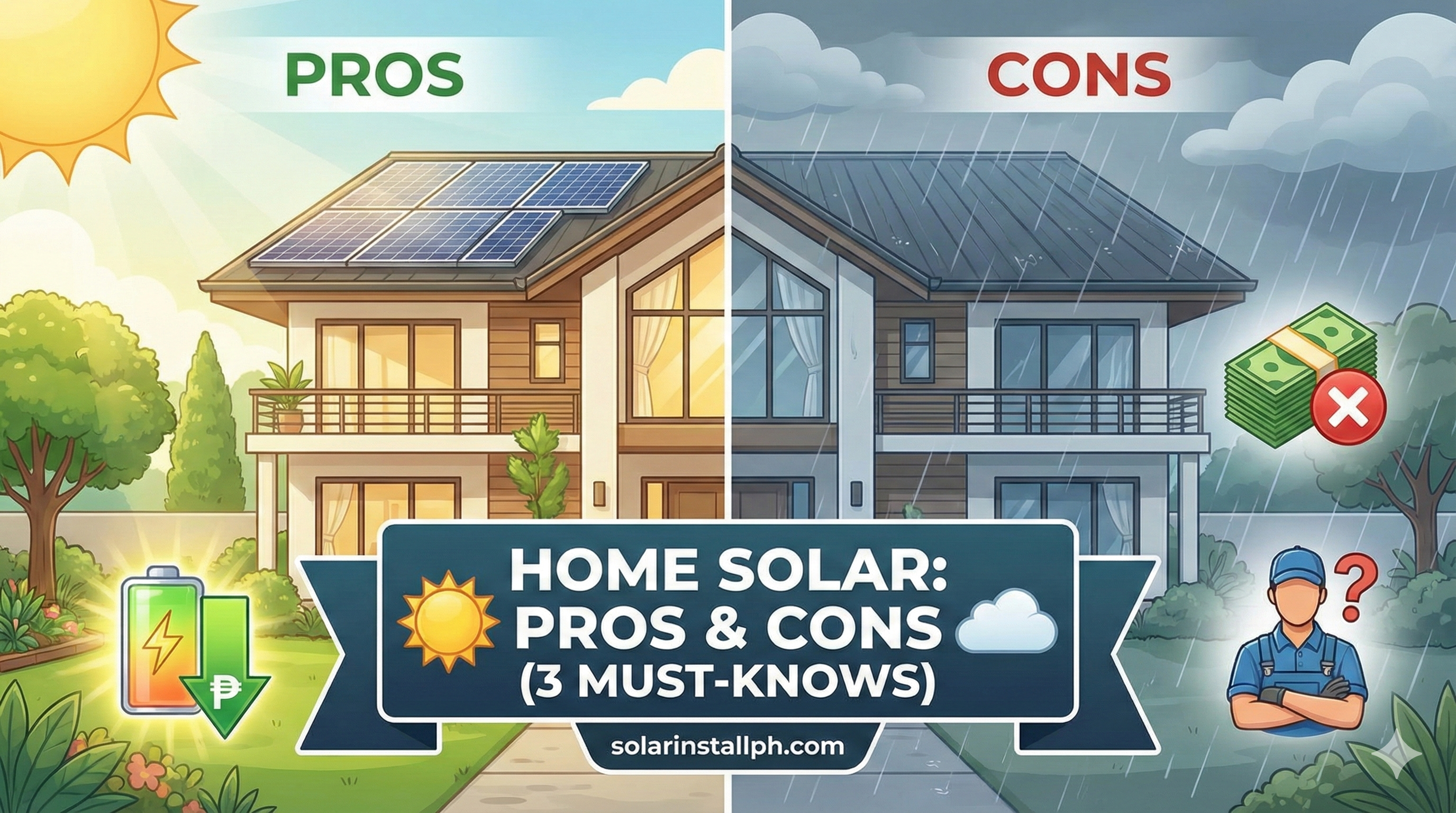
In the Philippines, rooftop solar has transitioned from a niche luxury to a strategic household investment. With electricity rates among the highest in Southeast Asia—frequently hitting over ₱13 per kWh in early 2026—the question for many Filipino homeowners is no longer "if" they should go solar, but "when." However, the journey from seeing a high Meralco bill to flipping the switch on a solar-powered home is filled with technical and regulatory nuances that can make or break your return on investment.
The Pros: Why Solar is Dominating the Philippine Market
The most immediate advantage is the drastic reduction in monthly bills. For a typical middle-class home in Metro Manila or Cebu, a properly sized solar system can wipe out 25% to 50% of your daytime electricity costs. Since we are in a tropical zone with abundant irradiance, our "free fuel" is consistent for most of the year.
Financial Independence and Property Value
Solar panels aren't just gadgets; they are home improvements that increase property value. Real estate trends in 2025 and 2026 show that "solar-ready" or "solar-powered" homes sell faster and at a premium. Buyers recognize that a home with solar panels comes with a hedge against the inevitable price hikes of distribution utilities.
Resilience Against Brownouts
While a standard grid-tied system will shut down during a power outage for safety (to prevent "back-feeding" and injuring linemen), hybrid systems with battery storage offer a critical lifeline. In provinces where the grid is unstable, having a solar-plus-storage setup ensures that your refrigerators, fans, and Wi-Fi stay on when the local coop fails.
The Cons: The Realities of Solar Ownership
It isn't all "free energy" and sunshine. There are significant hurdles that every homeowner must weigh before signing a contract.
The Upfront Cost Hurdle
The initial investment remains the biggest barrier. Even with prices dropping, a high-quality 5kW system can cost between ₱350,000 and ₱500,000. While there are many financing options available today through banks like BPI or via the Pag-IBIG Fund, the initial cash outlay (or the debt obligation) is a heavy commitment. You can check our breakdown of residential solar installation costs to see current market averages for different system sizes.
Weather Dependence and Maintenance
Solar panels do not work at night, and their efficiency drops significantly during the rainy season. Furthermore, living in an archipelago means dealing with salt air corrosion if you are near the coast and dust accumulation in urban areas. You cannot simply install panels and forget them; they require periodic cleaning and professional inspections to ensure the wiring hasn't been compromised by heat or pests.
Must-Know #1: The Permit Maze and Net Metering
One of the biggest shocks for new solar owners is that you cannot simply "plug and play" if you want to be legal and safe. Under RA 9513 (The Renewable Energy Act), homeowners are encouraged to join the Net Metering program.
The Net Metering Bottleneck
Net Metering allows you to sell your excess daytime production back to the grid. If your panels produce 10 units of power and you only use 4, the other 6 units go to the utility, and you get a credit on your bill. However, the application process is rigorous. You need:
An LGU Building Permit and Electrical Permit.
A Certificate of Final Electrical Inspection (CFEI).
A Certificate of Compliance (COC) from the Energy Regulatory Commission (ERC).
Without these, you cannot legally export power. If you try to do it "guerilla style" (without permits), your standard meter might actually charge you for the power you give away, as it cannot distinguish between import and export. For a step-by-step on how to handle this with the country's largest utility, refer to our Meralco net metering guide.
Must-Know #2: Sizing and Load Profiling
A common mistake is buying a system based on "number of panels" rather than your actual daytime load. Solar is most efficient when you consume the energy as it is produced.
The Daytime Consumption Rule
In the Philippines, solar makes the most sense if someone is home during the day—using air conditioners, washing machines, or pool pumps between 9:00 AM and 3:00 PM. If your house is empty during the day and you have a massive solar array, you are relying entirely on the Net Metering credit rate, which is usually lower than the retail rate you pay.
Understanding Your Payback
Your ROI is determined by how much "expensive" grid power you avoid buying. If you overbuild your system, your payback period stretches longer because you are selling power at a discount. If you underbuild, you won't see a significant dent in your bill. Several factors that determine your solar payback include your current kWh rate, your roof orientation, and whether you have shading from nearby trees or buildings.
Must-Know #3: Hardware Quality and Typhoon Engineering
The Philippines is hit by an average of 20 typhoons a year. A solar system that is "cheap" often saves money on the mounting hardware, which is the most dangerous place to cut corners.
Wind Load and Mounting
Panels act like sails in high winds. If your installer uses thin aluminum rails or insufficient roof attachments, a Signal No. 3 typhoon can rip the panels off your roof, potentially causing structural damage to your home or injuring neighbors. Always insist on typhoon-resistant solar mounting that is rated for at least 250kph wind speeds.
Choosing the Right Installer
The market is currently flooded with "freelance" installers who may not be around in three years when your inverter throws an error code. A solar system is a 25-year investment. You need a partner who provides a real warranty and after-sales support. Before you sign any deposit check, take the time to verify your installer’s credentials and check their portfolio of completed, permitted projects.
Conclusion
Home solar in the Philippines is a powerful tool for financial stability, but it requires a disciplined approach. By understanding the permit requirements, sizing your system according to your actual daytime habits, and prioritizing structural safety over the lowest price, you can turn your roof into a high-yielding asset.